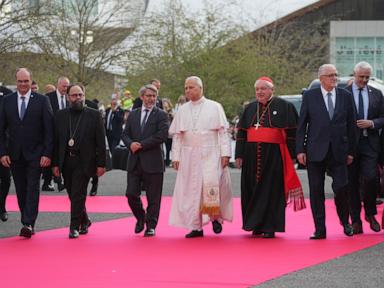
Europe has a memory problem. Whenever politicians gather in Brussels or Strasbourg today, they talk endlessly about trade deficits, defense budgets, and regulatory compliance. They treat the continent like a massive corporate board meeting. They forget what actually brought shattered nations together out of the ashes of the Second World War. Pope Leo XIV stepped directly into this historical amnesia during his visit to France, choosing the border city of Metz to deliver a sobering wake-up call to European leaders.
When the pontiff arrived at the Robert Schuman Congress Centre on September 28, 2026, he wasn't offering polite diplomatic pleasantries. He was cutting straight through the noise of modern political cynicism. By invoking the legacy of Robert Schuman—one of the foundational architects of European integration—Leo reminded a continent sliding back into nationalist friction that unity was never supposed to be a mere administrative convenience. It was meant to be a moral covenant. Recently making waves lately: When Gunfire Errupts at Sweet Sixteen Celebrations the Safety Crisis Hiding in Plain Sight.
The Dangerous Illusion of Rearmament
Look around the continent right now and you'll see a familiar, terrifying pattern. Borders are hardening. Nationalism is surging. Leaders are pouring billions into military hardware while convincing themselves that peace is simply a byproduct of having a bigger stick than your neighbor. Pope Leo shattered that illusion with brutal clarity.
True peace isn't a byproduct of rearmament. It isn't achieved by maintaining a delicate balance of terror or stockpiling weapons just in case diplomacy fails. Schuman understood this implicitly when he helped forge a community out of bitter historical enemies like France and Germany. He knew that economic treaties would rot away if they weren't backed by a shared moral vision of human dignity. More insights on this are detailed by NBC News.
Yet modern politicians treat peace as an afterthought. They manage crises instead of solving them. They react to flashpoints with panic rather than foresight. When Leo stood in Metz, he pointed out that Europe has spent decades proving that divergent interests can be resolved through encounter rather than conflict. Abandoning that method in favor of renewed hostility and mutual suspicion isn't just a political failure. It's a betrayal of the generations who bled to ensure future Europeans wouldn't have to march off to trenches.
Beyond Borders and Bureaucracy
We often make the mistake of viewing the European project as a finished building. We think of it as a finished house with locked doors and strict rules. The pope argued the exact opposite. Europe isn't a collection of protocols or a rulebook enforced by faceless bureaucrats. It's a living, breathing culture rooted in the deep soil of shared human experience.
This is where the choice of Metz matters immensely. Situated in the Moselle region at a historic crossroads between France, Germany, and Luxembourg, Metz embodies the painful cost of war and the miraculous grace of reconciliation. It's a land scarred by past conflicts where people refused to let hatred have the final word. When leaders bypass these historical roots in favor of expedient populism or vapid supranationalism, they sever the very ties that keep the continent grounded.
Populists love to exploit economic anxieties by building metaphorical walls and stoking fear of the outsider. At the same time, technocrats try to homogenize local cultures into a bland, rootless uniformity. Both approaches miss the mark. Real unity doesn't demand the erasure of national identity. It demands what Leo called the harmony of differences—where distinct peoples maintain their heritage while working together for the common good.
Disarming Hearts in an Age of Polarization
Religion has frequently been dragged into the mud of modern geopolitical conflicts. Fanatics love to weaponize faith, wrapping political ambitions in sacred rhetoric to justify oppression. Pope Leo didn't mince words on this front. He issued a stark warning to religious leaders and believers everywhere.
Invoking God's name to justify violence or tyranny is the ultimate profanation. When religious discourse is co-opted to fuel hatred, it ceases to be faith and becomes ideology. The true calling of faith communities is the complete disarmament of hearts and words. In a world drowning in toxic online discourse, political vitriol, and cultural polarization, religious leaders carry a heavy obligation to bridge divides rather than widen them. They have to be agents of healing, refusing to let sacred symbols be hijacked by merchants of conflict.
This principle extends directly into how societies handle mass migration and demographic change. Treating human beings fleeing war and poverty as statistical threats or political footballs poisons the soul of a community. A civilization proves its worth not by how high it builds its fences, but by how it protects and respects the most vulnerable among us.
The Courage to Break Resentment
History doesn't repeat itself neatly, but it certainly rhymes. Today's Europe faces compounding pressures that would have broken the post-war founders. Economic stagnation, demographic decline, and brutal wars right on the doorstep have frayed public patience. It's easy to grow cynical. It's easy to shrug and assume that human nature makes permanent peace impossible.
Pope Leo rejected that resignation outright. During his homily at Saint Stephen's Cathedral in Metz, he insisted that reconciliation is only possible when individuals and nations possess the raw courage to break the chains of resentment. Resentment is a comfortable trap. It allows nations to nurse historical grievances for decades, using past wounds as an excuse to inflict new ones. Breaking those chains requires an extraordinary act of political and moral will.
You can see this dynamic playing out across society. People are exhausted. Trust in public institutions is cratering. Yet beneath the surface cynicism, there's a surprising counter-trend. In countries like France, despite deep secularization, thousands of adults and teenagers are actively seeking baptism and spiritual grounding. People are hungry for meaning. They're tired of empty materialism and geopolitical posturing. They want solid ground to stand on.
Building a Future Worth Wanting
If European leaders want to honor the legacy of Robert Schuman and Alcide De Gasperi, they have to stop governing out of fear. Fear makes bad policy. Fear builds walls, cuts budgets for the needy, and justifies preemptive aggression.
True leadership requires vision. It requires stepping away from partisan echo chambers and remembering that the continent's strength has never come from the dominance of one nation over another. It has come from cooperation, mutual respect, and the stubborn belief that human beings are capable of building a just society.
The choice facing European leaders isn't complicated. They can continue down the path of rearmament, suspicion, and fragmentation, watching the hard-won peace of the last eighty years slowly unravel. Or they can return to the drawing board laid out in places like Metz, remembering that unity is built day by day through honest dialogue, respect for the rule of law, and an unwavering commitment to human dignity.
The founders didn't have a crystal ball. They had wreckage. Yet they looked at the smoking ruins of their continent and decided to build something better anyway. Today's leaders have far more resources, but they seem to lack the imagination. Pope Leo's visit to Metz was a reminder that the blueprint for peace hasn't been lost. It's just gathering dust, waiting for leaders brave enough to pick it up again.
Watch highlights from the Metz summit on YouTube. This video provides a firsthand look at Pope Leo XIV's historic gathering in Metz focused on European peace and unity.