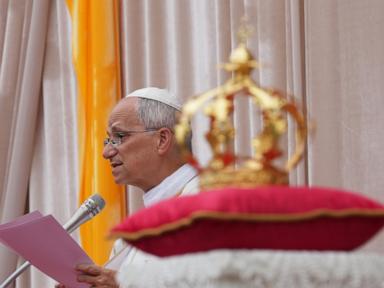
The cameras click. The vestments billow in the coastal wind of Chiclayo. The pontiff bows his head, his voice heavy with sorrow over the blood soaking the streets of Peru, offering prayers to heal a fractured nation.
And the global press eats it up.
Every major wire service runs the exact same, lazy narrative. They frame a Pope returning to his former Peruvian diocese to lament spiraling violence as a touching homecoming—a moral beacon cutting through the darkness of gang warfare and political decay. They treat papal lamentations as a diplomatic intervention. They treat prayers for peace as an actionable strategy against transnational organized crime.
They are completely missing the point.
After twenty years tracking Latin American security dynamics and ecclesiastical geopolitics from Lima to Rome, I have watched this exact theater play out across half a dozen countries. High-level religious hand-wringing does not slow down extortion rings. It does not disarm illegal gold miners in Madre de Dios, and it certainly does not stop the sicarios operating with impunity in Trujillo or San Juan de Lurigancho. When observers frame a papal visit to a former diocese around emotional pleas for peace, they obscure the brutal structural reality driving Peru’s collapse—and the uncomfortable role institutional religion plays in maintaining the status quo.
The Myth of Moral Suasion in an Extortion Economy
The prevailing consensus among foreign correspondents is simple. Peru is suffering from a crisis of violence, the state is weak, and the Catholic Church—still deeply embedded in Peruvian cultural life—serves as the ultimate moral authority capable of calling the nation back from the brink.
That diagnosis is fifty years out of date.
You cannot use moral suasion on an economic model built entirely on decentralized predation. What is happening in Peru right now is not an ideological civil war like the Shining Path insurgency of the 1980s and 1990s. Back then, the conflict had a clear political hierarchy, recognizable leaders, and an overarching doctrine that could be countered, negotiated with, or defeated militarily. Today, Peru is being hollowed out by a hyper-fragmented criminal market.
Extortion—known locally as cupos—has become the primary tax system for working-class Peruvians. Bus drivers in Lima, corner store owners in Piura, and construction foremen in La Libertad are not paying taxes to the Peruvian state; they are paying protection money to splinter factions of Tren de Aragua, Los Pulpos, and hundreds of hyper-local copycat crews. If they do not pay, a grenade lands on their porch.
When a Pope steps onto an altar in northern Peru and laments this violence, the men ordering those grenade attacks do not feel a sudden pang of Catholic guilt. Many of them wear rosaries around their necks while ordering hits. In the moral universe of Latin American organized crime, religious devotion and extreme brutality are not contradictions; they are transactional partners. Criminals tithe to local parishes, fund patron saint festivals, and ask the Virgin Mary for protection before heading out on an extortion run.
By treating papal sorrow as a meaningful counterweight to this crisis, commentators mistake public relations for structural power. Lamenting violence without naming the exact economic and political machinery enabling it is not leadership. It is institutional self-preservation.
What the Press Ignores About Chiclayo and the Northern Corridor
To understand why the standard media framing fails, look closely at the geography. Chiclayo, in the Lambayeque region, is not just a sentimental stopover for a former bishop. It sits squarely in the middle of Peru’s northern criminal corridor, wedged between the illegal mining hubs of Pataz in La Libertad and the drug trafficking transit routes of Piura and Tumbes.
I have sat in municipal offices across northern Peru and watched local officials admit, off the record, that the state’s monopoly on violence ended years ago. The police lack fuel for their patrol cars. Prosecutors are routinely assassinated or bought off. Meanwhile, Congress in Lima spends its legislative sessions passing laws that actively weaken the definition of organized crime, gutting asset forfeiture rules, and protecting illegal mining syndicates under the guise of "informal worker rights."
Think about what that actually means on the ground.
The violence enveloping Peru is not an inexplicable storm that blew in from nowhere. It is the direct, predictable result of legislative capture. Congressional coalitions—spanning both the populist right and the radical left—have systematically dismantled the judicial tools required to fight transnational syndicates. Why? Because illicit economies fund political campaigns. Illegal gold now generates more illicit revenue in Peru than cocaine. That money flows straight into municipal elections, regional presidencies, and congressional seats.
When a pontiff visits his former diocese and speaks in broad, poetic terms about "overcoming the culture of violence" and "seeking the common good," he is deliberately stepping around the actual culprits. Naming the complicity of the Peruvian Congress, the corruption of the National Police high command, and the laundering of illegal mining profits through respectable financial institutions would trigger an immediate diplomatic war with Lima.
The Vatican rarely fights wars it cannot win. Instead, it relies on the language of universal sorrow. It blames an abstract "sin" or "social decay" rather than specific lawmakers and prosecutors. And the media dutifully transcribes those platitudes as if they were profound geopolitical insights.
The Uncomfortable Truth About the Church's Own Political Baggage
Here is the nuance the wire stories refuse to touch: the Catholic Church in Peru is not a neutral referee standing above the fray. It is a deeply divided political actor whose own historical compromises helped create the institutional vacuum that criminals now exploit.
For decades, the Peruvian episcopate has been locked in a bitter internal war between liberation theology progressives—rooted in the legacy of Gustavo Gutiérrez—and ultra-conservative factions, notably Opus Dei and the now-disgraced Sodalitium Christianae Vitae (Sodalicio). While bishops spent years fighting ideological battles over reproductive rights, school curricula, and internal ecclesiastical power, evangelical neo-Pentecostal movements swept through Peru’s peri-urban slums and rural provinces.
The demographic shift has been massive. Twenty years ago, the Catholic Church commanded near-total cultural hegemony in Peru. Today, fast-growing evangelical churches dominate the exact neighborhoods most ravaged by extortion and gang violence—places like San Juan de Lurigancho, Villa El Salvador, and the sprawling informal settlements outside Trujillo and Chiclayo.
Let us be brutally honest about what this means for papal influence. When the Pope speaks in Peru today, he is no longer addressing a monolithic Catholic flock that hangs on every word from Rome. He is speaking to a fractured, skeptical public that watches bishops share banquet tables with the very politicians dismantling the rule of law.
Even worse, the Church’s historical obsession with maintaining cozy relationships with state power—regardless of who sits in the Presidential Palace—has blunted its prophetic edge. During the political upheavals of recent years, when security forces killed dozens of protesters in the southern Andes, the institutional Church offered cautious, carefully hedged statements calling for "dialogue" and "peace from both sides."
Imagine a scenario where a neighborhood is burning, the fire department refuses to turn on the hoses, and the local respected elder stands on the corner weeping about the tragedy of fire without ever pointing out that the mayor sold the firetrucks for scrap. That is the exact dynamic playing out when religious leaders lament Peruvian violence without confronting the state’s deliberate abandonment of its citizens.
Dismantling the "People Also Ask" Fallacies
Whenever a major news event like this hits the headlines, readers inevitably search for quick answers to make sense of the chaos. Most of those questions are built on flawed premises. Let us dismantle them directly.
Why is violence suddenly escalating in Peru?
It is not sudden. Journalists only notice when the body count hits Lima’s commercial districts or disrupts tourist corridors. The escalation you are seeing now is the maturation of a criminal ecosystem that has been building for over a decade.
Three specific catalysts converged:
- The post-pandemic economic collapse: Millions of Peruvians fell back into informality, wiping out legitimate credit markets and opening the door for Colombian and Venezuelan loan-sharking syndicates (gota a gota). Once you miss a payment on a gota a gota loan, extortion begins.
- The gold boom: Skyrocketing global gold prices turned northern highland provinces like Pataz into war zones. Armed criminal groups now employ heavy explosives and military-grade rifles to seize mine shafts, bringing those same weapons and mercenaries down to coastal cities like Trujillo and Chiclayo.
- Institutional sabotage: Between 2023 and 2026, the Peruvian Congress passed a series of laws that restricted prosecutors from conducting raids without prior notice to the suspect's defense attorney, narrowed the legal definition of a criminal organization, and repeatedly extended the REINFO registry—a regulatory loophole that shields illegal miners from criminal prosecution.
Can the Catholic Church mediate peace with Peruvian gangs?
No. Anyone suggesting a Church-brokered truce understands neither Peruvian criminal structures nor basic game theory.
In El Salvador, past governments—and occasionally religious intermediaries—attempted truces with MS-13 and Barrio 18 because those gangs had vertical command structures. You could put four leaders in a room, strike a deal, and watch the homicide rate drop overnight.
Peru has no equivalent. The criminal landscape in Lima and northern Peru is a chaotic bazaar of hundreds of competing micro-gangs, fractured cells of Tren de Aragua, local extortionists, and corrupt police units operating as freelance bandits. There is no central phone number to call. If a bishop negotiates a ceasefire with one extortion crew in Chiclayo, three rival crews will move into that territory by Tuesday morning and start shooting bus drivers to establish dominance. Mediation requires centralized authority on both sides of the table. Peru has it on neither.
Does a papal visit actually pressure the Peruvian government to act?
Temporarily, yes—for about seventy-two hours.
When the global press corps descends on Peru alongside a Pope, the government in Lima suddenly discovers an urgent passion for public security. They deploy extra tactical police units to the airports, scrub graffiti off highway overpasses, and announce grandiose "states of emergency" in troubled provinces.
States of emergency are the ultimate political placebo in Peru. They suspend constitutional rights, put soldiers on street corners for photo opportunities, and accomplish virtually nothing against sophisticated criminal networks. Soldiers are trained to fight conventional wars, not to trace money laundering through shell companies or run undercover financial intelligence operations. The moment the papal plane lifts off from Jorge Chávez International Airport, the soldiers return to their barracks, the extortion calls resume, and the legislative sabotage in Congress continues uninterrupted.
What Actually Disrupts a Criminal State (And Why Nobody Wants to Do It)
If prayers, papal visits, and military states of emergency are theatrical distractions, what actually works?
I have watched municipal leaders, prosecutors, and security strategists try everything across the region. The solutions are neither mysterious nor poetic. They are brutally technical, politically toxic, and entirely absent from diplomatic speeches.
First: Follow the gold and the concrete, not the street-level gunmen.
Locking up nineteen-year-old sicarios in overcrowded prisons like Lurigancho does nothing except enroll them in a graduate program for organized crime. Extortion rings operate from inside Peruvian prisons because cell signal blockers are routinely sabotaged by corrupt guards. You break these networks by attacking their financial infrastructure. That means aggressively auditing the refineries and export firms laundering illegal gold out of Lima and Callao, and freezing the real estate and construction fronts used to clean extortion proceeds.
Second: Rebuild the specialized police intelligence units—and insulate them from politics.
Peru actually knows how to dismantle complex criminal organizations. In the 1990s, the Special Intelligence Group (GEIN) captured Abimael Guzmán without firing a single shot, relying entirely on patient surveillance, garbage analysis, and financial tracking. More recently, specialized anti-corruption and anti-extortion police teams made massive strides before political interference gutted their leadership and transferred their best investigators to remote border posts. Until investigative units are legally shielded from ministerial whims, no amount of street-level policing will matter.
Third: Confront the Church's own silence on elite complicity.
If the Catholic Church wants to be more than a ceremonial backdrop for state funerals, its leadership in Peru must stop treating violence as a moral failing of the poor and start treating it as an economic crime of the powerful. That means using its vast network of parishes, schools, and media outlets to expose the specific judges releasing captured extortionists, the mayors taking bribes from illegal mining syndicates, and the lawmakers writing impunity into the penal code.
The Unavoidable Downside of Confrontation
Let us be clear about the cost of taking this contrarian path. Abandoning diplomatic neutrality carries lethal consequences in Peru.
When local priests, journalists, or prosecutors stop speaking in safe abstractions and start naming names, they get killed. In the Amazonian regions and the northern mining provinces, environmental defenders and outspoken clergy already live under constant death threats. If the institutional Church pivots from offering general lamentations to actively naming corrupt officials and criminal financiers, parishes will become targets, diplomatic ties with Lima will freeze, and the state will quietly cut off the subsidies and tax exemptions that keep Catholic social infrastructure running.
That is why the Vatican sticks to the script. Institutional survival almost always trumps institutional courage. A Pope weeping for peace in his former diocese is safe, photogenic, and universally applauded. It demands nothing from the powerful and offers nothing tangible to the bus driver paying fifty soles a week just to keep his windshield intact.
Stop applauding the sorrow. Start looking at who benefits from the silence.