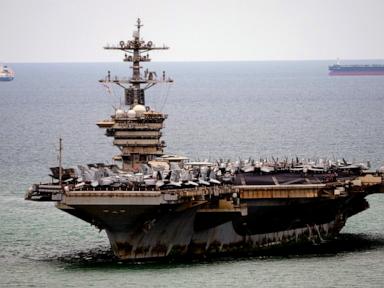
Every time a nuclear-powered supercarrier pulls into a port like Laem Chabang in Thailand after months of staring at empty ocean in the Middle East, naval traditionalists lose their minds. The headlines write themselves. Local vendors pop champagne, sailors flood the bars of Pattaya, and defense analysts on cable news nod solemnly about freedom of navigation and regional deterrence. It is a comforting theater. It tells a neat story about American power projection and allied hospitality.
It is also an operational delusion. You might also find this similar article useful: Why Saving the World’s Heaviest Parrot Proves We Can Fix Our Conservation Mess.
Let us dispense with the lazy consensus immediately. The standard narrative claims that these high-visibility port visits following grueling Middle Eastern rotations represent the smooth cogs of global deterrence turning as intended. They prove our reach. They reassure partners. They give crews a well-deserved break. Every single one of these assumptions misses the structural reality of modern naval warfare.
When a Nimitz-class carrier and its strike group spend months operating in high-threat environments, they do not just need a vacation; they need a structural reset. But docking in a civilian port in the Gulf of Thailand does not project strength to Beijing or Tehran. It exposes vulnerability. In an era where commercial satellite imagery tracks every square foot of ocean in real-time, parking a multi-billion-dollar floating air base within range of regional precision missile stockpiles is not a display of dominance. It is a tactical liability disguised as a morale boost. As highlighted in detailed coverage by BBC News, the results are widespread.
The Logistics Myth Nobody Wants to Discuss
I have watched organizations throw millions at high-profile operational resets, assuming that changing the scenery fixes systemic fatigue. The Navy does the exact same thing on a geopolitical scale.
Consider what actually happens during these high-profile stops. The logistical tail required to anchor a floating city off the coast of a partner nation is staggering. Fuel barges, security perimeters, diplomatic clearances, and shore leave management consume massive amounts of command bandwidth. Meanwhile, the core warfighting capability of the ship is effectively boxed in.
Naval logistics experts love to talk about operational flexibility, but a carrier hemmed in by shallow coastal waters and crowded commercial shipping lanes is a sitting duck compared to its posture in the open blue water. The lazy consensus assumes that a crew stepping off the brow for a plate of pad Thai translates directly into a revitalized fighting force. The data says otherwise. Crew fatigue is not cured by a 72-hour liberty window in a liberty town infamous for overstimulation and security incidents. It is managed through proper rotation, maintenance down-time at designated naval yards, and realistic deployment lengths.
By pretending that a goodwill tour through Southeast Asia is equivalent to strategic reassurance, defense planners are papering over the real crisis: chronic overextension.
What the Critics Get Wrong About Deterrence
When commentators look at the USS Abraham Lincoln shifting theaters from the Central Command area of operations to the Indo-Pacific footprint, they see a chess move. They imagine rival military planners sweating over the repositioning of floating air wings.
This is fantasy.
Peer competitors do not look at a carrier pulling into a Thai port and think, "We must check our aggression." They look at it and take inventory of wear and tear. They count the cracked composites on the flight deck. They analyze the time it takes to cycle aircraft through maintenance after months of constant catapult launches in the harsh Arabian Gulf environment. They recognize that a carrier on a goodwill tour is a carrier that is temporarily out of the fight, burning through its lifecycle hours for a diplomatic photo-op.
True deterrence does not require a floating runway to stop for cocktails in the Gulf of Thailand to prove it exists. It relies on invisible, persistent underwater presence and distributed lethality—concepts that get zero mainstream media coverage because you cannot film sailors taking selfies on the pier.
The Real Cost of the Goodwill Tour
We need to talk about the opportunity cost. Every day a carrier strike group spends meandering through Southeast Asian ports on its way back to homeport is a day its destroyer escorts are pulled away from high-value regional training, maritime interdiction coordination, or actual contested patrols.
We are spending precious hull-life and taxpayer capital on maritime pageantry. The defense establishment clings to these nineteenth-century rituals because they are photogenic. They look great in annual reports and press releases. They give politicians a backdrop for handshakes with foreign dignitaries.
Stop pretending that a routine transit stop is a masterclass in grand strategy. It is an administrative necessity wrapped in a patriotic flag.
If we want actual security in the Indo-Pacific, we need to stop measuring naval power by how many sailors are eating street food in Pattaya and start measuring it by how fast we can regenerate combat readiness without relying on tourist ports to boost morale.
The next time you see a headline celebrating a carrier dropping anchor in a tropical paradise, ask yourself what capability was compromised to make the photo-op happen.


