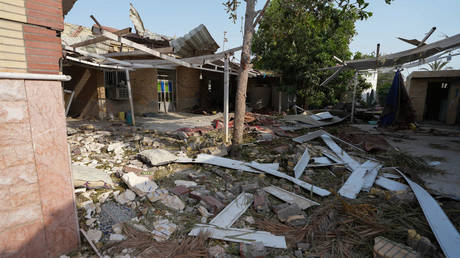
An errant U.S. glide bomb veered off course during a military operation in southern Iran, crashing directly into a residential home where dozens had gathered for a wedding celebration. The strike in the coastal town of Kuhestak left civilian casualties that include children and women, exposing the grim reality of how close urban civilian life sits next to military infrastructure during modern air campaigns.
Military planners designated a nearby communications complex as the primary objective for the strike. U.S. Navy aircraft deployed six precision weapons—specifically Joint Standoff Weapons, or JSOW glide bombs—toward the tower. Five of those munitions hit their mark, but one strayed roughly 440 feet off course, detonating directly on or immediately above the roof of a house hosting a family wedding.
Iran's deputy health minister reported that the explosion killed at least four people, including two children aged four and 16, while injuring upwards of 90 others. Independent weapons analysts, including Trevor Ball and former Air Force targeter Wes Bryant, reviewed visual evidence from the scene. They concluded that the blast patterns and crater shape were entirely consistent with a direct munition hit rather than secondary shrapnel or a malfunctioning domestic air-defense interceptor.
The Mechanics of a Guidance Failure
Weapons like the JSOW use advanced guidance packages, combining inertial navigation systems with GPS tracking, to maximize accuracy and minimize collateral damage. Yet, complexity breeds vulnerability. When electronic interference, minor mechanical anomalies, or sensor errors interfere with a weapon's flight path, high-tech engineering cannot completely eliminate the risk of catastrophic error.
The proximity of the communications tower to civilian homes highlights a persistent challenge in contemporary targeting operations. In many operational theaters, military assets are integrated into populated areas. This reality forces targeting analysts to weigh strategic necessity against civilian density. When a precision weapon fails to follow its programmed trajectory by even a fraction of a degree over a long glide path, the margin for error shrinks to zero in densely built environments.
Accountability and the Investigation Process
The Pentagon faces mounting pressure as details of the incident emerge. U.S. Central Command acknowledged awareness of the civilian casualty reports and initiated an internal review. Vice President JD Vance addressed reporters regarding the incident, stating that authorities are actively investigating because the administration intends to uncover what happened.
Despite these acknowledgments, military spokespersons maintain that the armed forces never intentionally target non-combatants. Investigators are currently running through various scenarios, verifying flight telemetry, and checking whether localized electronic countermeasures or environmental factors contributed to the weapon's deviation.
For the families affected in Kuhestak, administrative investigations offer little immediate comfort. The incident adds to a troubling record of civilian harm during the ongoing regional conflict, forcing a hard look at the limits of precision warfare when military technology intersects with civilian daily life. Watch how military command structures adjust their operational thresholds in upcoming tactical briefings.