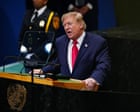
The footage rolls, and the dynamic is instantly familiar. Former President Donald Trump stands before an international assemblage, locks eyes with a familiar network correspondent, and delivers a public rebuke. The exchange is sharp, unscripted, and entirely predictable. Observers parse every syllable for hidden meaning, debating whether the confrontation represents a breakdown in decorum or a calculated masterclass in media manipulation.
It is neither. It is a well-rehearsed routine. In other news, we also covered: Why Defunding Anti Racism Charities Is Actually Saving Local Government From Itself.
When Donald Trump scolds a CNN anchor for covering him at a United Nations summit, he is not reacting to a perceived slight in the moment. He is executing a core tenet of his political survival playbook. For decades, the relationship between high-stakes politicians and the press corps has operated on an unspoken contract of mutual utility. Politicians need reach; networks need drama. Trump took that transactional friction and weaponized it, turning every live broadcast into a dual-purpose vehicle: policy messaging for his base and direct conflict theater for the ratings machine.
To understand why these clashes happen on global stages like the United Nations, one must look past the immediate spectacle and examine the underlying mechanics of modern political communication. The United Nations General Assembly is a peculiar beast. It is a diplomatic theater where world leaders deliver heavily vetted speeches to half-empty halls while international press pools scramble for a scrap of conflict to justify their multi-million-dollar bureau budgets. NBC News has also covered this fascinating topic in great detail.
Trump understood this vulnerability better than his predecessors. By singling out specific networks, particularly those he has branded as adversarial, he accomplishes three distinct goals simultaneously. First, he instantly starves competing narratives of their oxygen. Second, he shifts the entire framing of an international event from multilateral diplomacy—which rarely polls well with his core constituency—to a gritty, domestic grudge match. Third, he provides the network with irresistible footage, guaranteeing high viewership while simultaneously delegitimizing the messenger.
The mechanics of this maneuver rely heavily on what media theorists call conflict framing. Modern news organizations are structurally optimized to prioritize friction over consensus. A speech about climate financing or trade tariffs requires context, data interpretation, and patient listening—attributes that perform poorly in a fragmented digital ecosystem. A public dressing-down of a prominent journalist, however, requires no translation. It is immediate, emotional, and polarizing.
During these encounters, the physical architecture of the press setup matters immensely. Reporters are penned into designated areas, tethered to bulky transmission equipment, while the subject moves freely through protected corridors. Trump uses this spatial asymmetry to project dominance. He approaches the media corral not as a public figure facing accountability, but as an owner inspecting a manufacturing floor.
The reporters caught in the crosshairs face an impossible professional bind. Ignore the provocations, and risk appearing weak or evasive in front of millions of viewers. Engage with the provocation, and become the story, validating the exact narrative trap the politician has laid. Over the years, network anchors have tried various countermeasures—refusing to take the bait, offering deadpan factual corrections, or leaning aggressively into the adversarial role. None of these tactics consistently neutralize the effect.
The real story of these United Nations confrontations is not about media bias or political thin-skinnedness. It is about the complete collapse of traditional journalistic authority in the face of populist performance art. When a political figure can walk into an international house of diplomacy and pivot the global media apparatus toward a personal grievance, the institution of journalism loses its framing power.
Consider the broader historical context. Past administrations went to great lengths to manage the press corps through quiet backchannels, off-the-record background briefings, and carefully leaked policy memos. The objective was to maintain an aura of statesmanlike detachment. Trump discarded that playbook entirely, recognizing that transparency was a trap and that open hostility generated far more durable loyalty.
When an anchor attempts to ask a policy question during a diplomatic photo-op, they are operating under the assumption that the venue still adheres to traditional rules of engagement. Trump operates under the realization that the rules dissolved long ago. By publicly reprimanding the correspondent, he signals to his supporters that he is fighting a hostile establishment on their behalf. Every scowl, every pointed finger, and every dismissive remark is logged, clipped, and rebroadcast across social media channels within minutes, stripped of journalistic commentary and repackaged as proof of strength.
The economic incentives driving this cycle are equally stark. Cable news networks experience measurable spikes in viewership during these unscripted moments of tension. The confrontation at the United Nations podium generates high engagement metrics, digital ad impressions, and endless panel discussions. Both sides of the equation—the populist politician seeking free amplification and the corporate broadcaster chasing quarterly ratings—profit from the spectacle, even as public trust in both institutions continues to erode.
This dynamic leaves independent observers and media critics in a frustrating position. We spend hours dissecting the rhetoric, analyzing the body language, and debating the ethics of the exchange, while missing the structural reality. The confrontation is the product. The policies discussed inside the grand hall are secondary to the emotional resonance of the fight outside it.
As long as the political reward for attacking the press remains higher than the cost of breaking diplomatic norms, these scenes will continue to replay on our screens. Every international summit will feature its own version of the media showdown, a ritualized performance where the lines between news and entertainment, diplomacy and reality television, are permanently blurred.
The next time a prominent leader turns a multilateral forum into a personal grievance airing, do not look at the reporter holding the microphone. Look at the camera operator capturing the angle. Look at the control room watching the live ratings ticker. And look at the voters at home, whose worldview is being shaped not by the treaties being signed, but by the volume of the argument used to announce them.