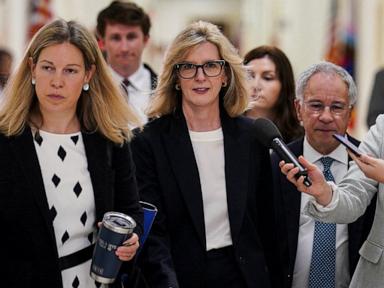
The marble floors of lower Manhattan do not echo with secrets; they absorb them. In places where capital moves like weather systems, power is measured not just in assets under management, but in the invisible architecture of access. Who returns your call on a Sunday morning? Whose name sits quietly in a private calendar, unlisted and unbothered by corporate compliance?
For years, Kathryn Ruemmler sat at the very center of that architecture. As the chief legal officer and general counsel of Goldman Sachs, and before that, as White House Counsel under President Barack Obama, her career was defined by an elite fluency in risk. She was the person institutions called when the walls threatened to cave in. Her defense attorney background had forged a mind that viewed every vulnerability as a puzzle to be managed, contained, and neutralized.
Yet the hardest vulnerabilities to spot are always the ones standing right next to you.
When the Department of Justice unsealed a massive trove of documents related to Jeffrey Epstein, the public archive expanded beyond the usual circle of tabloid speculation into the upper echelons of corporate and political gravity. Among the thousands of pages, emails, and calendar entries emerged a stark portrait of a relationship that defied the sanitized boundaries of modern corporate governance.
Between 2014 and 2019—long after Epstein's 2008 Florida conviction for procuring a minor for prostitution—the correspondence told a different story. There were luxury gifts, first-class flight arrangements, and affectionate terms of address. There was advice given on media inquiries, and informal check-ins. To the outside world, Epstein was a convicted sex offender wrapped in social radioactive waste. To those inside a tightly guarded bubble of elite social circles, he remained an embedded node in a network of influence.
Consider what happens when the digital ledger of private life meets the harsh fluorescent light of public scrutiny.
The defense offered was standard for the echelon. The relationship was professional, rooted in her days as a defense attorney. She did not know the monster he truly was. But corporate titans operate on a different ledger. Goldman Sachs, an institution where reputation is a fragile, multi-billion-dollar shield, found itself confronting a public relations crisis born not of a bad trade or a failed merger, but of personal proximity.
The fallout was swift. Despite earning tens of millions of dollars annually and presiding over the firm's reputational risk committee, the general counsel found her own position untenable. The announcement came: she would step down from her post.
Power often believes it is entirely insulated by its own brilliance. Brilliant minds analyze risk matrices, draft ironclad contracts, and calculate probabilities down to the decimal point. They convince themselves that proximity can be controlled, that moral contamination can be quarantined by intellect.
But institutions are ultimately tethered to trust. And when the files finally open, the grandest titles and the most lucrative compensation packages cannot bridge the distance between a polished corporate defense and the quiet, damning echo of an old email.