The rain in the Madre de Dios region of Peru does not merely fall. It accumulates. It descends in sheets so thick that the distinction between sky and earth dissolves, leaving the forest floor a soup of decaying mahogany, red clay, and ancient roots.
If you have never stood beneath a triple-canopy rainforest during a downpour, you cannot comprehend the silence that precedes it. Every animal, from the smallest dart frog to the howler monkeys high in the emergent branches, vanishes. The air becomes a heavy, saturated blanket. You hear only your own breathing. And, if you are unfortunate, the quiet scrape of a boot behind you.
For years, men like Quinto Inuma Silva listened to that silence and understood its shifting temperament.
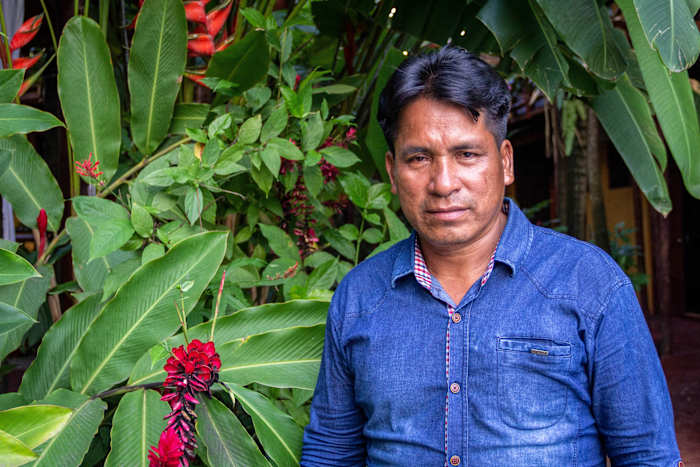
Quinto was not a mystic living in a romanticized past. He was a leader of the indigenous Kichwa community of Santa Clara de Uchunya in the Peruvian Amazon. He was a man who understood spreadsheets and GPS coordinates just as well as he understood the medicinal bark of the uña de gato vine. He knew that the forest was not an empty green void waiting to be conquered by progress. It was a library. It was an ancestral pantry. It was a boundary line protecting a fragile world from the relentless, grinding appetite of industrial extraction.
And for that boundary line, he paid with his life.
In late 2023, the silence in the forest was broken by something far more terrifying than thunder: gunshots.
When the news filtered out of the Amazon basin into the polished, air-conditioned courtrooms of Pucallpa, it arrived as a collection of dry legal metrics. Case numbers. Forensic reports. Ballistic trajectories. A man was dead. Others were wounded. The machinery of justice began its slow, grinding rotation, a process so often detached from the smell of wet earth and copper.
Yet, last week, something extraordinary happened within that rigid machinery. A Peruvian court handed down lengthy prison terms to the men responsible for silencing Quinto Inuma Silva.
To read the standard headlines is to see a bureaucratic milestone. A conviction secured. Rule of law upheld. But that clinical phrasing misses the human earthquake underneath. It misses the terror of waking up every morning knowing that your name is on a list circulated by illegal loggers and land traffickers. It misses the heavy stone that settles in the chest of every indigenous defender who looks at an official land title and realizes it is written on paper, while the men coming for them carry shotguns.
Consider what happens to a community when its voice is assassinated.
In Santa Clara de Uchunya, the Kichwa people have spent decades watching their ancestral territory carved up. Forests that once held centuries of ecological memory were clear-cut to make way for oil palm plantations. Imagine watching your refrigerator, your pharmacy, and your cathedral systematically bulldozed while distant politicians sign permits in ink you cannot drink.
Quinto did not ask for this fight. Few land defenders do. They are ordinary farmers, teachers, and basket-weavers who look out at their generational home and realize that if they do not speak, no one else will. They become sentinels entirely by default.
When Quinto stood up at public hearings to denounce the illegal logging operations bleeding his territory dry, he was not just pointing fingers at petty thieves. He was exposing a vast, complicated web of complicity. Illegal logging in the Amazon rarely operates as a few men with chainsaws in the dead of night. It is industrialized. It requires forged paperwork, corrupted local officials, laundering networks, and international markets hungry for cheap timber and agricultural commodities.
To challenge that machine is to invite a target onto your back.
The threats started small. Anonymous notes left on porches. Whispers at the edge of the village. Then came the direct warnings. Stay quiet. Move away. Let the forest fall.
Quinto knew the risks. I have spoken with defenders across Latin America who describe a peculiar brand of terror—the realization that your government cannot protect you, your local police are often on the payroll of the extraction syndicates, and the nearest safe haven is days away by boat and bus. You live in a state of hyper-vigilance. Every snapping twig at night sounds like a footfall. Every passing outboard motor on the river makes your stomach drop.
Yet Quinto kept walking into the forest. He kept speaking to journalists. He kept demanding that the courts honor the constitutional rights of indigenous peoples.
On that fatal day in November 2023, the violence caught up with him on a river journey. The ambush was not accidental. It was calculated. It was designed to send a message not just to his family, but to every indigenous community in the Amazon basin: Resistance has a ceiling, and we control the height.
For months after his murder, grief hung over Santa Clara de Uchunya like a physical weight. Justice in Peru, as in much of the Amazonian frontier, is historically elusive. Impunity is the default setting. Kill an environmental defender, and the odds heavily favor you walking free. The files gather dust. The witnesses grow too terrified to testify. The outrage fades from international headlines, replaced by the next geopolitical crisis or celebrity scandal.
That is why the recent court ruling feels so jarring.
It disrupts a long, grim historical pattern. The judges who reviewed the evidence did not blink. They listened to the testimonies of terrified eyewitnesses. They traced the financial flows and the communications between the gunmen and the masterminds. They looked past the remote geography of the crime and recognized a fundamental truth: the murder of an indigenous defender is an attack on the sovereignty of the nation itself.
The prison sentences handed down are severe. Decades behind bars. For the families of the convicted, it is a tragedy of a different sort, born of greed and lawlessness. But for the Kichwa people, and for the hundreds of other land defenders watching from the shadows of the canopy, it is a rare, flickering match in a very dark room.
It establishes a precedent. It suggests, however faintly, that the blood of the Amazon is not entirely cheap.
Yet we must be brutally honest about what this verdict does not do.
It does not bring Quinto back to his children. It does not replant the ancient trees that were dragged away to feed global supply chains. It does not automatically grant the Kichwa people full legal title to the land they have protected for generations. The systemic pressures driving deforestation—the land grabbing, the drug trafficking, the insatiable global demand for commodities—remain entirely intact.
The logging camps are still operating deeper in the interior, pushing further into uncontacted territories, clearing paths where jaguars and harpy eagles once reigned supreme.
We live in a moment of profound cognitive dissonance regarding the natural world. We consume the products of its destruction while posting digital solidarity with its guardians. We treat the Amazon as a distant lung of the planet, something abstract and theoretical, divorced from the human beings who bleed on its soil every single day.
When we talk about climate change, biodiversity loss, and ecological collapse, we often speak in the cold language of percentages, carbon parts per million, and hectare loss. We sanitize the crisis. We turn a murder mystery and a human rights catastrophe into an infographic.
We must stop doing that.
The defense of the Earth is not an environmental issue in the traditional sense. It is a human rights crisis. It is a war waged against people who happen to stand in the path of capital. When a man is gunned down for trying to save a forest, his death is not merely a local crime statistic. It is a puncture wound in the global shield that protects us all from our own worst impulses.
As the sun sets over the Madre de Dios, the shadows lengthen across the riverbanks. The cicadas begin their evening roar, a deafening wall of sound that vibrates through the humid air.
Somewhere out there, in a village whose name you will never learn, another indigenous leader is sitting on a wooden porch, listening to the night. They are checking the lock on their door. They are wondering if tomorrow will be the day the silence breaks. And they are deciding, with a quiet, terrifying courage, to wake up and do it all over again.


