We learn the art of swallowing our own thoughts before we even learn how to write our names.
A schoolyard slight passes without a word because making a scene is worse than absorbing the blow. A family dinner hums along a razor-thin wire of unspoken resentments, everyone smiling through gritted teeth while the roast beef gets carved. An office meeting concludes with nodding heads and polite applause for an idea that everyone in the room privately knows is a disaster.
We keep the peace. We maintain the equilibrium. We choke on our own convictions because we are terrified of the social friction that comes with an unvarnished truth.
Silence feels safe. It is a soft wool blanket wrapped around a shivering ego. If you never say the thing, you never have to defend the thing. If you keep the dangerous thought locked behind your teeth, nobody can accuse you of rocking the boat.
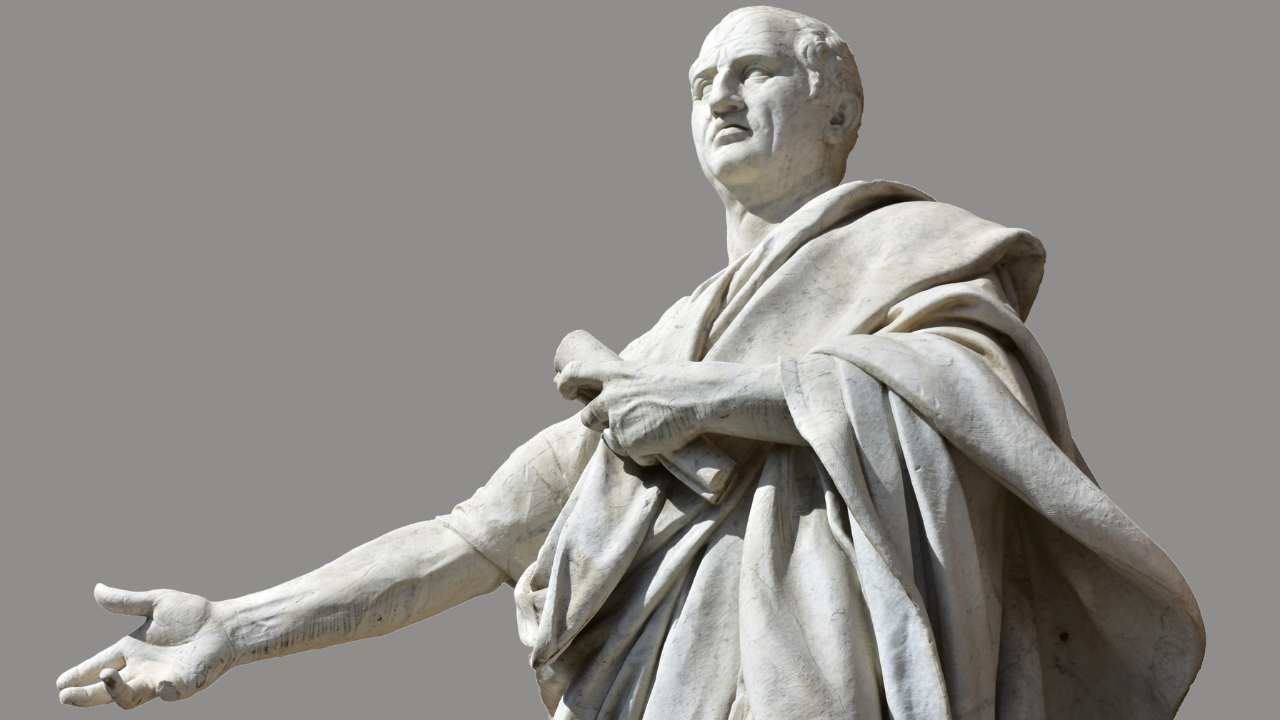
Marcus Tullius Cicero looked at this human cowardice more than two thousand years ago and diagnosed the rot with surgical precision.
If we are not ashamed to think it, we should not be ashamed to say it.
Think about the sheer weight of that sentence. It is an indictment of our daily hypocrisy. It exposes the cowardly gap between our inner sanctuary and our outer presentation. We spend our lives wandering through a labyrinth of our own unexpressed thoughts, terrified that our private minds might spill out into the light of day.
The Anatomy of an Inner Exile
Consider Julian. Julian is a mid-level manager at a logistics firm, a man whose spine has been slowly softened by fifteen years of corporate caution. Every morning, he commutes through a gray haze, rehearsing the neutral smiles he will deploy by nine o'clock.
Last Tuesday, Julian sat in a boardroom while his director pitched a disastrous software migration strategy. Julian knew the vendor. Julian knew the software. He had spent his previous weekend reading leaked post-mortems from three other companies that had gone bankrupt implementing this exact system. The thought bloomed in his mind with terrifying clarity: This is going to destroy us.
Did he say it?
Of course not.
He adjusted his tie, muttered something non-committal about exploring all options, and watched the rest of the room nod like mechanical ducks. He protected his status. He avoided the awkward silence. He swallowed his thought whole, letting it curdle into a quiet ulcer of resentment.
By hiding his thought, Julian thought he was being diplomatic. Cicero would have called it something else entirely: self-betrayal.
When we hide what we think because we fear social rejection, we split ourselves in two. There is the person who sits at the table, nodding along with the madness, and there is the silent ghost inside who knows better but lacks the courage to stand up. Over time, that ghost grows heavier. It turns into cynicism. It turns into burnout. It turns into the quiet desperation of a life lived entirely in quotation marks.
The Dangerous Architecture of Repression
Why do we do this to ourselves? Evolution gave us language not just to coordinate hunting parties or trade grain, but to map the topography of our minds so we could navigate reality together. Yet, civilization demands restraint. We build rules to keep society from devolving into a permanent brawl of competing egos.
Somewhere along the way, we confused restraint with erasure.
We started believing that politeness requires the complete sterilization of our authentic perspectives. We treat our own thoughts like radioactive waste, burying them deep underground in concrete drums of compliance.
This creates a bizarre psychological phenomenon. We assume that if we are thinking a radical, critical, or uncomfortable thought, we must be uniquely dangerous or wrong. We look around at the placid faces of our peers and assume they are experiencing the same serene mental landscape. We forget that they are likely sitting three feet away, terrified of their own thoughts, too.
It is a grand, collective masquerade. Everyone is wearing a mask, terrified that if they adjust it even a millimeter, everyone else will see the panic underneath.
Cicero’s maxim cuts straight through this theater. He strips away the polite fictions and lays bare a fundamental rule of integrity: Your internal life should be able to withstand the sunlight.
If an idea is worthy of taking up residence in your consciousness, if it is robust enough to form in the quiet theater of your mind, why do you treat it like a criminal when it reaches your lips? If you believe it in the dark, why do you disown it in the dawn?
The Cost of Conversational Cowardice
We tell ourselves that keeping our thoughts to ourselves is a kindness to others. We do not want to hurt feelings. We do not want to start an argument. We do not want to be labeled difficult.
(Note: This is a hypothetical scenario illustrating behavioral avoidance patterns documented in modern organizational psychology.)
Watch what happens when a team operates entirely on unexpressed thoughts for six months. Problems compound in the shadows. Bad strategies march forward because nobody wants to be the one to state the obvious emperor-has-no-clothes reality. Resentments fester like stagnant water in a basement.
Then, inevitably, the dam breaks.
It never happens calmly. Because people spent months swallowing their real thoughts, the eventual release is rarely a measured critique. It is an explosion. A minor disagreement over a parking space or a font choice turns into a screaming match that unearths grievances from three years ago.
This is the hidden tax of self-censorship. When you refuse to speak your thoughts when they are small and manageable, you allow them to mutate into monsters that eventually devour the room.
Cicero understood that public discourse is only as healthy as private honesty. If the senate chamber is filled with men who think one thing and say another, the republic rots from the inside out. The words we withhold do not disappear; they simply poison the wells from which we must all eventually drink.
Walking into the Fire of Authenticity
To apply Cicero’s rule is not to grant yourself a license to be cruel. There is a vast, oceanic difference between speaking an unvarnished truth and weaponizing rudeness. Brutal honesty is often just brutality disguised as honesty.
The master of authentic speech does not hurl thoughts like grenades; they offer them like maps.
When you strip away the fear of social friction, your voice changes. It loses the hesitant, upward-inflecting cadence of someone constantly checking to see if they are allowed to exist. It drops into a register of calm, immovable clarity.
You find yourself saying things like: "I see this differently, and here is why." Or, "That plan has a fatal flaw that we need to address right now." Or simply, "I disagree."
The sky does not fall. The room does not explode into flames. Often, a strange, electric silence descends—not the heavy silence of repressed tension, but the clean, bracing silence of truth entering a room that has been starved of oxygen for too long.
People stop scrolling on their phones. They look up. They realize someone has finally opened a window.
The Last Unbroken Word
We spend decades trying to curate an image that everyone will find acceptable. We sand down our edges. We paint over our convictions with neutral pastel shades so we never offend anyone in the gallery of our lives.
And for what? To be liked by people who only love the ghost we invented?
The ultimate tragedy is not that we occasionally say the wrong thing and face the consequences. The tragedy is getting to the end of a long, quiet life and realizing you spent the whole thing whispering in a language that wasn't your own.
Look at the thoughts you are holding right now. The boundary you know you need to set. The creative direction you know is better. The apology you owe. The love you are too proud to confess. The warning you are too cowardly to voice.
They are already sitting in your mind. They have already taken shape.
Stop running from your own inner life. Speak the thought before the thought begins to own you.