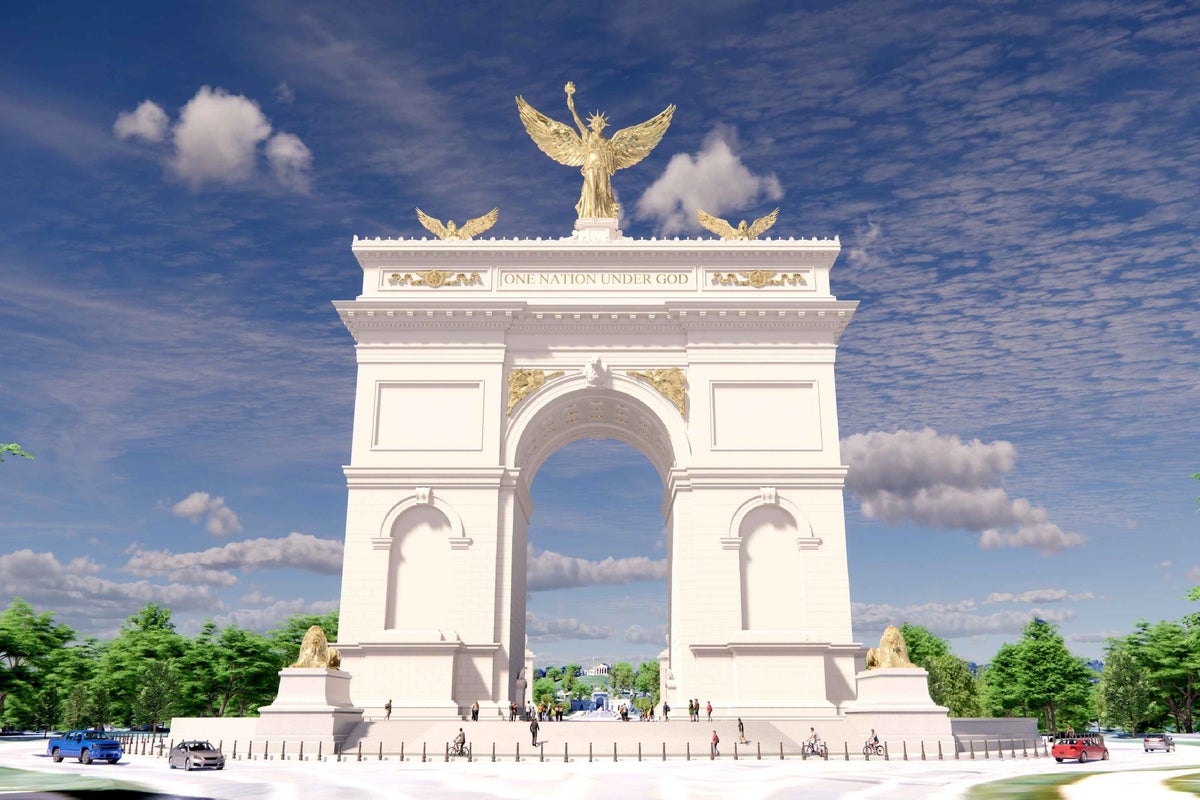
Donald Trump wants to build a massive victory arch in Washington D.C. It is a bold, classical monument meant to rival the Arc de Triomphe in Paris. Sketches show a towering stone structure topped with an observation deck offering panoramic views of the National Mall. It sounds spectacular on paper.
There is just one glaring problem. Nobody can figure out how visitors are actually supposed to get up to that observation deck.
Early design concepts released by the administration showcase the grand exterior. Massive pillars. Intricate carvings. A monumental presence. Yet, a close look at the architectural layout reveals an astonishing omission. There is no visible space for an elevator shaft or a compliant stairwell within the leg columns. The pillars look too narrow to house modern vertical transit systems without compromising the structural integrity of the arch itself. This leaves a massive question mark hanging over the entire project. It turns a public attraction into an engineering puzzle.
The Logistics of a Monumental Oversight
Architects and structural engineers are already pointing out the practical realities of building public observation platforms. If you want to put hundreds of tourists a day at the top of a monument, you need infrastructure. You cannot just wish them up there.
Look at the Gateway Arch in St. Louis. It uses a unique, custom-designed tram system that follows the curve of the arch. It took years of specialized engineering to make that work. The proposed Trump victory arch uses a traditional, straight-legged classical design. It looks great in a rendering. But traditional masonry arches do not naturally accommodate the massive mechanical footprints required for modern elevators.
Safety regulations complicate things further. The Americans with Disabilities Act requires public observation decks to be fully accessible. You cannot just throw a spiral staircase inside a pillar and call it a day. You need a modern elevator setup. That requires a significant amount of square footage for the shaft, the counterweights, and the mechanical housing. If you carve out the center of the support pillars to fit an elevator, you weaken the very legs holding up the massive observation deck. It is a classic engineering catch-22.
How Other Famous Monuments Solved the Lift Problem
This isn't the first time a monument designer faced this issue. History shows that adding observation spaces to triumphal arches always requires a compromise between aesthetics and engineering.
The Arc de Triomphe in Paris features an observation deck, but it was built in an era before modern elevator shafts were standard. Visitors traditionally climbed 284 steps to reach the top. A small elevator was retrofitted later for disabled access, but it does not go all the way to the very peak. Passengers still have to navigate additional stairs. That setup would face severe legal hurdles under modern American building codes.
Then you have the Marble Arch in London. It originally housed a tiny police station inside its structure, showing that arches can have functional interior rooms. But it was never meant to hold heavy tourist traffic at the summit.
If the proposed victory arch moves forward, the design team has a few realistic options. They could widen the pillars significantly. That would change the classical proportions and make the arch look bulky. They could attach an external glass elevator to the back of the monument. That would ruin the historical aesthetic. Or, they could explore a subterranean entrance that funnels visitors into a central column, though that requires deep excavation in an area already packed with underground transit and utility lines.
The Battle for Space on the National Mall
Securing approval for any new structure in the heart of Washington D.C. is notoriously difficult. The National Mall is tightly regulated by the National Capital Planning Commission and the U.S. Commission of Fine Arts. These bodies guard the historic sightlines of the city fiercely.
A massive new arch would disrupt the visual flow between the Lincoln Memorial, the Washington Monument, and the Capitol. Adding a highly visible observation deck adds another layer of scrutiny. The height of buildings in D.C. is strictly limited by the Height of Buildings Act of 1910. While monuments can sometimes bypass certain restrictions, a new platform that rivals the height of surrounding structures will face immediate pushback from urban planners.
The financial reality is equally daunting. Monumental architecture is incredibly expensive. Carving out complex elevator shafts inside custom stone pillars multiplies those costs exponentially. If the design requires bespoke engineering like the St. Louis Arch, taxpayers or private donors will look at a massive bill just to solve a basic transit problem.
What Needs to Happen Next
If this project is going to transition from a political talking point into a real, physical structure, the design team needs to go back to the drawing board immediately.
First, engineering firms must conduct a feasibility study on the pillar dimensions. They need to calculate the exact load-bearing capacity required to support an observation deck while housing a code-compliant elevator shaft.
Second, the administration needs to present a clear, transparent plan for visitor flow. Where does the queue form? How do people exit safely during an emergency? If the answers to these questions require altering the exterior design, the public should see those modifications now, rather than waiting until construction begins. Beautiful sketches are fine for a press release, but buildings require blueprints that actually function in the real world.


