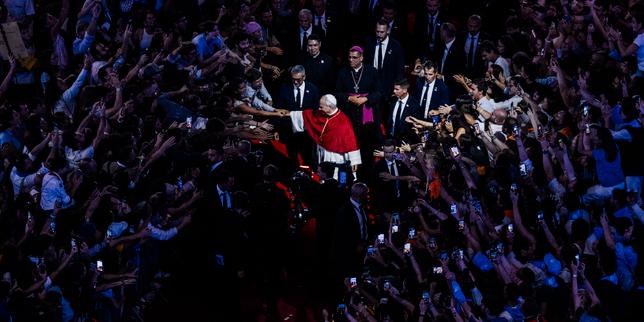
Mass ideological events operating within highly secularized metropolitan environments present a complex optimization puzzle for central institutions. When tens of thousands of individuals converge on a high-capacity venue like the Stade de France, the observable output is rarely a uniform ideological bloc. Instead, observer reports consistently register a heterogeneous mixture of fervent adherents, curious secular observers, and politically motivated actors. Deconstructing this phenomenon requires moving past surface-level descriptions of crowd enthusiasm and examining the underlying operational mechanics that govern large-scale institutional mobilization, demographic fragmentation, and long-term retention failure points.
The Structural Mechanics of Ideological Mobilization
Large-scale public assemblies function as high-energy signaling environments. Within these settings, institutional actors attempt to bridge the gap between abstract doctrinal mandates and immediate emotional resonance. The core mechanism driving participation is not necessarily systemic ideological agreement across the entire demographic, but rather the utility of collective effervescence.
When participants enter a stadium environment, individual behavioral variance narrows due to environmental cues, acoustic saturation, and synchronized rituals. This compression of individual agency creates a temporary illusion of homogenous consensus. However, a rigorous audit of the demographic makeup reveals distinct operational segments:
- Core Ideological Adherents: Individuals whose operational behavior, resource allocation, and daily routines are fully aligned with institutional doctrine. They represent the baseline retention pool.
- Peripheral Participants: Attendees drawn by social networks, cultural curiosity, or episodic spectacle. Their engagement is transactional rather than foundational.
- External Observers: Media representatives, secular state actors, and ideological critics whose presence alters the signaling dynamic of the event itself.
The primary friction point for leadership lies in crafting messaging that satisfies the core adherents without alienating the peripheral participants, while simultaneously projecting authority to external observers. When public discourse frames such gatherings around terms like combat or defense of faith, the messaging strategy shifts from inclusive community building to adversarial mobilization. This militaristic framing optimizes for short-term emotional spike among the core demographic while increasing alienation risk for the peripheral segment.
The Cost Function of Institutional Retention
A fundamental error in analyzing large assemblies is equating attendance metrics with organizational sustainability. Headcounts at a stadium do not measure structural loyalty; they measure event-driven capture efficiency. The cost function of maintaining a major religious or ideological institution involves calculating the resources required to convert transient emotional engagement into permanent behavioral commitment.
Every institutional touchpoint incurs a specific cost in attention, capital, and social friction. In a secular urban center, the opportunity cost for a young participant to engage with traditional doctrine is exceptionally high. Alternative identity vectors—ranging from political subcultures to secular lifestyle brands—compete directly for the same cognitive bandwidth.
When an institution relies on periodic high-intensity stadium events to drive retention, it exhibits characteristics of a cyclical acquisition model rather than a sustainable compounding model. The mathematical reality of this model is stark:
$$Retention = Initial_Capture \times (1 - Churn_Rate)^{Time}$$
Because stadium assemblies generate high initial capture numbers through spectacle, they mask high underlying churn rates. The peripheral attendees who experience a transient surge of enthusiasm during a mass gathering frequently encounter a steep drop-off in institutional reinforcement once they return to their dispersed secular environments. Without continuous micro-engagement structures, the decay curve of enthusiasm approaches zero within months of the event.
Urban Friction and Secular Institutional Interface
The geographical and cultural context of Paris introduces specific operational constraints on religious mobilization. Urban environments characterized by high cultural pluralism and robust secular legal frameworks create structural resistance against traditional hierarchical authority.
When an institution attempts to project influence within a secular state, it triggers regulatory, media, and social feedback loops. The interaction between the central authority and the local population is mediated by public scrutiny. Every rhetorical choice made during a major public address is dissected not only by adherents but by administrative apparatuses tasked with monitoring public order and ideological compliance.
This dynamic creates a strategic paradox. To maintain internal cohesion and motivate the core base, leadership must project unyielding commitment to foundational principles. Yet, this uncompromising posture hardens the resistance of the surrounding secular ecosystem, reducing the institution's capacity to recruit from the broader population. The resulting equilibrium is a self-contained feedback loop where the organization speaks with increasing intensity to a shrinking, highly committed subset of society, while the peripheral boundary layer thins.
Demographic Fragmentation Inside the Crowd
Describing a mass gathering as a unified youth movement misrepresents the internal stratification of the assembly. Modern demographic cohorts under the age of thirty do not process institutional authority through a single lens. Within the Stade de France crowd, distinct ideological fractions operate under different motivational drivers.
One segment seeks traditional continuity, finding psychological security in rigid structures and historical continuity amidst rapid societal change. Another segment approaches the event through an aesthetic or cultural lens, consuming the spectacle of mass assembly much like a music festival or a political protest. A third segment participates out of familial or institutional obligation, maintaining compliance without internalizing the ideological core.
These disparate motivations generate divergent behavioral outcomes post-event. The traditionalist segment absorbs the doctrinal messaging and seeks deeper integration into local parishes or operational cells. The aesthetic consumer captures digital media for social distribution, translating institutional spectacle into personal social currency without altering their underlying worldview. The compliant segment treats the event as a completed obligation, returning unchanged to their secular routines.
Failing to account for this internal fragmentation leads analysts to miscalculate the true impact of the gathering. A public demonstration of size does not translate into proportional institutional growth. The conversion efficiency from spectator to active participant is bounded by the capacity of local institutional infrastructure to absorb and engage each specific demographic fraction upon their return to ordinary life.
Strategic Forecast and Long-Term Trajectory
Evaluating the long-term viability of high-intensity public mobilization models reveals clear structural limits. Periodic displays of scale provide short-term media visibility and morale boosts for core administrative layers, but they fail to alter the structural decline of baseline institutional attachment in secularized urban zones.
The future trajectory of such movements depends entirely on their ability to decouple retention from centralized spectacle. Organizations that rely on stadium-scale events to mask underlying attrition will face diminishing returns as the cost of staging such events rises relative to their conversion yield. Conversely, resilient models will shift capital and attention away from centralized mass staging and toward localized, peer-to-peer micro-structures capable of withstanding the continuous friction of a secular urban environment. The strategic imperative is clear: scale without structural integration produces temporary effervescence, while durability requires relentless operational depth at the periphery.


