Two sealed doors. One pressurized pod. Thousands of miles of sky separating a humid clinic in Central Africa from a high-containment ward in London.
When a British healthcare worker tested positive for Ebola in the Democratic Republic of the Congo in early November 2026, the official bulletins read like a logistical checklist. Patient stable. Evacuation protocols activated. Specialist care arranged. Risk to the public assessed as low.
Cold sentences for a terrifying reality.
You do not read a headline like that and think first about air corridors or diplomatic clearances. You think about the moment a doctor or nurse—someone who went to help stop a spreading outbreak—realizes their own thermometer is climbing. You think about the zipper of a protective suit, the sting of sweat pooling behind a visor, the quiet shock of a positive test in a place already buckling under strain.
That single evacuation carries more than a medical transfer. It shines a harsh, unmistakable light on how outbreaks feel depending on where you stand when the alarm sounds.
What a Headline Leaves Out
Standard news reports are built for speed, not depth. They give you the skeleton of an event and move on. A British man—a healthcare worker deployed through a humanitarian effort—contracts Ebola in the DRC and is flown back to the UK for specialist treatment at a high-consequence infectious disease unit.
Left at that, the story feels neat. Contained. Almost tidy.
But outbreaks do not happen in neat boxes. The Bundibugyo virus outbreak declared in May 2026 across parts of the DRC and Uganda has already grown into a vast, grinding crisis, with cumulative confirmed cases in the DRC passing eleven thousand and thousands of deaths recorded by mid-November. Across eight provinces and dozens of health zones, local clinics have been stretched past breaking point, with frontline workers facing unpaid wages, community fear, and relentless exposure.
(Note: The following two characters, Dr. Samuel Okafor and nurse Clara Mensah, are hypothetical composite figures created to illustrate real-world conditions described by frontline responders and public health reports, not real individuals.)
Picture Samuel, a hypothetical local clinician working twelve-hour shifts in a rural treatment center in eastern Congo. He has worn the same heavy personal protective equipment in stifling heat until his boots felt full of water. When a colleague falls ill, there is no charter plane waiting on a runway with negative-pressure isolation gear. There is no embassy coordinator clearing airspace overnight. Samuel stays, treats the next patient, and hopes his own supplies do not run out before Friday.
Now picture Clara, a hypothetical visiting nurse from abroad who flew in to bolster the response. When her fever spikes and the lab confirms Ebola, an entire international machinery springs into motion. Within hours, she is moving toward a specialist bed in Europe where critical care ratios, advanced diagnostics, and dedicated isolation teams are waiting.
Both of them deserve to live. Every human life carries the same weight. Yet watching those two parallel tracks side by side forces a hard question: why is rapid, high-tech rescue the exception reserved for a tiny fraction of people fighting the same virus?
Why Frontline Workers Keep Getting Hit
People often ask a deceptively simple question when a medic catches Ebola: Didn't they wear protective gear?
Yes. Almost certainly, they did.
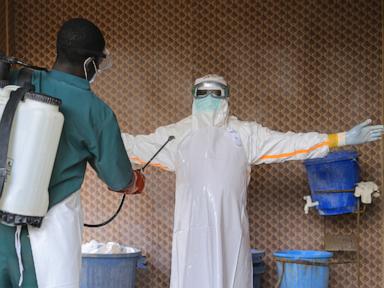
Full-body suits, double gloves, face shields, goggles, aprons, disinfection protocols—on paper, the barrier is ironclad. In practice, medicine inside a viral hemorrhagic fever ward is physical gruel. Visibility fogs. Dexterity drops when your fingers are wrapped in two layers of latex and your hands are slick with sweat. A needle slips. A splash hits an exposed inch of skin during a chaotic emergency. A tear happens while doffing gear at the end of a twelve-hour stretch when exhaustion dulls muscle memory.
Infectious disease specialists have pointed out for years that even rigorous precautions cannot reduce risk to zero when caring for severely ill patients under harsh conditions. Ebola spreads through direct contact with blood or body fluids of an infected person—or contaminated surfaces—not casually through the air like a common cold. That sounds reassuring until you are holding an IV line on a dehydrated, vomiting patient in a room with failing air conditioning.
It is scary. Honestly, anyone who says they would feel calm stepping into that suit is kidding themselves—or has never seen how unforgiving human error can be.
And the incubation window—typically two to twenty-one days after contact—adds a psychological weight that is hard to describe unless you have lived near an outbreak. Every headache feels suspicious. Every wave of fatigue triggers a quiet mental rewind of the past week's shifts.
The Invisible Stakes Behind an Evacuation
When a country like the UK brings a citizen home for treatment, domestic anxieties flare up almost immediately. Is it safe? Could it spread here?
Let us look at the facts plainly. Since Ebola was first identified in 1976, Britain has recorded only a handful of confirmed cases—four prior to this latest evacuation, including a 1976 laboratory needle incident and cases involving health workers returning from West Africa's 2014–2015 outbreak. High-consequence infectious disease units are specifically engineered for this: single-occupancy negative-pressure rooms, strict waste handling, trained staff, and rapid contact tracing.
Think of a specialist isolation ward like a bank vault for biology. You do not leave the vault door propped open on a busy high street, and inside it, trained guards control every movement in and out. For the general public in a well-equipped hospital system, the risk remains low when protocols are followed.
(Note: The comparison of a specialist isolation unit to a bank vault is a metaphor meant to clarify containment mechanics, not a literal description of building materials or security guards.)
But focusing solely on whether the virus reaches a London street misses the bigger danger.
Outbreaks do not stay politely inside borders if they are allowed to burn unchecked at their source. In 2026 alone, the Bundibugyo virus outbreak has crossed into neighboring Uganda, seen cases confirmed in Kenya, and prompted international health agencies to declare a public health emergency of international concern. Meanwhile, evacuating a single patient—vital as it is for that individual—costs immense resources and specialized transport that cannot scale to thousands of local residents.
If we treat an evacuation as the end of the story, we miss the point. An evacuation is a rescue of one person. Stopping an epidemic requires strengthening the clinics, paying the local nurses on time, delivering diagnostics and therapeutics to remote health zones, and building trust with communities that have been battered by years of instability and misinformation.
What This Moment Demands of Us
Why does a story from thousands of miles away matter to someone reading on a screen today?
Because global health is a single chain, and a chain is judged by how it treats its heaviest links. When local health workers in the DRC burn out or walk away because pay is delayed or clinics lack basic supplies, the entire response weakens. When fear turns into violence against responders or officials trying to share health guidance, tracing contacts becomes nearly impossible.
We like to imagine progress as a steady march upward—better vaccines, faster flights, smarter labs. Many of those advances are real. Supportive care, diagnostics, and rapid containment tools have come a long way since 1976.
Yet human vulnerability has not changed. Fear still makes people pull away. Distance still makes suffering easy to skim past. And the people standing closest to the fire are still the ones most likely to get burned.
A plane touches down. Doors unseal. A patient steps into a specialist ward where cameras do not follow and sirens do not blare.
Somewhere miles away, in a clinic without air conditioning and without a waiting jet, another nurse pulls on a pair of gloves and walks back inside.