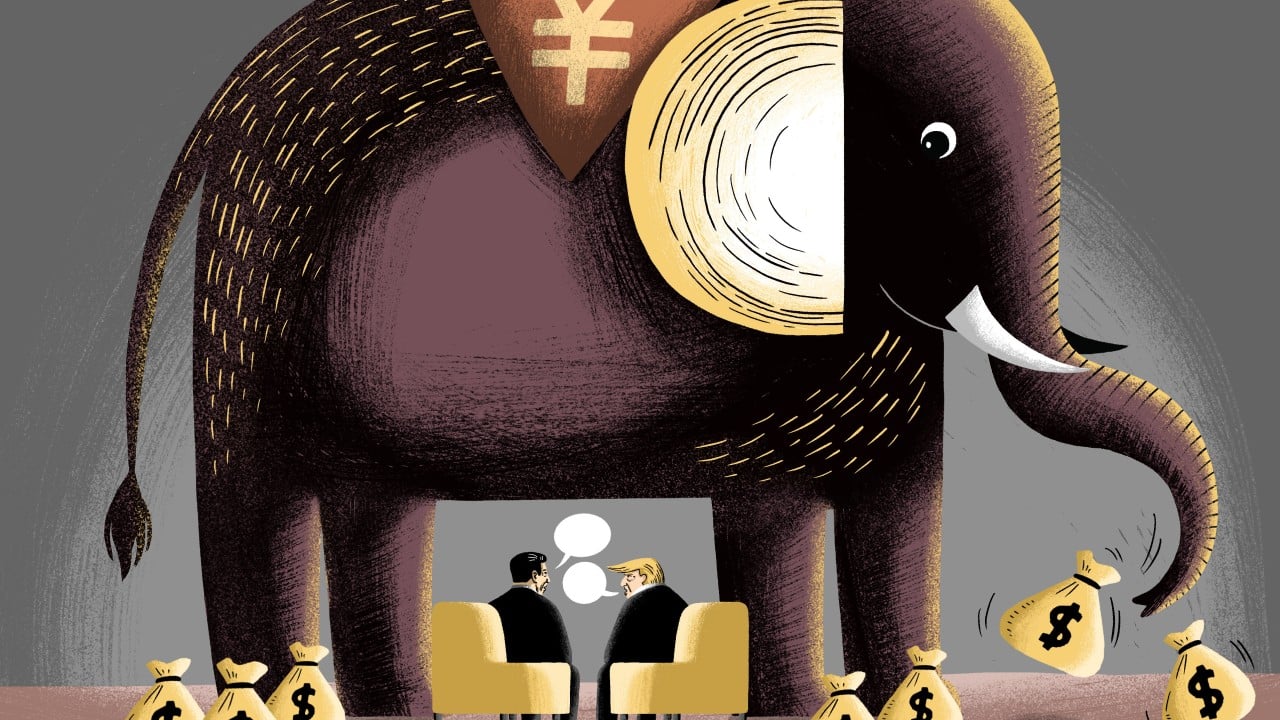
Two men sit across a polished mahogany table, smiling for the cameras. The flashbulbs pop. Handshakes are warm, backs are slapped, and the official press releases brim with diplomatic optimism about cooperation, trade stability, and mutual respect. On the surface, a cordial summit between Xi Jinping and Donald Trump looks like the exact sedative an anxious global economy has been begging for.
Look closer at the ledger books beneath the table. Recently making headlines lately: The Real Reason The Tinder Swindler Wants To Build A Dating App And Why Big Tech Should Be Terrified.
While the public watches the theater of personal diplomacy, a quieter, far more consequential shift is underway in Beijing’s financial architecture. For decades, the unspoken bargain between the world’s two largest economies was simple, if lopsided: China manufactured the goods, America bought them with dollars, and China recycled those dollars right back into U.S. Treasury bonds. That recycling loop kept American interest rates low, funded Washington’s deficits, and gave Beijing a safe, liquid place to park trillions in export earnings.
Now, that loop is fraying. Even amid warm handshakes and tariff truces, China has been steadily reducing its holdings of U.S. Treasuries, accumulating physical gold at a historic pace, and settling an ever-growing share of its cross-border trade in renminbi rather than greenbacks. More information into this topic are detailed by Bloomberg.
Tremors.
They rarely announce themselves with a siren, beginning instead as an imperceptible vibration in the floorboards before the glassware starts rattling in the kitchen cabinet.
To understand what a Chinese pivot away from the U.S. dollar actually means, we have to leave the summit halls of Washington and Beijing and step into a cramped freight office in Ningbo, a sprawling port city south of Shanghai.
The Freight Broker’s Dilemma
Consider a hypothetical character—let’s call him Lin Wei—who runs a mid-sized logistics and sourcing firm in Ningbo. For twenty years, Lin’s business ran on a single, undisputed operating system: the U.S. dollar. Whether he was shipping patio furniture to Ohio, copper wire to Brazil, or machine parts to Malaysia, every invoice was priced in dollars, cleared through New York correspondent banks, and hedged against dollar fluctuations.
Lin didn't love the dollar out of ideology. He used it because everyone else did. In global trade, currency is like a language; you speak the one the buyer and the port authority both understand.
Over the past few years, however, Lin’s daily routine has quietly mutated. When he pays a Russian timber supplier or a Brazilian soybean exporter, the invoices increasingly arrive denominated in Chinese yuan. When his clients in the Middle East or Southeast Asia settle accounts, Beijing’s Cross-Border Interbank Payment System—known as CIPS—handles the transfer directly, bypassing the Western-dominated SWIFT network entirely.
"Five years ago, asking a Brazilian supplier to take yuan felt like asking them to take monopoly money," Lin might tell you over a cup of bitter green tea, scrolling through currency settlement screens on his monitor. "Today, they ask me if we can skip the dollar conversion so neither of us loses two percent to bank fees and exchange spreads."
This is not a dramatic overnight collapse. It is plumbing work. Pipe by pipe, valve by valve, Beijing is building an alternative financial aqueduct that doesn't pass through Manhattan.
The data backs up Lin’s fictionalized ledger. According to figures from the People’s Bank of China and international payment trackers, the renminbi recently overtook the U.S. dollar as the most-used currency in China’s own cross-border transactions—a milestone that would have seemed unthinkable a decade ago. Meanwhile, China’s official holdings of U.S. Treasury securities have slid from a peak of over $1.3 trillion in 2013 down toward the $750 billion mark, hovering near their lowest levels since 2009.
Even when Xi and Trump share a cordial podium, the structural incentives driving Beijing’s diversification haven't budged an inch. Why? Because Beijing watched what happened when Washington froze roughly $300 billion of Russia’s foreign exchange reserves in 2022. That single stroke of financial statecraft demonstrated to every central banker in the world—friend and rival alike—that dollar reserves held in Western custody come with a geopolitical off-switch.
A smile at a summit cannot erase that memory.
The Invisible Anchor in Your Living Room
You might wonder why a shift in Beijing’s reserve portfolio matters if you live in Austin, Ohio, or Manchester, far removed from Ningbo’s shipping containers.
Think of the U.S. dollar’s status as the world’s primary reserve currency as an invisible subsidy woven into the fabric of everyday American and Western life. Because central banks, sovereign wealth funds, and multinational corporations around the globe must hold dollars to buy oil, settle debt, and backstop their own currencies, there is a perpetual, built-in global demand for U.S. assets.
Imagine a restaurant that never has to advertise because it is the only place in town licensed to sell water. The owner can charge a little more, borrow money from the bank at cheaper rates, and run a bigger tab with suppliers without anyone questioning his creditworthiness.
For eighty years, since the Bretton Woods agreement of 1944 crowned the dollar king, the United States has owned that restaurant. Economists call this "exorbitant privilege," a phrase coined in the 1960s by French finance minister Valéry Giscard d’Estaing.
Here is how that privilege shows up in your actual bank account:
- Lower mortgage and auto loan rates: When foreign giants like China buy hundreds of billions in U.S. Treasury bonds, bond prices stay high and yields—the interest rates the government pays—stay artificially low. Since consumer interest rates are priced off Treasury yields, foreign appetite directly shaves percentage points off your thirty-year mortgage.
- Cheaper imported goods: Strong, consistent demand for the dollar keeps its purchasing power elevated, meaning foreign electronics, clothing, and raw materials cost less at the checkout counter than they otherwise would.
- Fiscal breathing room: Washington can run massive budget deficits—currently surpassing $1.8 trillion annually—without triggering the immediate currency crises that punish smaller nations when they overspend.
Now, consider what happens when the biggest buyer at the auction quietly steps back from the bidding table.
China isn't dumping its remaining Treasuries in a single afternoon; doing so would crash the value of its own remaining holdings, shooting itself in the foot to spite its rival. Instead, Beijing is letting bonds mature without buying new ones, redirecting its trade surpluses into physical gold bullion, strategic commodities, and bilateral lending across the Global South.
When a structural buyer steps away just as the U.S. Treasury needs to issue record amounts of new debt to fund deficits and refinance old obligations, someone else has to absorb those bonds. Private investors, pension funds, and domestic banks will step in—but only if you pay them more.
Higher yields. Higher borrowing costs. A heavier anchor on economic growth.
The Anatomy of a Slow-Motion Tremor
I remember sitting in a trading room in London during the autumn of 2022, watching the British gilt market nearly implode in forty-eight hours. On paper, the crisis was triggered by an unfunded tax-cut budget. In reality, it was a brutal lesson in what happens when foreign buyers suddenly decide a sovereign government’s debt isn't worth the yield it offers. Within days, pension funds were facing margin calls, mortgage offers were pulled off the market overnight, and the Bank of England had to intervene with emergency bond purchases just to keep the financial system from seizing up.
The United States is not the United Kingdom; the dollar’s moat is vastly wider and deeper than sterling’s. Yet the underlying physics of sovereign debt remain identical across every timezone. Confidence is binary—it erodes gradually, and then it reprices suddenly.
What makes the current moment so deceptive is the contrast between political optics and financial reality.
When Trump and Xi meet amicably, headlines celebrate "de-escalation." Markets rally on hopes that punitive tariffs might be paused or rolled back. Investors breathe a sigh of relief, assuming that cordial personal chemistry between two strongmen equals systemic stability.
It doesn't. In fact, cordiality can mask the divergence.
During a period of open hostility, policymakers treat currency and debt risks as urgent national security emergencies. During a period of surface-level warmth, complacency creeps in. Yet behind the scenes, the two leaders are pursuing agendas that, paradoxically, push in the exact same direction: away from the old dollar-recycling model.
On the American side, both tariff policies and industrial reshoring efforts aim to shrink the U.S. trade deficit with China. Think through the math of that goal. If America buys fewer goods from China, China earns fewer surplus dollars. If China earns fewer surplus dollars, it literally has fewer dollars to recycle back into U.S. Treasury bonds. You cannot simultaneously eliminate the trade deficit and preserve the capital inflows that the trade deficit generated. It is an accounting identity, as unyielding as gravity.
On the Chinese side, Beijing is grappling with its own domestic headwinds—a protracted property slump, local government debt, and an aging population. To keep its factories humming without relying on debt-fueled real estate construction, China has doubled down on manufacturing exports, sending electric vehicles, solar panels, and industrial machinery into emerging markets across Asia, Latin America, and Africa. And as it sells to those markets, it offers yuan credit lines to finance the purchases.
Step by step, trade routes are being rewired to bypass the greenback.
Why No Single Rival Needs to Replace the Dollar
Whenever economists debate "de-dollarization," a familiar counterargument surfaces: What could possibly replace it?
Critics point out—accurately—that the Chinese yuan is still shackled by strict capital controls. You cannot freely move billions of yuan in and out of Shanghai the way you can move dollars through New York or London. China’s bond market lacks the depth, transparency, and independent rule of law that institutional investors demand. The euro has its own structural fractures; gold doesn't pay interest; cryptocurrencies remain far too volatile for sovereign reserves.
All of this is true. And all of it misses the real danger.
A hurricane doesn't need to replace the roof over your head to ruin your house; it just needs to tear off enough shingles to let the rain in.
The dollar does not need a single, triumphant successor to lose its monopoly pricing power. Shifting from a unipolar currency system—where the dollar accounts for roughly 58 percent of global foreign exchange reserves, down from over 70 percent at the turn of the century—to a fragmented, multipolar system is enough to alter the financial weather for everyone.
Let’s trace how that fragmentation plays out in real life through another grounded scenario.
Picture a mid-sized manufacturing company in the American Midwest—let’s call it Heartland Precision Tools—that relies on imported specialty steel and electronic components while exporting finished machinery to South America.
In a dollar-dominated world, Heartland’s CFO manages one primary currency risk, borrows at predictable rates anchored by strong foreign demand for U.S. debt, and competes on a playing field where every competitor in Germany, Japan, or China also prices their bids in dollars.
In a fractured currency world, three things happen simultaneously to Heartland:
- The Cost of Capital Rises: With Beijing and allied central banks steadily trimming their Treasury allocations in favor of gold and regional swap lines, baseline interest rates in the U.S. settle structurally higher—say, 4.5 to 5 percent instead of the 2 to 3 percent norm of the 2010s. Expanding the factory floor suddenly costs hundreds of thousands of dollars more in interest over the life of a loan.
- Currency Volatility Spikes: As commodities like oil, liquefied natural gas, and copper increasingly trade in a patchwork of yuan, dirhams, rupees, and dollars, exchange rates swing more violently. Heartland’s suppliers face erratic input costs, passing those surcharges down the chain.
- Loss of Pricing Power: A Brazilian buyer who previously had to scramble for scarce dollars to buy machinery now has easy access to low-interest yuan financing backed by a Chinese policy bank, nudging them toward a rival supplier in Shenzhen.
None of these shifts look like a Hollywood market crash. There is no single day when the screens turn crimson and sirens wail on Wall Street. Instead, it feels like walking uphill into a steady headwind—every step takes slightly more effort, margins compress by a fraction of a percent, and household budgets feel perpetually stretched even when official employment numbers look healthy.
The Honest Uncertainty at the Heart of Global Finance
It is tempting to demand certainty from financial history—to ask whether the dollar will reign supreme for another century or crumble within five years. Anyone offering you a definitive answer to that question is selling a narrative, not analysis.
The truth is messier and far more unsettling. The global monetary system is a massive, adaptive organism built on collective habit, institutional trust, and raw geopolitical leverage. Inertia is a powerful force in finance; networks are notoriously hard to abandon because the value of using the dollar comes from the sheer fact that everyone else uses it. Even Chinese state-owned banks still rely heavily on dollar liquidity to fund their overseas operations.
Yet history also teaches us that monetary regimes look permanent right up until the moment their foundations wash out. The British pound sterling dominated global trade for over a century, backed by the Royal Navy and the financial might of the City of London. Even after World War I hollowed out Britain’s finances, sterling clung to its status for decades through sheer habit and imperial preference—until the Suez Crisis of 1956 exposed the gap between Britain’s imperial ambitions and its depleted dollar reserves, triggering a run on the pound that ended its reserve reign for good.
Today, the tension isn't between a declining empire and a rising one in the classic nineteenth-century mold. It is between two deeply entangled superpowers trying to untangle their financial nerves without killing the patient.
Xi and Trump can share a warm meal, sign a bilateral trade accord, and pose beneath the flags for a dozen photographers. Those gestures matter—they buy time, lower the immediate temperature of military confrontation, and keep shipping lanes open.
What they cannot do is turn back the clock to 2005, when Beijing happily absorbed every Treasury bond Washington printed and asked no questions about how those dollars might one day be weaponized.
Reading the Seismograph
If you want to know where the global economy is actually heading over the next five years, stop watching the body language at diplomatic summits and start watching three quiet numbers instead:
- Central Bank Gold Purchases: When sovereign nations buy physical metal that pays zero yield and costs money to store in underground vaults, they are buying insurance against sovereign debt and currency sanctions. Central bank gold buying has shattered multi-decade records in recent years, led overwhelmingly by China and emerging-market peers.
- The Term Premium on 10-Year U.S. Treasuries: This is the extra yield investors demand for locking their money up in long-term U.S. debt rather than rolling over short-term bills. When foreign central banks step back, the term premium creeps upward—quietly raising the floor under every mortgage, corporate bond, and student loan in America.
- Bilateral Swap Lines: Beijing has signed currency swap agreements with more than forty central banks worldwide, from Saudi Arabia and Argentina to Indonesia and South Africa, creating a ready-made liquidity safety net that operates completely outside the Federal Reserve’s orbit.
Every one of those indicators is flashing the same quiet message: the era of effortless, automatic foreign financing for American deficits is drawing to a close.
Late at night in Ningbo, long after the diplomatic communiqués from Washington and Beijing have faded from the evening news cycle, container cranes still swing illuminated steel boxes onto outbound hulls under the glare of sodium-vapor floodlights. Inside the port’s digital clearinghouses, millions of lines of code settle invoices—fewer in dollars than yesterday, a few more in yuan than the day before. Nobody rings a bell when an era shifts; the water simply finds a new channel, stone by stone, until one morning you look down at the riverbed and realize the current is flowing somewhere else entirely.