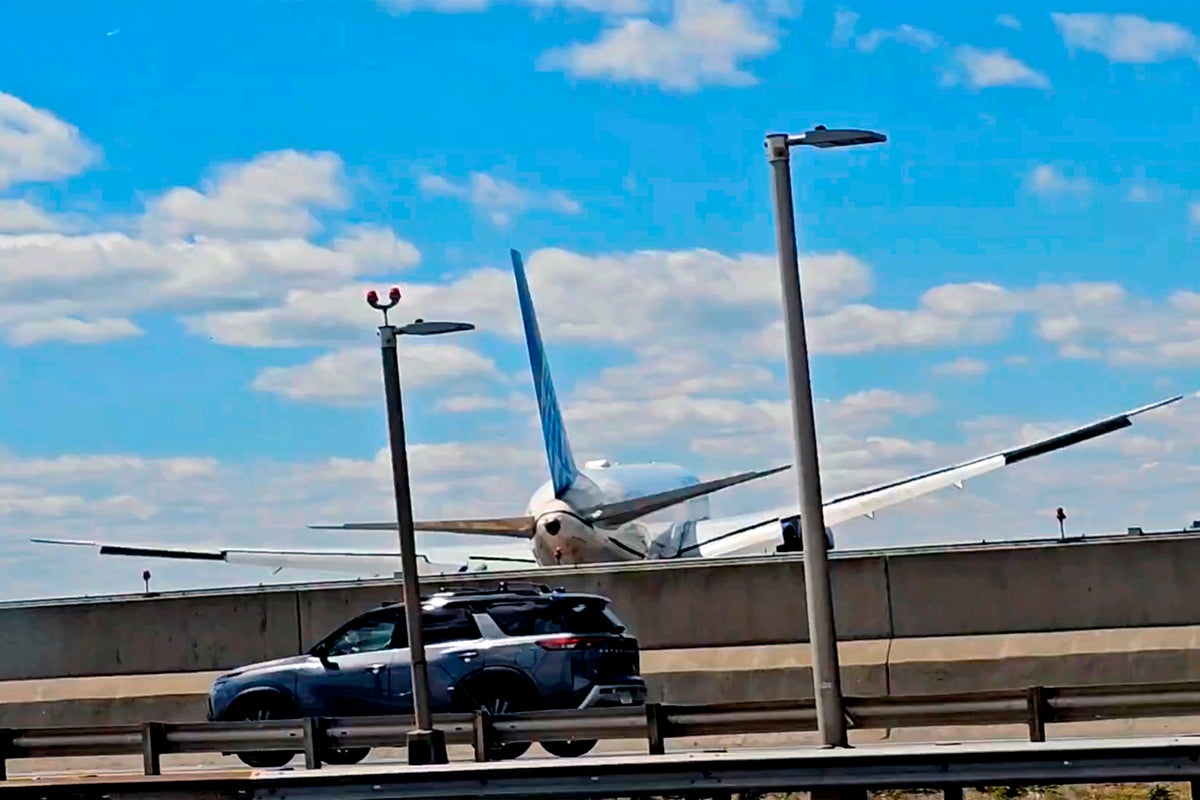
The margin between a routine landing and a mass-casualty event on a commercial runway is often measured in feet. At Newark Liberty International Airport, that margin recently shrank to the width of a tractor-trailer. Newly surfaced footage of a United Airlines Boeing 777 narrowly missing a vehicle on the airport’s perimeter road isn't just a viral clip for social media. It is a damning indictment of the physical constraints at one of the world’s most congested hubs. The aircraft, screaming in over the threshold of Runway 22L, cleared the top of a truck by a distance that would make even the most seasoned aviator break a sweat. This wasn't a mechanical failure. It was a spatial one.
When a wide-body jet like the Boeing 777-200 approaches Newark, it is battling a decades-old layout that was never designed for the sheer volume and scale of modern long-haul hardware. The footage shows the aircraft in a standard stabilized approach, yet its landing gear appears to hunt for the asphalt just inches above the perimeter fence. To the casual observer, the pilot "messed up." To those who understand the physics of a glideslope and the geography of Northern New Jersey, the incident reveals a much deeper systemic risk regarding displaced thresholds and the encroachment of ground infrastructure on active flight paths. You might also find this related coverage insightful: The Cruise Industry Bio-Security Myth Why Boarding Quarantine Ships is a Performative Failure.
The Geometry of a Near Miss
The physics of landing a 250-ton machine requires a precise descent angle, usually three degrees. If an aircraft stays on the electronic "path" provided by the Instrument Landing System (ILS), it should clear all obstacles with a comfortable buffer. However, Newark’s Runway 22L presents a unique set of challenges. The perimeter road runs in jarring proximity to the runway’s start.
When a pilot is dealing with heavy headwinds or a "sink" on short final, the aircraft can temporarily dip below that ideal three-degree line. In most airports, this results in a slightly firm landing on a wide expanse of grass. At Newark, it results in the belly of a jet nearly shearing the roof off a service vehicle. The "why" behind this close call lies in the intersection of pilot technique and the unforgiving reality of airport boundary lines. As reported in detailed articles by Lonely Planet, the effects are significant.
The Boeing 777 has a massive wingspan and a landing gear assembly that hangs low and heavy. During the flare—the moment the pilot raises the nose to soften the touchdown—the main gear actually sinks slightly before the lift takes over. If that flare is initiated even a second late, or if the touchdown point is aimed too close to the "numbers" (the start of the runway), the aircraft’s footprint extends back toward the fence. This is where the truck was. It was a collision of two worlds that are supposed to be separated by a vacuum of safety.
Infrastructure Dragging Behind Technology
We are flying 21st-century computers into mid-20th-century concrete boxes. Newark Liberty has undergone billions of dollars in terminal renovations, but you cannot easily move a runway or the highways that hem it in. The Port Authority of New York and New Jersey faces a literal "land lock" problem.
Runway Safety Areas (RSAs) are designed to give planes room to breathe if they undershoot or overshoot. However, at Newark, the proximity of the New Jersey Turnpike and internal service roads creates a high-stakes environment. The FAA has spent years improving RSAs across the country, often installing EMAS (Engineered Materials Arresting System)—collapsible concrete that stops a plane like a runaway truck ramp. But EMAS helps with overruns. It does nothing for an undershoot where the plane is still in the air.
The real culprit here is the "displaced threshold." This is a portion of the runway that is available for takeoff but not for landing. It is meant to ensure that planes are high enough to clear obstacles—like trucks—before they touch down. The United flight was legally within its bounds, but the bounds themselves are increasingly insufficient. As aircraft grow in size and weight, the "standard" buffers become relics. We are seeing a trend where the physical limits of the airfield are being tested by the aerodynamic realities of larger, more efficient engines that require different approach speeds and profiles.
The Human Factor in the Cockpit
A pilot’s job on short final is a frantic exercise in energy management. They are juggling airspeed, rate of descent, and crosswind corrections. At Newark, the visual cues can be deceptive. The surrounding industrial sprawl creates a "busy" background that can interfere with a pilot’s depth perception during the transition from instruments to visual flying.
In the case of the United close call, the flight crew was likely focused on hitting the "thousand-foot markers"—the ideal touchdown zone. If the jet caught a sudden downdraft, a common occurrence in the choppy air over the Jersey marshes, the plane would "settle" faster than anticipated.
The industry refers to this as "unstable approach criteria." If a plane is too low or too fast, the pilot is mandated to go around. But what happens when the "dip" occurs in the final three seconds of flight? There is no time to go around. You are committed to the pavement. The truck driver on that perimeter road likely had no idea that a massive Rolls-Royce engine was passing close enough to vibrate the glass out of his mirrors. This highlights a terrifying lack of synchronization between ground traffic control and the tower.
Redefining the Buffer Zone
If we are to prevent the "one-in-a-million" catastrophe, we have to stop treating these incidents as anomalies. The data shows that runway incursions and near-misses are on the rise across the United States. This isn't because pilots are getting worse; it’s because the sky is getting smaller.
There are three immediate levers that industry analysts point to for fixing the Newark problem:
- Raising the Glideslope: Some airports have moved from a 3.0-degree to a 3.2-degree approach angle. It sounds small, but it provides significantly more clearance over perimeter fences.
- Automated Perimeter Alerts: We have technology that tells a pilot if another plane is on the runway. We do not have widespread, integrated systems that tell a truck driver to stop because a heavy jet has dipped below the safety floor on short final.
- Mandatory Threshold Recess: Moving the landing point further down the runway. This reduces the available landing distance, which is a problem for heavy jets in rain or snow, but it removes the "guillotine" effect of the perimeter fence.
The pushback from airlines is predictable. Moving a landing threshold means planes have to carry less fuel or fewer passengers to ensure they can stop in time on a shorter strip of Tarmac. It is a direct hit to the bottom line. But the cost of a 777 clipping a vehicle and cartwheeling into the terminal is an expense no airline can survive.
The Silence of the Regulators
The FAA and the NTSB often wait for a tragedy to mandate change. We saw it with the introduction of ground radar and cockpit voice recorders. Currently, the "close call" at Newark is being treated as a footnote because no metal was twisted and no blood was spilled. That is a dangerous way to run an aviation system.
The footage from Newark should be the catalyst for a total audit of perimeter road safety at "tight" airports like LGA, EWR, and DCA. These airports are the crown jewels of American commerce, but they are operating on the edge of their safety envelopes. When you see a jet's wheels skim a vehicle, you aren't looking at a "cool" video. You are looking at a system that has run out of space.
We rely on the "Swiss Cheese Model" of safety. This theory suggests that many layers of defense (the holes in the cheese) must align perfectly for an accident to happen. In Newark, the holes are starting to line up. The pilot’s descent, the truck’s timing, and the runway’s geography nearly created a straight line for disaster.
The industry must now decide if it will move the fence, move the road, or wait for the day the wheels don't miss. The laws of physics do not care about airport budgets or flight schedules. They only care about the distance between two objects moving in the same space. Right now, that distance is far too small.
Clear the perimeter road or move the landing marks. There is no third option that guarantees safety.