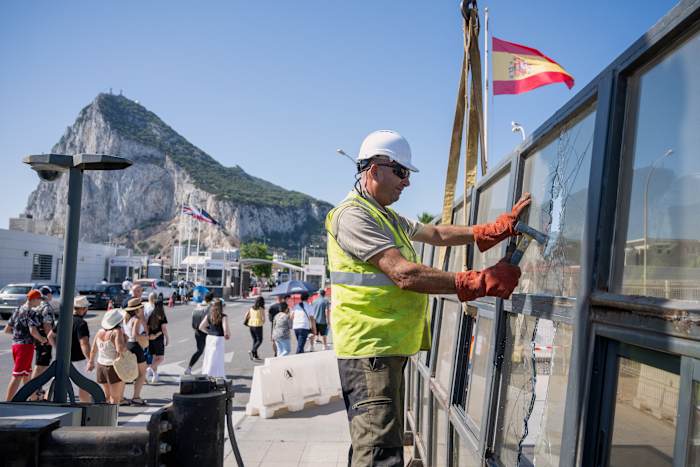
The physical border fence separating the British territory of Gibraltar from mainland Spain is coming down, a historic shift that effectively moves the outer edge of the Schengen zone to the Rock’s ports and runway. While optimistic politicians paint this as the dawn of a frictionless future, the reality is far more complex. This is not a simple victory for local integration. It is a calculated, high-stakes geopolitical concession that fundamentally alters the nature of British sovereignty in the Mediterranean, forcing Gibraltar to accept Spanish oversight in exchange for economic survival.
For three centuries, the sheer existence of Gibraltar has been a thorn in the side of Madrid. Now, the removal of "La Verja"—the physical barrier erected by Spain during the height of the Cold War—signals a profound realignment. To understand why this is happening now, one must look past the celebratory press releases and examine the grueling negotiations that took place in Brussels, London, and Madrid.
The Paperwork Behind the Open Gate
To the casual observer, an open border looks like freedom. To a customs official, it looks like a security nightmare. Under the terms of the treaty, Gibraltar will enter a bespoke arrangement with the European Schengen Area. Because Gibraltar is not a sovereign nation, it cannot sign the Schengen Agreement on its own. Instead, Spain acts as the guarantor of the external Schengen border.
This creates a constitutional paradox. To keep the land border open, the border controls must move to Gibraltar’s airport and seaport. This means that anyone arriving in Gibraltar from the United Kingdom or any other non-Schengen country will be entering the European passport control zone the moment they touch down.
The immediate question is who polices those gates.
Gibraltar’s government, led by Chief Minister Fabian Picardo, steadfastly refused to allow Spanish national police to stand at the airport and harbor. For Gibraltarians, the sight of Spanish uniforms operating on their soil is an absolute red line. The compromise is a temporary, four-year deployment of Frontex, the European Union's border and coast guard agency.
But Frontex is not an independent entity. The agency operates under the legal authority of the host Schengen member state. In this case, that state is Spain. While the officers on the ground may wear Frontex armbands, they will be executing Spanish and European law, reporting back to Madrid. This is a major concession wrapped in a flag of European cooperation.
The Airport Stumbling Block and the Treaty of Utrecht
No patch of land on the Rock is more contested than the narrow isthmus where Gibraltar International Airport sits. Spain has long argued that the 1713 Treaty of Utrecht, which ceded Gibraltar to Great Britain, did not include this strip of land.
The runway itself crosses the main road connecting Gibraltar to Spain. Every time a plane lands, the road must close. Under the new treaty, this runway becomes a shared space.
- Joint Management: Spain has secured joint use of the airport, a goal Madrid has chased for decades.
- Schengen Screening: Passengers arriving from international destinations will face dual checkpoints, separating those heading into Gibraltar from those transiting straight into Spain.
- Sovereignty Creep: By allowing Spain a say in the administration of the airport, the British government has conceded that absolute control over this strategic military asset is no longer viable in a post-Brexit world.
This airport compromise is the clearest indicator of how much leverage Spain held during the negotiations. The UK Royal Air Force still uses the airfield for military transport. How the presence of Spanish and Frontex officials at the civil terminal will affect British military operations remains a highly classified, deeply sensitive issue.
The Economic Realities of the Campo de Gibraltar
To understand why this fence had to fall, one must look south from the Spanish town of La Línea de la Concepción. The region surrounding the Rock, known as the Campo de Gibraltar, is one of the poorest in Spain. Unemployment rates in La Línea regularly surpass thirty percent.
For the people living there, the border is a lifeline.
Every single day, roughly fifteen thousand Spanish workers cross into Gibraltar to work in its hospitals, hotels, construction sites, and financial institutions. They keep the Gibraltar economy running. In turn, they take their tax-free pounds back to Spain, spending them in local supermarkets, cafes, and real estate.
Had the border closed completely, or had a hard Schengen border been enforced at the fence, both economies would have collapsed.
Economic Interdependence
| Metric | Gibraltar | Campo de Gibraltar (Spain) |
|---|---|---|
| Primary Dependency | Spanish manual and professional labor | Gibraltarian investment and employment |
| Daily Border Crossers | ~15,000 workers | ~15,000 workers |
| Economic Output | High-value finance, gaming, bunkering | Agriculture, refinery work, tourism |
| Vulnerability | Supply chain disruption, labor shortages | Mass unemployment, economic depression |
The removal of the fence prevents an economic catastrophe, but it also locks Gibraltar into a permanent state of dependency on Spanish goodwill. If Madrid ever decides to slow down the data feeds to the Frontex terminals, or if a future Spanish government decides to enforce stricter customs checks on goods entering the Rock, the economy of Gibraltar can be choked off within forty-eight hours.
Sovereignty by Stealth
For decades, the standard Spanish strategy to reclaim Gibraltar was aggressive. General Franco closed the gate entirely in 1969, cutting off families, telephone lines, and trade. It failed. The siege only hardened the resolve of the Gibraltarians, who voted overwhelmingly in 1967 and again in 2002 to remain British.
The modern Spanish foreign ministry has learned from those mistakes. The aggressive rhetoric has been replaced by administrative diplomacy. By focusing on practical issues like environmental standards, tobacco taxation, and police cooperation, Spain has achieved what military blockades never could: a foot in the door.
Gibraltar has long been accused of operating as a tax haven on Spain’s doorstep. The low corporate tax rates and the absence of VAT have historically drawn Spanish capital away from the mainland. Under the new framework, Gibraltar has had to align its tax transparency laws with EU standards and agree to keep the price of tobacco within a specified percentage of Spanish prices to curb smuggling.
This is harmonization in all but name. Gibraltar is being forced to play by European rules without having a seat at the table where those rules are written.
A Fragile Peace on the Rock
The fence is gone. The physical barrier that stood as a monument to twentieth-century European divisions has been dismantled. But the psychological barrier remains as sturdy as ever.
Many of the older residents of Gibraltar remember the years of isolation when the gates were locked. They look at the incoming Frontex officers with deep suspicion. They understand that while the British flag still flies from the top of the Rock, the everyday management of their borders, their economy, and their airport is now inextricably linked to Madrid.
This treaty was not born out of a sudden wave of European solidarity. It was born out of cold, hard necessity. Gibraltar could not survive as an isolated island of British territory in a hostile European sea. Spain could not afford the social unrest that a dead border would bring to its poorest southern province.
Both sides have made compromises that would have been politically unthinkable a decade ago. The British government has allowed European officials to govern entry to its territory. The Spanish government has shelved its immediate demands for joint sovereignty to focus on economic pragmatism.
It is a fragile arrangement built on the assumption that the temporary Frontex compromise will work, and that the political winds in Madrid and London will not shift toward nationalism. If those assumptions fail, the infrastructure to rebuild the border is only a flatbed truck and a roll of barbed wire away.