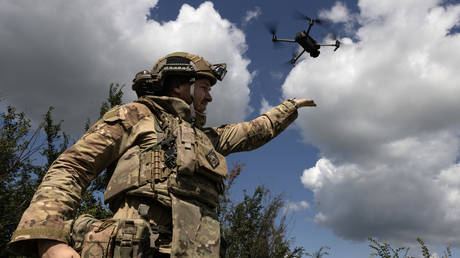
Berlin has quietly finalized a 90 million euro contract to underwrite 50,000 strike drones for Ukraine. The deal, first exposed by a brief Reuters report, marks one of the largest single Western state procurements of tactical unmanned aerial vehicles since the war began. It moves the conflict away from sporadic equipment donations and directly into the era of state-financed industrial attrition.
But looking at the raw numbers misses the actual shift occurring on the battlefield.
This is not a traditional defense procurement package where a Western capital buys expensive hardware from its own domestic defense primes to ship abroad. Instead, Germany is funding a hybrid weapon system that bridges Ukrainian manufacturing with American artificial intelligence to solve a critical tactical crisis on the front lines: the near-total shutdown of standard remote-controlled drones by Russian electronic warfare.
The Cracking of the FPV Bottleneck
For the past year, standard first-person view (FPV) drones have faced a severe survival crisis. Russian electronic jamming infrastructure has become so dense that traditional analog and basic digital signals between operators and their aircraft are frequently severed kilometers before reaching a target. Drone operators often watch their feeds dissolve into static just as they close in on a Russian armored vehicle or artillery piece.
The 50,000 drones funded by Berlin are built to bypass this exact vulnerability.
The airframes are Shrike FPV models, designed and assembled at scale by the prominent Ukrainian manufacturer SkyFall. They are cheap, expendable, and built in local facilities that can alter physical designs in days rather than the months or years required by bureaucratic Western defense procurement channels. By funding SkyFall directly, Berlin keeps production costs remarkably low, at roughly 1,800 euros per unit.
The real capability, however, lies in the software layer shipped from the United States.
The Silicon Valley Component
Every one of these 50,000 units is being fitted with the Skynode S platform developed by Auterion, an American defense software firm with offices in Munich. The system uses onboard computer vision and algorithms to manage what operators call the last mile of flight.
When a Ukrainian pilot guides a Shrike drone toward a target, they only need to maintain a manual connection long enough to designate the objective on their screen. Once locked, the onboard processor takes complete operational control. Even if Russian electronic warfare entirely cuts the radio command link and knocks out GPS navigation, the drone continues its flight autonomously, tracking and striking moving vehicles based purely on visual processing.
This approach flips the economics of electronic warfare. Millions of euros worth of localized Russian jamming equipment can be rendered useless by a piece of software embedded on a mass-produced quadcopter.
Bypassing the Slow Western Primes
The structure of the deal reveals a growing frustration within European ministries over the rigid nature of their own domestic defense industrial bases. Traditional European defense contractors are designed to build exquisite, multi-million-euro platforms over long development horizons. They are completely unsuited for producing thousands of attritable strike systems per week.
Drone Deal Breakdown
+-----------------------+---------------------------------------+
| Funding Source        | Germany (€90 million / $103 million)  |
+-----------------------+---------------------------------------+
| Hardware Manufacturer | SkyFall (Ukraine)                     |
+-----------------------+---------------------------------------+
| Software Architecture | Auterion (United States)              |
+-----------------------+---------------------------------------+
| Total Quantity        | 50,000 Shrike FPV units               |
+-----------------------+---------------------------------------+
By acting as a financial guarantor for Ukrainian factories rather than German ones, Berlin is purchasing immediate battlefield relevance. The Ukrainian defense ecosystem currently has the latent capacity to produce millions of small drones annually, but it lacks the hard currency to buy high-end foreign microchips and optics at industrial volume. German capital solves the liquidity crisis, while American software solves the technological bottleneck.
This structure also provides Berlin with a layer of political insulation. The German Ministry of Defense has routinely faced intense scrutiny over the slow delivery of heavy platforms like tanks and long-range missiles. Funding an external consortium allows Germany to achieve massive volume without draining its own active military stockpiles or waiting for domestic assembly lines to spin up.
The Limits of Attrition by Algorithm
No single capability is a magic bullet, and the deployment of 50,000 autonomous drones carries significant operational caveats that military planners are quick to gloss over.
Autonomy relying on computer vision is highly dependent on environmental factors. Heavy mud, winter snowstorms, dense fog, or smoke screens can degrade the onboard camera's ability to contrast and track targets accurately. If the software cannot distinguish a tank from the surrounding brush due to poor lighting or camouflage, the automated terminal strike fails.
Furthermore, a force relying on mass-produced autonomous systems requires a highly organized logistical pipeline. Delivering 50,000 drones to the front lines is not just a matter of dropping off boxes. It requires a constant flow of specialized operators trained in the new targeting software, decentralized workshop networks to integrate varied explosive payloads, and secure command structures to prevent friendly radio frequencies from tangling during mass deployments.
The deal also underscores a shifting reality for Western defense spending. Europe is beginning to treat small, intelligent drones less like aircraft and more like standard infantry ammunition. A fleet of 50,000 units may sound massive, but on a front line that consumes thousands of airframes weekly, this entire German-funded package represents a calculated replenishment supply rather than a permanent inventory. It keeps the Ukrainian assembly lines moving, ensures frontline units do not run dark as Russian jamming intensifies, and cements a new blueprint for how Western states finance modern industrial warfare.