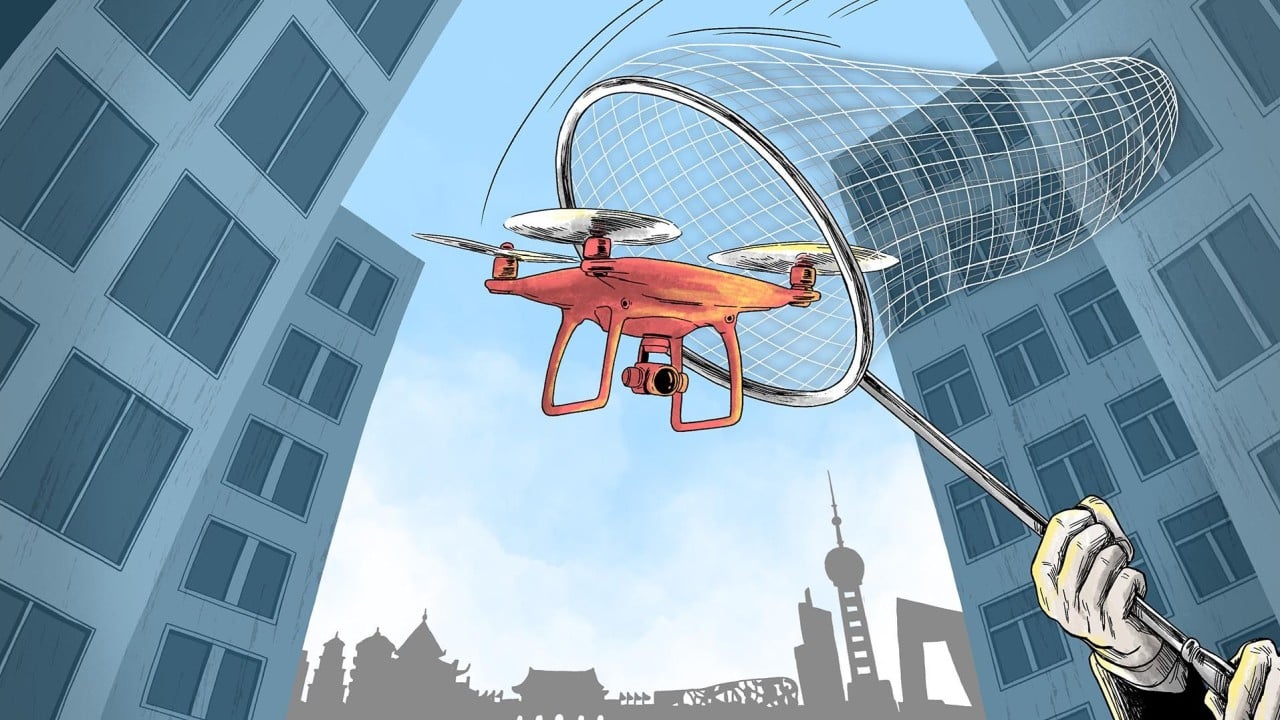
Beijing has quietly choked off the skies above its major cities, imposing a sweeping, undeclared clampdown on civilian drone operations. While external analysts point to the war in Ukraine as the primary catalyst, the truth is far more calculated. The conflict in Europe did not trigger China’s urban drone ban; it merely validated a long-standing domestic security agenda. China is moving to secure its airspace not out of fear of foreign tactics, but to preemptively control the explosive growth of a technology that presents an unprecedented internal surveillance and security challenge.
For years, the consumer drone market thrived under a regulatory blind spot. Anyone with a few hundred dollars could launch a high-definition camera into the sky, hovering over government compounds, critical infrastructure, and dense residential blocks. That era is over. The restriction of urban civilian flights represents a structural shift from commercial promotion to total state oversight, prioritizing regime stability and homeland security over market expansion.
The Ukraine Illusion versus Domestic Reality
Western defense circles frequently argue that China’s sudden regulatory tightening stems from watching consumer-grade quadcopters drop grenades into trenches in eastern Europe. It is an easy connection to make. The war demonstrated that cheap, unmodified civilian hardware could be weaponized with terrifying efficiency.
The timeline tells a different story. China’s bureaucracy had been laying the groundwork for total airspace control long before hostilities broke out in Europe. The war simply provided the perfect geopolitical cover to accelerate a domestic crackdown without panicking the commercial tech sector.
Beijing’s primary anxiety is not an invading army of hobbyist drones. It is the challenge of managing millions of unmonitored, autonomous eyes over its own cities. A standard consumer drone can map sensitive urban typography, capture unauthorized footage of state facilities, or disrupt commercial aviation corridors. In a system built on total informational control, an unmapped, untracked flying camera is an intolerable security risk.
The Iron Cage of Real Name Registration
The mechanism of this ban is not a single, dramatic decree. It is a slow, bureaucratic asphyxiation executed through the Real-Name Registration System for Unmanned Aircraft.
Every civilian drone weighing over 250 grams must now be tied directly to a citizen’s national identity card or a corporate business license. This goes far beyond standard registration protocols seen in the West.
- Integrated Geofencing: Firmware updates pushed by major manufacturers have hardcoded expansive "No-Fly Zones" over virtually every major urban center.
- Real-Time Telemetry Tracking: Operating a drone now requires a constant data link to state-managed air traffic systems, broadcasting the pilot's precise location, altitude, and flight path.
- Algorithmic Approvals: Flight permissions in major municipal zones are filtered through automated police databases. If a flight plan does not serve a verified state, corporate, or authorized research purpose, the system denies the launch request.
Attempting to bypass these digital guardrails is treated as a severe public security offense. Hackers who previously sold software modifications to override manufacturer geofencing have been systematically arrested, and their digital storefronts dismantled.
The Collateral Damage of Total Control
This regulatory squeeze is suffocating the very industry China spent a decade dominating. Companies that built global empires on consumer quadcopters are finding their domestic testbeds entirely restricted.
Consider the logistics sector. For years, tech giants promised a future where automated delivery drones would navigate high-rise complexes to drop off packages. Those ambitions have hit a brick wall. Local public security bureaus refuse to authorize low-altitude commercial corridors over densely populated neighborhoods. The risk of mechanical failure, signal jamming, or bad actors hijacking a delivery vector outweighs any perceived economic efficiency.
Industrial Stagnation
The restrictions are creating a stark divide between state-sanctioned industrial applications and the broader commercial market. Drones used for agricultural spraying in remote provinces or power line inspection in mountain ranges face minimal scrutiny. But the moment an enterprise attempts to operate within a major metropolitan boundary, the compliance burden becomes paralyzing.
The Data Sovereign Problem
The underlying friction is data sovereignty. Modern drones do not just fly; they harvest massive volumes of spatial data. High-resolution 3D mapping, thermal imaging, and radio-frequency scanning are standard capabilities for mid-tier commercial units. If this data is stored on private servers or accessible via decentralized networks, the state views it as a leak in its national security perimeter. By banning civilian flights in cities, the government effectively monopolizes urban spatial intelligence.
The Infrastructure of the Low-Altitude Economy
Beijing is not trying to kill the drone industry. It is trying to nationalize its utility. The state is aggressively funding what it calls the Low-Altitude Economy, but this framework completely excludes the independent civilian operator.
Future urban airspace is being designed exclusively for state-vetted entities operating on closed, government-managed networks. We are seeing the construction of dedicated drone ports atop government buildings and municipal transport hubs, completely separate from public spaces. These systems use dedicated cellular frequencies protected by military-grade encryption, ensuring that no civilian signal can interfere with or replicate their flight paths.
This creates a highly controlled ecosystem where only state enterprises can leverage the benefits of aerial automation. The independent aerial photographer, the startup surveyor, and the hobbyist tech enthusiast are being systematically pushed out of the sky.
The Real Threat Is Signal Chaos
Beyond espionage and surveillance, the ban addresses a critical technical vulnerability: radio frequency congestion.
Imagine a hypothetical scenario where thousands of delivery, hobbyist, and corporate drones operate simultaneously over a city like Shanghai. The resulting cross-talk, signal interference, and competition for bandwidth would jeopardize emergency services, police communications, and military command networks. By clearing the skies of civilian traffic, the state ensures that its own electronic warfare capabilities and defensive jamming systems can operate in urban centers without causing collateral economic chaos.
The war in Europe did not change China's mind. It merely confirmed its deepest suspicion: that uncontrolled technology in the hands of the public is an inherent vulnerability. The quiet ban on urban civilian flights is the logical conclusion of a governance model that views total control not as a policy choice, but as an existential necessity. The skies over China's cities are clear of civilian drones because the state decided that the price of technological freedom was a risk it was no longer willing to take.