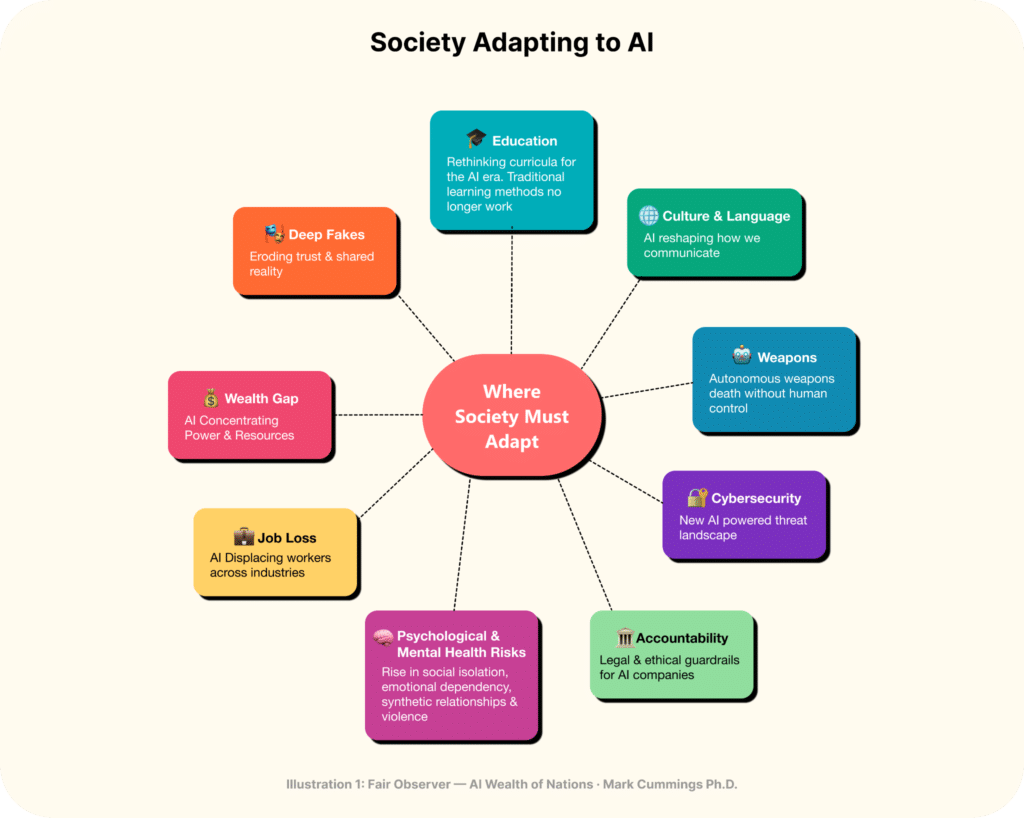
When public records revealed that New South Wales officials swung from breathless excitement over OpenAI to panic about Hollywood killer robots, they exposed a systemic crisis in public sector governance. Governments worldwide are rushing to sign agreements with artificial intelligence giants without understanding the code, the infrastructure, or the long-term structural costs. This is not a story about science fiction. It is an indictment of a political class that treats complex algorithmic architecture as a public relations prop, leaving state machinery vulnerable to corporate capture and operational failure.
The pattern is identical across hemispheres. A premier or a minister meets a Silicon Valley executive. A glossy press release promises automated efficiency, reduced waiting times, and a digitized future. Then, the realization sets in that the state has promised away its data sovereignty to a private entity that operates as a black box.
The Illusion of Innovation in the Public Sector
Politicians love ribbons to cut. Software deployment offers a digital equivalent, a way to signal progress without building physical infrastructure. When OpenAI began its global charm offensive, setting up regional dialogues and courting regional authorities, public sectors responded with uncritical adulation. Internal documents from state departments show an eagerness to bypass standard procurement safeguards just to secure a meeting with high-profile technology founders.
This enthusiasm is rarely grounded in technical literacy. Bureaucrats see automated text generation as a magic wand for administrative backlogs. They envision systems summarizing policy papers, drafting correspondence, and answering citizen queries around the clock. The underlying reality of large language models, specifically their tendency to manufacture falsehoods with total statistical confidence, is ignored during the initial honeymoon phase.
State departments routinely mistake linguistic fluency for comprehension. A system that predicts the next most likely word in a sentence is not an analyst. It is a highly sophisticated mirror of its training data. When governments deploy these systems into public administration, they are embedding unverified biases and structural errors into the very mechanisms that distribute public resources.
From Uncritical Adulation to Pop Culture Panic
The transition from absolute fascination to existential dread happens remarkably fast within government departments. It usually takes a single briefing from a legal counsel or an external risk analyst to shatter the illusion. In the case of the Australian state deliberations, the sudden introduction of existential risk arguments, complete with references to cinematic tropes, paralyzed the decision-making process.
This paralysis highlights a dangerous intellectual vacuum. When policymakers lack the technical framework to evaluate algorithmic systems, they rely on cultural narratives. They skip past immediate, quantifiable harms like data privacy violations, copyright infringement, and algorithmic discrimination. Instead, they fixate on speculative, sci-fi catastrophes.
This shift serves a specific purpose for both the technology companies and the bureaucrats. By framing the conversation around distant, apocalyptic scenarios, both parties avoid discussing immediate accountability. It is much easier for a minister to fret about autonomous machine consciousness than it is to address why a government department is uploading sensitive citizen data to servers owned by a foreign corporation.
The Sovereign Risk of Outsourcing National Logic
Public administration relies on a clear chain of accountability. If a human bureaucrat denies a housing application or miscalculates a tax benefit, an administrative tribunal can review the decision-making process. The logic is transparent, written down in policy guidelines and statutory frameworks.
Proprietary models destroy this transparency. When a state agency embeds a commercial model into its workflow, it outsources its core logic to a private enterprise. The inner workings of these models are trade secrets, protected by intellectual property laws and hidden behind application programming interfaces.
A citizen denied a service by an automated system has no path to meaningful appeal. The state cannot explain why the machine reached its conclusion because the state does not know. The agency becomes a consumer of a service it cannot audit, bound to the terms and conditions of a company whose primary fiduciary duty is to its shareholders, not the public.
Furthermore, the financial model of these tech partnerships is inherently predatory. Initial access is often subsidized or offered via low-cost pilot programs to encourage dependency. Once a government department integrates these tools into its daily operations, retraining its staff and restructuring its databases around a specific proprietary standard, the vendor locks them in. Prices rise, and the state, having dismantled its internal capabilities, has no choice but to pay.
The Technical Reality That Bureaucrats Ignore
To understand why these implementations stumble, one must look at the physical reality of the technology. Large language models require immense computational power, continuous data feeds, and relentless maintenance. They are not static utilities like electricity or water.
[Citizen Data] ---> [State Interface] ---> [Third-Party API] ---> [Proprietary Cloud]
                                                                        |
[Unverifiable Decision] <--- [Automated Output] <--- [Model Inference] <---'
Every update to a commercial model alters its underlying behavior. A system that performed acceptably during a three-month government trial can degrade in accuracy after a sudden software update rolled out from California. This phenomenon, known to engineers as model drift, can introduce systemic errors into public workflows overnight.
- Data ingestion hazards: Public sectors handle protected health information, criminal records, and tax identifiers. Passing this information through third-party infrastructure violates fundamental privacy principles.
- The hallucination tax: Verifying the output of an automated system often requires more human labor than writing the document from scratch. Bureaucrats become editors of low-quality machine prose, increasing the cognitive load on an already strained workforce.
- Infrastructure dependency: Relying on international cloud providers undermines domestic technological self-reliance, leaving state functions vulnerable to geopolitical shifts and foreign infrastructure outages.
Building Capable States Instead of Buying Hype
The solution to this crisis does not involve banning technology, nor does it involve writing hysterical memos about cinema plots. It requires a deliberate, unglamorous investment in sovereign public capacity. If a government lacks the expertise to build, test, and maintain its own digital tools, it has no business procurement-managing them from global monopolies.
Public agencies must establish hard boundaries for automation. Core civil decisions, resource allocation, and policy formulation must remain strictly within human-executable frameworks. Technology can assist with basic indexing and data retrieval, but the moment a machine is used to judge a citizen's eligibility for a state benefit, the social contract breaks down.
Developing open-source, localized models that run on secure, government-owned hardware provides a transparent alternative. These systems can be audited by independent researchers, their training data can be scrubbed of systemic biases, and their operational costs remain predictable. This approach lacks the glamour of a Silicon Valley partnership, but it preserves the integrity of public institutions.
The fascination with commercial artificial intelligence in political circles is a symptom of institutional exhaustion. It is the false promise of an easy fix for complex social and administrative problems. True modernization requires rigorous engineering, strict legislative oversight, and the courage to tell technology executives that public sovereignty is not for sale.