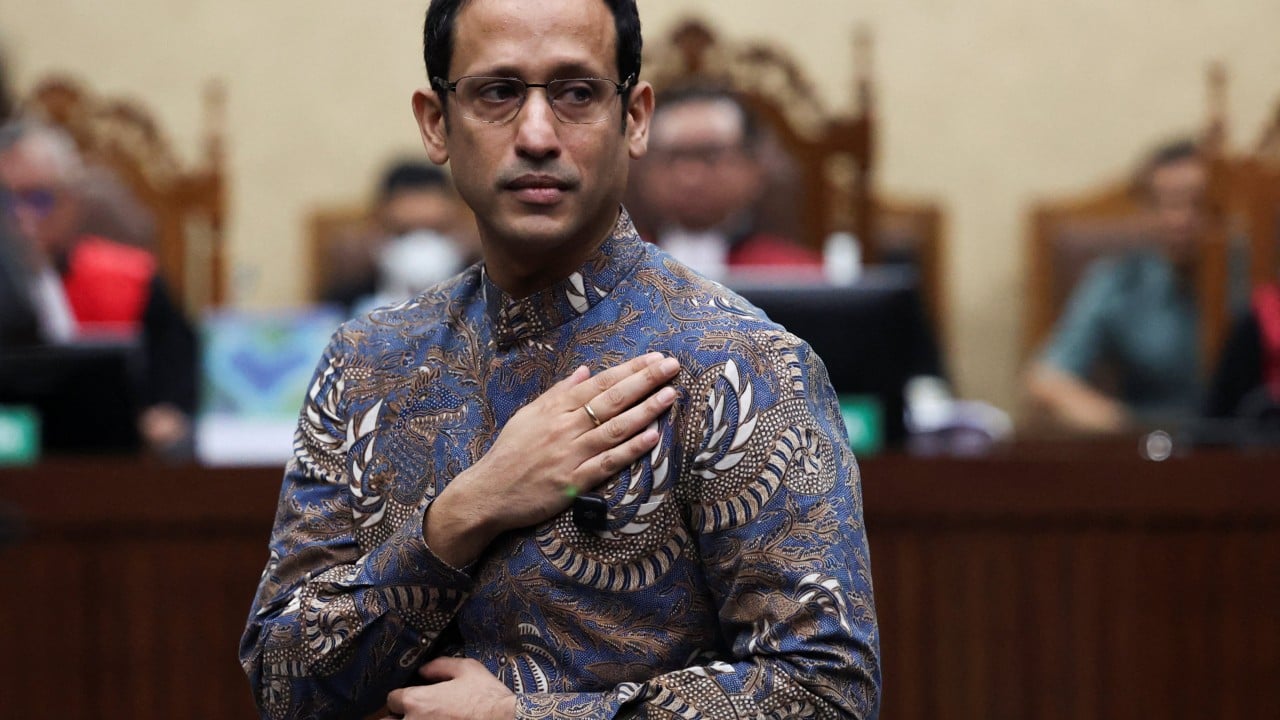
The ten-year prison sentence handed down to Nadiem Makarim, the Harvard-educated co-founder of Gojek and former Indonesian education minister, has shattered the delicate understanding between Southeast Asia’s tech elite and state authorities. In a single ruling on June 30, 2026, the Central Jakarta Anti-Corruption Court effectively criminalized the bridge between private tech innovation and public sector modernization. While local headlines frame the case as a victory against government graft, the underlying mechanics of the trial reveal a far more dangerous reality for foreign capital. The verdict demonstrates that in Indonesia, a standard venture capital investment can now be retroactively reinterpreted by state prosecutors as a corrupt quid pro quo.
At the heart of the prosecution's case was a pandemic-era initiative. Between 2020 and 2022, Makarim’s Ministry of Education procured approximately 1.1 million Google Chromebooks for public schools shifting to online learning. State prosecutors alleged that Makarim chose Google’s ecosystem because the American search giant was simultaneously investing hundreds of millions of dollars into Gojek’s parent company, PT Aplikasi Karya Anak Bangsa. The court found that this created a massive conflict of interest, ordering Makarim to pay a staggering 809 billion rupiah (roughly 45.2 million dollars) in restitution—a number judges explicitly tied to the perceived value of Google’s corporate investment in the ride-hailing giant. Expanding on this topic, you can find more in: The Forty Five Million Euro Bet On How We Heal.
Yet, looking closely at the details of the ruling reveals a glaring legal contradiction that should alarm every foreign investor eyeing Southeast Asia.
The Core Contradiction of the Laptop Graft Verdict
The court explicitly found Makarim not guilty of personal enrichment. It acknowledged that no illicit funds flowed into his private bank accounts, nor did he directly profit from the laptop purchases. Instead, the panel of judges convicted him under a broad, elastic interpretation of "abuse of authority causing state losses." The prosecution claimed the laptop drive cost the state 1.56 trillion rupiah in losses by ignoring cheaper domestic options and bypassing standard local pricing benchmarks. Observers at Harvard Business Review have also weighed in on this matter.
Makarim’s defense presented a fundamentally different mathematical reality. By choosing a free, cloud-based operating system like ChromeOS over complex enterprise software licenses, the ministry saved the state an estimated 3.6 trillion rupiah.
"Nothing in my conviction said that I was self-enriching, and yet they have given me a fine which is far more than I am worth," Makarim stated immediately following the verdict.
The legal logic applied here sets a terrifying precedent for corporate governance. The court essentially ruled that if a multinational corporation invests in a local tech company, and a former executive of that tech company later joins the government and selects that multinational's product—even if it is the global industry standard—the corporate investment itself can be legally designated as criminal restitution. The court made this logical leap without proving that Makarim directly influenced Google's investment strategy or that Google's capital was contingent on a school laptop contract.
The Fragile Wall Between Tech and the Indonesian State
For over a decade, Indonesia’s tech ecosystem thrived on an unspoken agreement. Founders like Makarim were celebrated as national champions. Gojek grew from a modest fleet of twenty motorcycle drivers into a multi-billion-dollar decacorn that fundamentally transformed the informal labor economy of Jakarta. When former President Joko Widodo appointed Makarim to the cabinet in 2019, it was viewed as a progressive step toward digitizing a notoriously bureaucratic state apparatus.
But bringing tech-sector efficiency into the halls of government requires shattering entrenched networks. Makarim openly admitted that his efforts to automate ministry processes and introduce transparent digital procurement systems ruffled feathers. Digitization eliminates the opaque intermediaries who traditionally skim profits from paper-based state contracts.
The political tide shifted dramatically under President Prabowo Subianto. The new administration has adopted a starkly nationalist economic posture, stepping up state interventions across various sectors. In recent months, anti-graft bodies have seized millions of hectares of land from palm oil plantations and resource firms over retroactive regulatory violations. More concerning for the venture capital ecosystem, executives at a state-backed investment firm were recently jailed after a startup they funded went bankrupt, with the state treating a failed business bet as a criminal offense.
The Chilling Effect on Global Capital
Foreign venture capital does not cope well with shifting legal definitions. In the past, institutional investors evaluated Indonesian tech based on user growth, regulatory compliance, and market penetration. Now, they must factor in the existential risk of retrospective political prosecution.
If a prominent founder can be sentenced to a decade in prison for deploying standard global technology solutions, the risk profile changes completely. Corporate investments from giants like Google, Meta, or Temasek—which were once viewed as validation of Indonesia's digital rise—are now potential legal liabilities if those firms ever interact with the public sector.
State Loss Allegation:   Rp 1.56 Trillion (Court Verdict)
Defense Proven Savings:  Rp 3.60 Trillion (Software & Licensing)
Restitution Demanded:    Rp 809 Billion   (Tied to Google's Corporate Investment)
This structural shift forces foreign funds to ask a difficult question. Can any cross-border investment in Indonesian tech remain safe if the founders eventually transition into public service or advisory roles? The answer right now leans toward a definitive no.
A System Enacting Its Own Isolation
The prosecution claimed that Makarim strategically hid his ongoing influence in Gojek by appointing close associates to leadership positions before entering government. The defense proved that Makarim fully divested his formal holdings upon taking office, noting his personal net worth actually fell by more than 50 percent during his ministerial tenure. The court ignored this drop in wealth, choosing instead to focus on the institutional relationship between Gojek and Google.
This focus reveals a profound misunderstanding of how global technology ecosystems scale. Modern tech platforms rely on interconnected cloud architectures, international investment syndicates, and global software standards. By treating these standard corporate relationships as evidence of an illicit web, the Indonesian judiciary is forcing a choice between global integration and local compliance.
Top-tier professionals and tech executives will think twice before entering Indonesian public service. The danger of having an unproven conflict of interest turned into a ten-year prison term is simply too high. This will likely leave public sector modernization in the hands of traditional bureaucrats, stalling the very digital transformation that companies like Gojek proved was possible.
Makarim remains under house arrest as his legal team prepares an appeal. The higher courts may yet review the lack of financial evidence linking him to personal enrichment, but the damage to investor confidence is already done. Capital is highly mobile, and tech money that previously flowed into Jakarta is already looking at regional alternatives with more predictable legal systems. Indonesia’s anti-corruption drive has achieved a chilling milestone, proving that an honest attempt to modernize a state agency using global technology can end with a decade-long prison sentence.