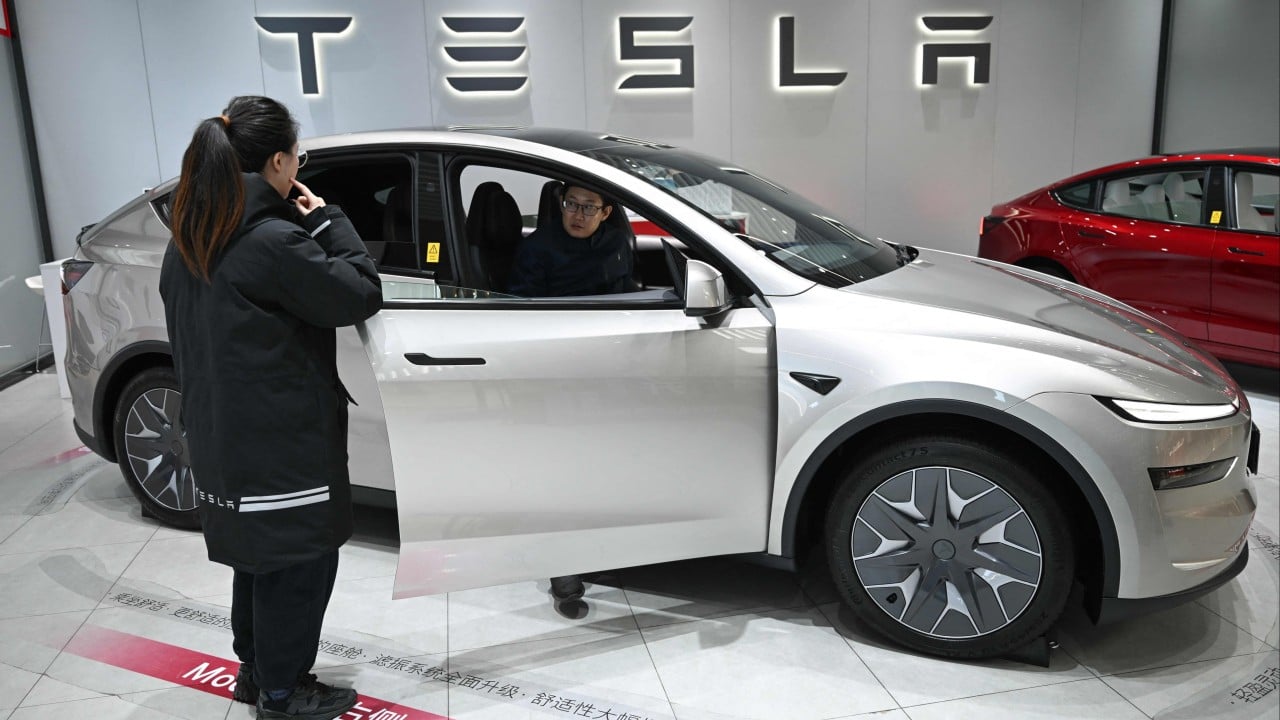
Tesla just reported a massive 39.4% year-over-year surge in deliveries from its Shanghai Gigafactory for May 2026, hitting a record 85,982 vehicles. While retail investors celebrate this headline as a definitive victory over local rivals, the raw data masks a punishing structural crisis. Tesla is increasingly using its Chinese manufacturing hub to supply foreign markets because its domestic retail market share in mainland China is eroding. Local giants like BYD and Geely are choking off Tesla's growth inside the world’s largest electric vehicle market, forcing the American pioneer to rely on aggressive financing gimmicks and export diversions to keep the factory lines running.
The reality on the ground contradicts the simple narrative of unchecked dominance. You might also find this related story useful: Why Wall Street Is Completely Wrong About India and the AI Gold Rush.
The Paper Engine of Growth
A closer examination of the numbers provided by the China Passenger Car Association reveals a glaring disparity between factory output and local consumption. For the first four months of 2026, Tesla exported 154,122 vehicles from Shanghai, a massive 127% surge compared to the same period last year. Conversely, domestic retail sales within China dropped by 15% over that exact same timeframe.
When a factory increases its output while its local market share shrinks, it is not a sign of expanding regional power. It is a strategic retreat. As discussed in recent articles by Investopedia, the implications are widespread.
Tesla’s primary lever for maintaining local volume in May was a desperate credit play. The company rolled out zero-percent interest financing over five years and slashed required down payments by roughly 30%. For a base Model 3 priced at 235,500 yuan, the down payment dropped from 79,900 yuan to 55,900 yuan.
Subsidizing vehicle purchases through zero-interest loans is an expensive way to buy market share. It erodes operating margins and pulls forward demand that would otherwise mature naturally. More importantly, it highlights an uncomfortable truth. Tesla can no longer sell its vehicles in China based purely on product desire; it must compete on financial engineering.
The Brutal Truth About Product Stagnation
The domestic slowdown points directly to a lack of product freshness. The Model 3 and Model Y remain exceptional pieces of engineering, but they are aging platforms in a market that demands constant iteration. While Western legacy automakers operate on five-to-seven-year product cycles, Chinese electric vehicle manufacturers operate on consumer electronics timelines.
Consider what happened in the market while Tesla was tweaking its financing packages. BYD captured more than 20% of China's total new energy vehicle market by inundating buyers with fresh sheet metal, advanced plug-in hybrids, and next-generation battery architectures. In late May, BYD launched its updated Yuan Plus built on an upgraded platform, securing 30,000 orders in its first week alone at a starting price of just 119,800 yuan.
Tesla simply does not have an answer to a modern, feature-packed electric SUV that costs roughly $16,600.
The competitive pressure is not just coming from budget players. Premium domestic brands have effectively ring-fenced Tesla's market position.
- Geely and Changan have systematically chipped away at Tesla's volume by launching dedicated electric sub-brands that offer longer ranges and more luxurious interiors for less money.
- Huawei’s HIMA alliance and Xiaomi EV have turned the vehicle cabin into an extension of the smartphone ecosystem, a feature that resonates deeply with younger urban Chinese buyers.
- Leapmotor and Nio continue to post record delivery months by targeting the exact middle-market sweet spots where Tesla used to operate without opposition.
In April 2026, Tesla’s domestic retail volume plunged so sharply that it failed to crack the top ten list for retail new energy vehicle sales in China, slipping to just 25,956 units for the month. While the May financing incentives triggered a predictable rebound, the structural trend remains downward.
The Humanoid Shift
Tesla’s leadership is fully aware that manufacturing mid-sized sedans and crossovers in Shanghai will yield diminishing returns as domestic protectionism grows globally and local competition intensifies. The long-term plan for the Lingang free-trade zone facility is already shifting away from passenger vehicles.
The company completed its final deliveries of the premium Model S and Model X vehicles in China last month. The original assembly lines for those flagship models are scheduled to be dismantled completely within the next four months. They will not be replaced by a cheaper vehicle or a refreshed crossover.
Instead, the floor space is being converted into dedicated assembly lines for humanoid robots, with an annual planned capacity of 1 million units.
This pivot reveals the actual corporate roadmap. Tesla is gradually transitioning its Chinese operational footprint from a pure-play automotive factory into a high-tech automation laboratory. It is a necessary hedge. If European tariffs or domestic Chinese players eventually choke out Shanghai’s automotive export and retail channels, the factory can pivot to producing industrial intelligence.
The Margin Trap
Relying on exports to bail out soft domestic demand is a perilous strategy in the current geopolitical environment. The European Union and other regional trade blocs are actively erecting tariff walls specifically designed to neutralize the cost advantages of vehicles built in China, regardless of whether the badge on the hood belongs to a domestic firm or an American multinational.
When those export markets tighten, Tesla will be forced to dump more inventory back into mainland China. To move those cars, the company will have to rely even more heavily on low-interest loans, direct price cuts, and aggressive marketing packages.
The record 85,982 deliveries in May look impressive on a spreadsheet, but they represent a defensive triumph, not an offensive breakthrough. Tesla is running faster just to stand still in a Chinese market that has outgrown the need for Western templates.