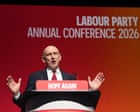
Political headlines move fast, and sometimes they get the job titles completely wrong.
If you saw the viral live-blog headline claiming John Healey delivered his first Labour conference speech as Chancellor, you probably did a double take. You should have. John Healey isn't the Chancellor of the Exchequer, and he never has been. Rachel Reeves holds the keys to Number 11 Downing Street, while Healey serves as the Secretary of State for Defence. For another look, read: this related article.
Yet that exact headline circulated during Labour's autumn conference season, sparking plenty of confusion among casual readers and political junkies alike. Live news desks move at breakneck speed. Sub-editors type fast, wires get crossed, and suddenly the Defence Secretary is accidentally promoted to running the British Treasury in a breaking news banner.
When you look past the editorial typo, the actual speech John Healey gave—and the economic reality tying his Defence brief directly to Rachel Reeves's Treasury—tells a much bigger story about where the UK government is heading. Related reporting on the subject has been shared by Reuters.
The Anatomy of a Live-Blog Blunder
Anyone who has spent time in a newsroom knows how these mix-ups happen. During the annual Labour Party Conference, cabinet ministers take the main stage back-to-back, delivering twenty-minute addresses designed to rally the party faithful and reassure the markets.
Rachel Reeves speaks as Chancellor. John Healey speaks as Defence Secretary. Both are senior figures in Keir Starmer's cabinet, both hail from Yorkshire constituencies, and both spent years in opposition preparing for government. When a live-blog editor is juggling quotes from the Treasury chief in one tab and the Defence chief in another, a hasty copy-paste error is practically inevitable.
The irony is thick. While Healey doesn't hold the title of Chancellor, his department represents one of the biggest line items—and biggest headaches—on the actual Chancellor's balance sheet. You can't talk about UK defence policy without talking about Treasury cash. Every submarine, artillery shell, and troop deployment comes down to what Reeves is willing to sign off on.
What John Healey Actually Said at the Labour Conference
Strip away the mislabeled headline, and Healey's real conference address was laser-focused on national security, the war in Ukraine, and fixing what he described as a hollowed-out military.
Healey has spent decades immersed in defence policy, serving as Shadow Defence Secretary from 2020 until Labour's landslide election victory in July 2024. Unlike some politicians who treat the Ministry of Defence as a stepping stone to higher office, Healey genuinely knows the brief inside and out. His conference speech reflected that long-standing focus rather than Treasury spreadsheets.
He hammered home three central themes during his time at the podium:
- Unwavering support for Ukraine. Healey reiterated that Britain's backing for Kyiv remains ironclad, framing European security as starting on the front lines in Eastern Europe rather than at the White Cliffs of Dover.
- The Strategic Defence Review. He pointed to the government's sweeping review of Britain's armed forces, led by former NATO Secretary General George Robertson, aimed at matching military capabilities to modern threats.
- Fixing military housing and morale. For years, armed forces families have dealt with moldy, crumbling accommodation under private contracts. Healey used the conference stage to promise better conditions for service personnel, arguing you can't defend the country if you don't look after the people wearing the uniform.
Notice what wasn't in his speech? Tax brackets. Gilt yields. Inflation targets. Those belong strictly to Rachel Reeves.
Why Defence and the Treasury Are Locked in a Tug-of-War
Even though Healey isn't the Chancellor, his political fate is tied directly to the person who is. The friction between the Ministry of Defence and HM Treasury is one of the oldest battles in Whitehall, and it's heating up fast.
Labour campaigned on a pledge to set out a clear path toward spending 2.5% of GDP on defence. That sounds straightforward on a campaign leaflet. In practice, finding billions of extra pounds when public services are creaking and the Treasury is hunting for savings is brutal.
Here is the basic math problem facing the government. The UK already spends roughly 2.3% of its GDP on defence, putting it among the top tier of NATO allies. Bridging that remaining gap to 2.5% isn't pocket change—it requires tens of billions of pounds in additional funding over the course of a parliament.
Reeves has made fiscal discipline her calling card, insisting every penny of day-to-day spending must be accounted for without blowing up borrowing rules. Meanwhile, military chiefs and NATO allies are warning that the global security environment is the most dangerous it has been since the Cold War. With Russian aggression in Europe, instability in the Middle East, and rising tensions in the Indo-Pacific, Healey has to argue for more money at the exact moment the Treasury wants to tighten the belt.
The Black Hole Argument
During the conference, Labour ministers repeatedly referenced a £22 billion fiscal black hole inherited from the previous Conservative administration. Whether you buy that exact figure or view it as political framing—and the Institute for Fiscal Studies has noted that while pressures were real, some choices were political—it sets the tone for every spending review.
For Healey, this means squeezing maximum efficiency out of existing MoD procurement budgets before expecting blank checks from Reeves. British defence procurement has a notorious reputation for delays and cost overruns, from the Ajax armored vehicle program to naval shipbuilding schedules. Healey knows he can't walk into Number 11 demanding extra billions unless he proves the MoD has stopped wasting the money it already gets.
How to Spot Misleading Political Headlines Before Sharing Them
That viral "John Healey as Chancellor" headline is a classic case study in why you shouldn't trust breaking news banners blindly. Live blogs are rough drafts of history written in real time, and errors slip through even at major broadsheets.
If you want to keep your bearings during major political events like party conferences, a quick sanity check saves you from falling for editorial glitches:
- Check the Great Offices of State. In the UK, the four top jobs are Prime Minister, Chancellor of the Exchequer, Foreign Secretary, and Home Secretary. They rarely change hands outside of major, headline-dominating cabinet reshuffles. If a headline casually mentions a different person holding one of those four roles, it's almost certainly a typo.
- Look at the URL slug vs. the headline. Often, a live blog's headline updates every fifteen minutes as new speakers take the stage. An editor will change the name at the front of the headline ("John Healey addresses Labour conference...") and forget to delete the tail end left over from the previous speaker ("...in first speech as chancellor").
- Verify through official transcripts. If you care about what a minister actually committed to on policy, skip the live-blog summaries and read the full speech text on the Labour Party's press portal or GOV.UK. Live blogs optimize for clicks and speed; full transcripts show you the exact caveats ministers slip into their sentences.
What Actually Matters for UK Defence and Economic Policy
Forget the accidental promotion in the headline. The real takeaway from Labour's conference season is how tightly interlocked Britain's economic recovery and national security have become.
Healey's job as Defence Secretary is to rebuild Britain's military readiness, overhaul broken procurement systems, and keep NATO's European pillar strong. Reeves's job as Chancellor is to spark enough economic growth to pay for those ambitions without crashing the bond markets. Neither minister can succeed if the other fails.
Next time you see a jarring political headline flying across your feed, take ten seconds to verify who actually holds the brief—then look at the budget numbers behind their promises, because that's where the real story always lives.