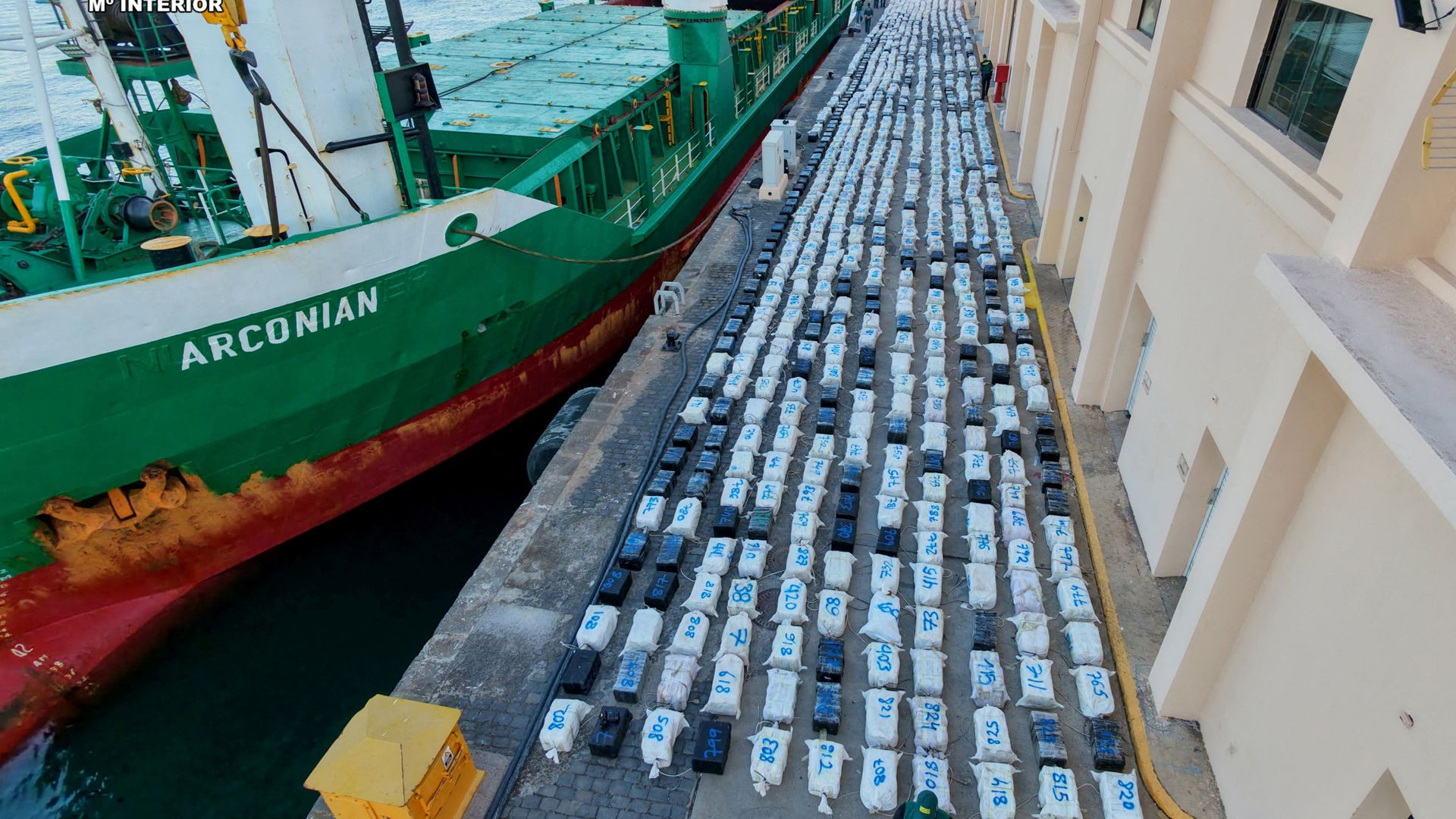
The headlines are always the same. A grainy photo of a rusted container ship. Polished officers standing behind a mountain of shrink-wrapped bricks. A number—usually in the billions—representing the "street value" of the haul. The media treats these events like a championship win for the good guys. They call it a "record-breaking seizure."
They are looking at the scoreboard upside down.
If you are a supply chain professional or a market analyst, a "record seizure" isn't a victory. It is a loud, flashing signal of a massive, unaddressed surge in supply. When customs officials brag about intercepting twenty tons of white powder, they aren't telling you they’ve won the war. They are telling you that the volume of traffic has reached such a staggering scale that even their outdated, underfunded screening processes can’t help but trip over a shipment now and then.
In any other industry, if your loss rate stays at 10% while your total volume triples, your business is exploding. That is exactly what is happening in the global narcotics trade.
The Myth of the Street Value
Every time a "record haul" hits the wires, the first thing you see is the dollar sign. "$2.4 Billion Seized!" It’s a vanity metric. It’s the equivalent of a failing tech company reporting "Total Addressable Market" instead of "Monthly Active Users."
The "street value" is a fictional number calculated by multiplying the weight of the pure product by the price of a gram sold on a street corner in London or New York. It ignores the reality of wholesale pricing, bulk discounts, and the fact that most of that product was destined to be cut with levamisole or caffeine before it ever touched a consumer’s nose.
The cartels don’t lose $2 billion when a ship gets raided in Antwerp. They lose the cost of production and transport. In the jungles of the Andes, a kilo of cocaine costs roughly $1,500 to produce. By the time it hits the docks in Europe, the "cost of goods sold" (COGS) is still remarkably low compared to the retail markup. For a cartel, a massive seizure is simply a "tax" on doing business. It’s an insurance premium paid in product.
When you see a record bust, don't think about the money lost. Think about the surplus that allowed the cartel to risk that much volume on a single hull. You don't put 20 tons on one ship unless you have 200 tons already moving through the pipeline.
The Survivorship Bias of Law Enforcement
The public is fed a narrative of "sophisticated intelligence-led operations." In reality, most record-breaking busts are the result of three things: luck, a tip-off from a rival cartel, or a "sacrifice" shipment.
I’ve spent years watching how global logistics hubs handle volume. Whether it’s iPhones or illicit substances, the math remains the same. Major ports like Rotterdam or Hamburg can only physically inspect about 1% to 2% of the containers passing through. The cartels know the math better than the bureaucrats do.
If you are a logistics manager for a multi-national syndicate, you don't worry about the 2% inspection rate. You overwhelm it. You send ten containers, knowing two might get flagged. You bake that 20% loss into your quarterly projections.
The "record seizure" is a classic case of survivorship bias. We only talk about the ships that got caught. We never see the data on the 98% that sailed through, nor do we acknowledge that the purity of cocaine on European streets has actually increased over the last decade. If the seizures were working, the price would go up and the purity would go down. Instead, we see the opposite: a cheaper, stronger product.
That is the definition of a failed intervention.
Why We Should Stop Celebrating Seizures
The celebration of these busts creates a dangerous illusion of safety. It suggests that the problem is being "managed." It isn't.
1. The Displacement Effect
When a major route is closed or a specific crew is detained, it doesn't reduce supply. It merely shifts the "innovation" to a different region. We saw this when the crackdowns in the Caribbean pushed the trade into Mexico, turning a transit zone into a war zone. We are seeing it now as West Africa becomes the new primary transit hub for European markets. By "winning" at the docks in one port, law enforcement is simply exporting violence to a more vulnerable geography.
2. The Professionalization of Smuggling
Every time a ship’s crew is detained, the cartels learn. They stop using "mules" and start using semi-autonomous submersibles. They stop hiding bricks in fruit crates and start chemically bonding cocaine into plastic pellets or liquid solutions that are invisible to X-rays. High-profile seizures act as a Darwinian filter, killing off the amateur smugglers and ensuring that only the most sophisticated, well-capitalized, and dangerous organizations survive.
3. The "Whack-a-Mole" Resource Drain
The cost of these operations is astronomical. Millions are spent on surveillance, tactical teams, and legal proceedings. And for what? To temporarily remove a fraction of the annual global output? If a private corporation spent $50 million to recover $5 million in stolen inventory, the board would fire the CEO. In the world of drug interdiction, they give the CEO a medal and ask for a bigger budget next year.
The Uncomfortable Truth About Demand
The competitor article focuses on the "crew detained" and the "ship seized." It treats the shipment like an invading army. This is the "Supply-Side Fallacy."
As long as the demand in London, Paris, and Berlin remains insatiable, the supply will find a way. You could seize a ship every single day for a year and it wouldn't change the number of people looking for a fix on a Friday night.
We are obsessed with the "Ship" because it's a tangible enemy. It has a name, a flag, and a crew you can put in handcuffs. It makes for a great photo op. But the ship is just a symptom. The "Record Haul" is actually a report card on our inability to address the root causes of the trade.
The Logistics of a Failed War
Imagine a scenario where a global shipping giant like Maersk or MSC lost 5% of their cargo to "seizures" every year. They would optimize. They would find new ports. They would bribe the right officials. They would diversify their routes.
The cartels are more agile than Maersk. They don't have a board of directors. They don't have to worry about ESG scores. They operate on pure, cold-blooded market efficiency.
When you see "20 tons seized," you are looking at a market that is so over-saturated that 20 tons is a rounding error. It is the excess of a production machine that is running at 110% capacity. It is the waste product of a booming industry.
The next time you see a "record-breaking" headline, don't applaud. Ask yourself why the product is still cheaper than it was five years ago. Ask yourself why the purity is higher. Ask yourself why, despite decades of "victories," the mountain of white powder just keeps getting taller.
Stop looking at the mountain of bricks. Look at the ocean of containers behind it. We aren't catching more because we’re getting better at the job. We’re catching more because there has never been more to catch.
The "record haul" isn't a sign of the end. It's proof that we haven't even started to understand the scale of the defeat.