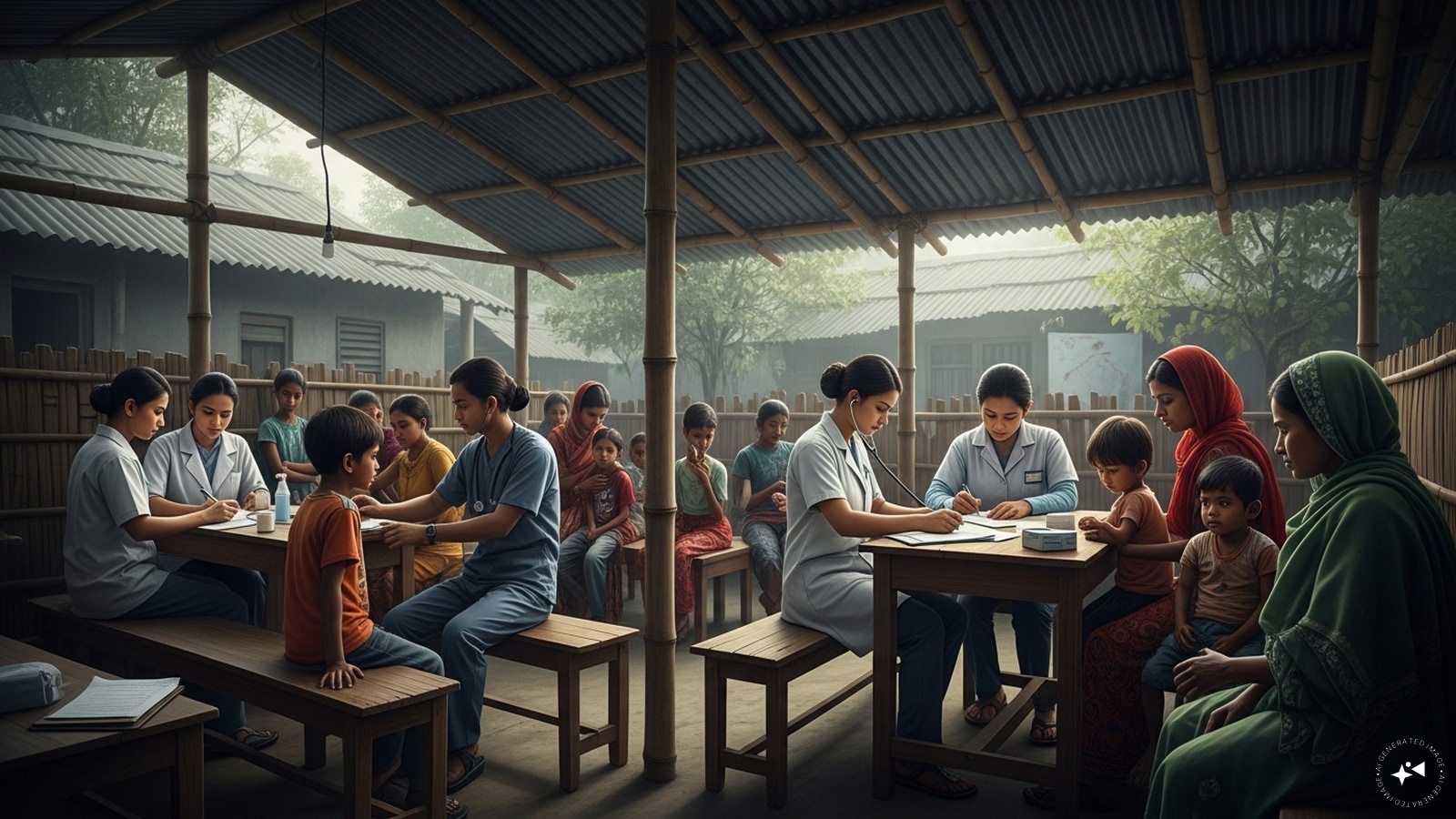
In the cramped corridors of a community clinic in Chittagong, the air carries a specific weight. It is the scent of antiseptic fighting a losing battle against the humid, salt-heavy breeze. A young mother named Rahima—let’s call her that for the sake of the story—sits on a wooden bench, her knuckles white as she grips the edges of her sari. In her lap, her three-year-old son is a furnace. His skin, usually the color of polished mahogany, is now obscured by a blooming, angry topography of red spots.
This isn’t just a rash. It is a signature.
The measles virus is an ancient, relentless traveler. It doesn't care about borders or the vibrant bustle of Bangladesh’s growing economy. It looks for the gaps. It looks for the child who missed a second dose because a monsoon flooded the local road, or the family that moved from a rural village to a Dhaka slum and slipped through the cracks of the digital health registry. When we talk about a "measles outbreak," we aren't just discussing a data point on a WHO spreadsheet. We are talking about the sound of a child’s dry, hacking cough echoing in a tin-roofed house at 3:00 AM.
The Anatomy of an Invasion
To understand why this matters, we have to look at how the virus operates. It is perhaps the most contagious pathogen known to science. If one person has it, nine out of ten people around them who are not immune will catch it. It lingers in the air like a ghost, long after the infected person has left the room.
The assault begins quietly. For the first ten to twelve days, nothing happens. The virus is busy. It infiltrates the respiratory tract, hitching a ride on white blood cells to reach the lymph nodes, and from there, it colonizes the rest of the body.
Then comes the "prodromal" phase. This is the great deceiver. It looks like a common cold. A high fever. Runny nose. Red, watery eyes. Tiny white spots, known as Koplik spots, might appear inside the mouth like grains of salt on a red carpet, but most parents won't see them. They are looking at the fever. They are worried about the cough.
Then, the eruption.
The maculopapular rash starts at the hairline. It creeps down the neck, over the trunk, and finally to the hands and feet. It is itchy, hot, and relentless. But the rash is just the visible tip of the iceberg. The real danger of measles isn't the spots; it’s what the virus does to the body’s defenses. It causes a temporary "immune amnesia." It wipes out the body’s memory of how to fight other diseases, leaving a child vulnerable to pneumonia, permanent blindness, or brain swelling long after the red spots have faded.
The Fragile Shield of the Delta
Bangladesh has been a global poster child for vaccination success. For decades, the country’s Expanded Programme on Immunization (EPI) has been a marvel of logistics, reaching deep into the marshlands and the hill tracts. But the delta is a shifting landscape.
Population density is the virus’s best friend. In the narrow alleys of Narayanganj or the sprawling refugee camps of Cox’s Bazar, social distancing is a luxury no one can afford. When immunization coverage dips even slightly—say, from 95% to 88%—the "herd immunity" shield begins to crack.
Consider the logistical nightmare of maintaining a "cold chain." Vaccines are delicate. They are biological masterpieces that require constant refrigeration. In a country where the power grid can be temperamental and the summer sun is a hammer, keeping a vial of the MR (Measles-Rubella) vaccine at exactly the right temperature from the central warehouse to a remote river island is an act of quiet heroism.
When an outbreak occurs, it is often a symptom of a larger fatigue. Perhaps it's a gap in education. Some parents believe that because they haven't seen measles in years, the disease is gone. They think the vaccine is a "nice to have" rather than a "must have." They are wrong. Measles hasn't gone anywhere; it’s just been waiting for an invitation.
The Search for a Cure That Doesn’t Exist
Here is the frightening truth that many people find hard to digest: there is no specific antiviral treatment for measles.
Once the virus takes hold, doctors can only manage the symptoms. They provide Vitamin A supplements—a critical intervention in Bangladesh that helps prevent the devastating blindness and lung damage associated with the disease. They treat the secondary infections with antibiotics. They hydrate. They wait.
The "cure" for measles is a ghost story. The only true remedy is the one that happens weeks, months, or years before the first sneeze. It’s the two-dose schedule. The first at nine months, the second at fifteen months. Anything less is a half-built bridge.
The Invisible Stakes of a Fever
Why should a businessman in a Dhaka high-rise or a student in London care about a fever in a Chittagong clinic? Because the stakes are interconnected.
An outbreak drains the healthcare system. It pulls nurses away from maternity wards and doctors away from emergency rooms. It creates a ripple effect of malnutrition, as a sick child cannot eat and a worried parent cannot work. But more than the economics, there is the moral weight. Measles is a "never event." In a world with a safe, effective, and cheap vaccine, no child should ever have to suffer through the suffocating grip of croup or the darkness of measles-induced encephalitis.
We often talk about "prevention" as a dry, clinical concept. Let’s reframe it. Prevention is the act of ensuring that Rahima doesn't have to spend her night listening to the rhythm of a failing breath. It is the decision to trust the science of the needle over the rumors of the marketplace.
The current rise in cases across certain districts in Bangladesh is a wake-up call. It’s a reminder that our victory over infectious disease is a lease, not an ownership. We have to pay the rent every single day through surveillance, through funding, and through the simple, radical act of showing up for the second dose.
The Path Forward Through the Dust
Back in the clinic, the doctor hands Rahima a packet of oral rehydration salts and a dose of Vitamin A. He speaks to her in a low, urgent tone. He isn't just treating her son; he is recruiting her. He tells her to tell her neighbors. He tells her that the "red shadow" can be stopped, but only if the whole village moves together.
The solution isn't found in a laboratory breakthrough or a high-tech miracle. It’s found in the dusty ledgers of health workers who walk miles under a black umbrella to find one missing child. It’s found in the clarity of a mother who realizes that a small prick in the arm is a shield for a lifetime.
The spots will eventually fade from the boy’s skin. If he is lucky, his sight will remain clear, and his lungs will recover their strength. But the memory of that heat, that terrifying heat, will stay with Rahima. She will be the one standing in line first when the next vaccination van rolls into town.
The virus is persistent. We must be more so. The delta is wide, the population is vast, and the challenges are many, but the math is simple. One child. Two doses. A future without the red shadow.
In the end, the story of the measles outbreak in Bangladesh isn't a story of tragedy. It is a story of a race. It is a contest between the speed of a virus and the reach of human care. We know how to win this. We have the tools. The only question that remains is whether we have the collective will to ensure that the next bench in the clinic stays empty.