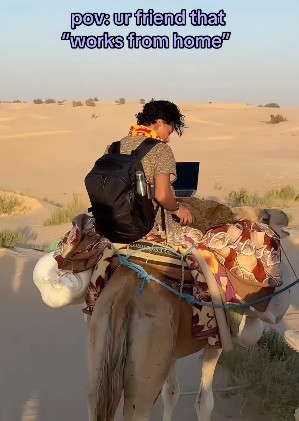
You think your hybrid work schedule is flexible because you answered an email from a coffee shop last Tuesday. Sit down. A viral video is making the rounds on social media, and it completely resets the baseline for what working from anywhere actually looks like.
New York City-based creator Saad Akhtar uploaded a short clip on Instagram that has logged millions of views and a massive wave of global laughter. The premise is painfully simple. A man sits high up on a camel, balance-typing on an open laptop while the animal plods through the endless sand dunes of the Sahara Desert.
Akhtar captioned the post with a sharp jab at modern corporate life, writing that "some people love increasing shareholder value." Overlay text on the video pushes the joke further by capturing the ultimate white-collar lie: "POV: He told his boss he's working from home."
It is funny because it hits directly at the anxiety of 2026 remote work culture. We were promised freedom, but we mostly just got a longer digital leash.
The Reality of Working From Camel
The internet immediately started obsessing over the technical and physical logistics of this makeshift desert workspace. The viral comment section quickly birthed a new corporate acronym: WFC, or Work From Camel.
Commenters split into two camps. The first camp focused on the pure corporate absurdity. Jokes about "even camels have KPIs" and workers being unable to escape a Zoom invite even in North Africa flooded the feed. The second camp looked at the mechanical nightmare of trying to hit spreadsheet deadlines while straddling a large mammal.
Let's talk about the actual ergonomics of a camel office. Camels don't walk smoothly. They move both legs on one side simultaneously, creating a heavy, rolling sway that travel writers frequently compare to a direct pelvic massage or a boat on choppy water. Balancing a five-pound MacBook Pro on a camel's hump while trying to type something coherent is a recipe for carpal tunnel and a dropped device.
Then there's the environmental factor. The Sahara isn't just hot; it's incredibly dusty. Fine silica sand gets into everything. Standard laptop fans will suck that dust right into the heat sink, choking the processor within an hour.
The Starlink Question and Battery Anxiety
The biggest technical mystery debated by viewers involves the internet connection. How do you stream a live virtual meeting from the deep dunes of North Africa?
A few years ago, you'd be entirely out of luck, stuck hunting for weak cellular roaming signals near tiny Moroccan border towns like Merzouga. Today, the obvious answer on everyone's mind is portable satellite internet. As one commenter put it, "Does he have a Starlink in his pocket or what?" High-speed satellite dishes have shrunk down to backpack size, making live video calls technically possible from almost any blank spot on the map.
But even if you solve the internet problem, you run face-first into power limitations. Sunlight is brutal on screens. To read a monitor outdoors under the desert sun, you have to crank the screen brightness to 100%. That drains a standard laptop battery in about ninety minutes flat. Unless this digital nomad has a massive lithium power bank stuffed into a saddlebag, his corporate productivity had a very strict expiration date.
Why We Can't Stop Laughing at Remote Work Satire
This video blew up because it exposes the core contradiction of modern workplace flexibility. Employers offer the freedom to work remotely, but the psychological pressure to remain visible, responsive, and productive never actually stops.
The image of a guy checking his notifications while riding a beast of burden through a landscape that used to symbolize absolute isolation tells you everything you need to know about corporate culture today. True disconnection is dead. You can travel to the ends of the earth, but the Slack pings will still find you.
If you want to take your work on the road without turning into a viral meme or ruining your expensive hardware, skip the camel ride. Invest in a proper anti-glare screen protector, buy a heavy-duty rugged case that seals out dust, and carry a portable power bank capable of handling a 65-watt laptop charge. Most importantly, learn to actually close the laptop lid when you reach the destination. The sand dunes aren't going to look at your slides.