Conventional conservation treats cattle ranching and high avian diversity as mutually exclusive land uses, yet a single tropical property sustaining 440 bird species proves that production grazing and habitat complexity can operate inside the same boundary. To understand how a working ranch reaches that threshold without abandoning economic viability, land managers must examine four interacting systems: habitat stratification, forage and trophic mechanics, land-tenure economics, and ecological measurement limits. Rather than attributing avian abundance to pastoral goodwill alone, a rigorous operational analysis shows that bird richness rises when physical structure multiplies niches, grazing pressure stays calibrated to regrowth rates, and non-timber revenue streams offset lost commodity yield.
The Structural Architecture of Avian Niches
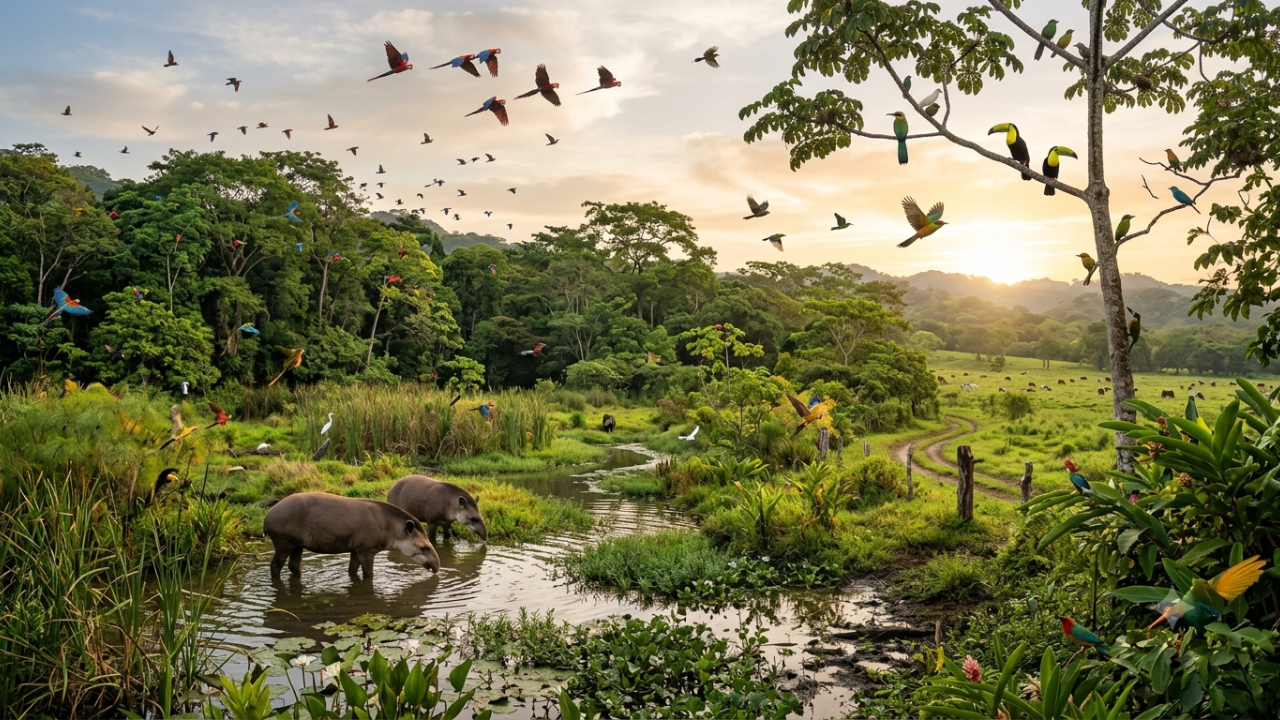
Avian species richness on a tropical cattle property is governed less by the presence of cows than by vertical and horizontal structural diversity. Birds partition space by foraging height, canopy density, edge contrast, and moisture gradients. A uniform monoculture pasture—even one fenced off from hunting—offers a narrow slice of those niches, primarily ground foragers, aerial insectivores hunting over open air, and edge species perched along perimeter trees. Expanding the count toward 440 species requires overlapping vegetation layers: emergent canopy trees, mid-story broadleaf cover, dense understory shrubs, riparian galleries, and managed grass swards.
This architecture functions through three interacting structural levers:
- Vertical canopy layering: Tall residual trees provide song posts, raptors' perches, and cavity or branch nesting sites above the grazing zone, while mid-story and shrub layers shelter insectivores and frugivores that avoid exposed grass.
- Riparian and wetland corridors: Unfenced or buffered streams and seasonal depressions create microclimates with higher humidity, distinct fruiting and flowering phenologies, and aquatic or semi-aquatic prey unavailable on dry slopes.
- Edge-to-interior ratios: Patches of secondary forest interspersed with open pasture generate transition zones where forest-interior birds meet open-country species, increasing turnover across short distances.
In Costa Rica, where biogeographic overlap between Mesoamerican and South American avifauna already creates a high regional species pool, structural complexity acts as a filter that captures migratory transients alongside resident breeders. Yet structure alone does not guarantee persistence. Fragmented woodlots that are too narrow or isolated can function as ecological sinks if nest predation or brood parasitism exceeds recruitment, or if genetic and dispersal barriers prevent recolonization after disturbances.
Trophic and Grazing Mechanics Behind Species Counts
A common analytical error in coverage of high-biodiversity ranches is treating the number 440 as a static scorecard rather than a dynamic equilibrium driven by energy and disturbance flows. Cattle act as large herbivores that alter plant composition, soil compaction, and invertebrate availability. When stocked too heavily or continuously on the same ground, cattle simplify sward height, compact topsoil, trample ground nests, and strip understory regeneration, depressing insect biomass and ground-cover specialists. Conversely, complete cessation of grazing in tropical environments can trigger rapid woody encroachment that eliminates open-grassland and edge species while starving the ranch of cash flow.
Mechanistically, moderate or rotational grazing influences bird communities through two pathways:
- Invertebrate subsidy and disturbance: Hoof action and manure deposition alter soil moisture and organic matter, supporting dung beetles, dipterans, and orthopterans that attract insectivorous birds during foraging bouts.
- Vegetation height heterogeneity: Varying rest periods across paddocks produces a mosaic of shorter grazed grass and taller ungrazed clumps, creating distinct cover and seed or insect profiles within a single management unit.
Whether these mechanisms net out positively or negatively depends on site-specific variables that remain educated hypotheses without property-level survey data: baseline soil fertility, annual rainfall distribution, slope steepness, and the proportion of intact forest versus active pasture. High bird counts also reflect detection and spatial scale effects. A large property spanning multiple elevations or life zones naturally accumulates more species than a small single-habitat parcel, and intensive birding over years—especially along ecotones and migration flyways—inflates cumulative lists relative to single-season breeding censuses.
Land-Tenure Economics and the Cost Function of Biodiversity
Turning a cattle ranch into a wildlife sanctuary is an economic optimization problem, not merely a biological triumph. Traditional beef production in tropical regions often operates on tight margins per hectare, sensitive to input prices, transport costs, and seasonal drought. Dedicating land to forest corridors, silvopastoral trees, or low-intensity grazing alters the ranch's cost function in concrete ways: foregone grazing area reduces maximum herd size, tree planting and fencing require upfront capital expenditure, and labor requirements shift from routine herd maintenance toward trail upkeep, guest operations, or ecological monitoring.
A practical way to model this trade-off is to separate operating costs into direct production outlays and opportunity costs of unharvested commodity output. Leaving mature trees standing or retiring steep riparian strips lowers immediate beef volume per total hectare, yet it can reduce long-term exposure to heat stress in cattle and erosion on vulnerable slopes. When landholders pair conservation with diversified revenue—such as nature tourism, guided birding, research lodging, or payments for ecosystem services where available—non-beef cash flows can compensate for lower cattle stocking rates.
This economic balance carries sharp constraints:
- Capital and time lags: Reforestation and secondary succession take years to yield mature habitat structure or ecotourism appeal, creating cash-flow gaps that smallholders without outside capital may not survive.
- Market volatility: Nature-based tourism depends on travel demand, seasonality, accessibility, and reputation, meaning a ranch that abandons cattle entirely in favor of visitors trades commodity risk for hospitality risk.
- Externalities and boundary leakage: Wildlife moves across property lines; poaching, agricultural chemical drift, or neighboring deforestation can degrade a ranch's biodiversity asset regardless of internal management discipline.
The second limitation in scaling this model is measurement bias. Reporting 440 species signals extraordinary taxonomic breadth, yet species richness treats a rare vagrant spotted once the same as a breeding resident sustaining a viable population. A ranch can host an impressive checklist while still losing forest-dependent specialists if surrounding landscapes fragment.
Operating Playbook for Mixed-Use Tropical Properties
Operators aiming to replicate high avian diversity without sacrificing land solvency should treat habitat and enterprise design as a single system rather than competing priorities. Begin with a baseline spatial audit mapping existing forest cover, watercourses, slopes, soil types, and current paddock boundaries. Identify high-risk erosion zones and riparian strips first, as retiring those areas protects soil and water while creating high-value movement corridors for wildlife.
Next, calibrate grazing and vegetation management to protect regeneration without locking the land into a single state. Retain and recruit native shade and fruit trees within pastures where agronomic conditions allow, protect shrubby fencerows and understory buffers along forest edges, and adjust stocking density and rotation intervals so ground cover and woody recruits are not continuously stripped. Pair physical management with standardized monitoring—separating resident breeders, seasonal migrants, and occasional vagrants—so decisions track ecological stability rather than raw checklist novelty.
Finally, align revenue streams with the property's actual carrying capacity and risk tolerance. Test whether eco-lodging, guided birding, or conservation partnerships can generate reliable net margins before scaling down herd size, and maintain operational flexibility so market shifts in either beef or tourism do not force distress liquidation of the land. High bird diversity on a cattle ranch succeeds when ecological structure, calibrated herbivory, and diversified cash flows reinforce one another—and fails when any one of those three legs is pushed past its physical or financial limit.