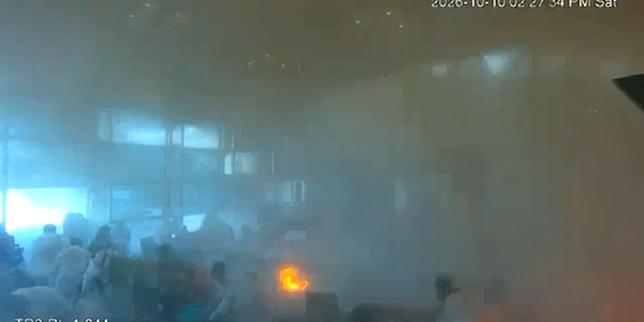
Every time a pixelated smartphone video of a streak in the night sky over Riyadh goes viral, the standard playbook kicks in. Security analysts who haven't set foot in the Gulf since the last defense expo rush to television studios to lament the vulnerability of modern capitals. Social media feeds flood with panicked commentary about failing missile shields and porous borders. The lazy consensus is as predictable as it is wrong: the narrative that a successful interception capture means a defensive system is failing.
Let us look past the cinematic explosion on your timeline and examine the brutal mathematical reality of modern air defense economics.
The Interceptor Trap And The Cost Asymmetry Fallacy
The core argument driving the panic is the financial imbalance. Critics love to point out that a crude, locally assembled loitering munition or a modified ballistic missile costs a fraction of the Patriot or Terminal High Altitude Area Defense interceptor launched to stop it. This is treated as an existential threat to Saudi Arabia’s fiscal health, as if the Kingdom is going to bankrupt itself buying interceptors faster than regional actors can weld together fiberglass drone bodies.
This line of reasoning fundamentally misunderstands how strategic endurance works.
I have watched defense contractors and sovereign procurement officers obsess over cost-per-kill metrics for decades, and they are almost always missing the bigger picture. Imagine a scenario where a $20,000 drone forces the expenditure of a $3 million missile. On a spreadsheet, that looks like a terrible trade. But ask yourself what happens if that drone gets through and detonates inside a primary crude stabilization unit at Abqaiq or a major desalination plant outside Riyadh. The economic damage is not measured in the replacement cost of the hardware; it is measured in billions of dollars of lost daily crude export capacity, cascading energy shocks across global markets, and immediate panic in shipping lanes.
The interceptor is not expensive because the missile factory is greedy. It is expensive because it is cheap insurance against catastrophic supply chain collapse. Nations do not measure national security optimization through the lens of a venture capitalist looking for immediate margin expansion. They measure it through continuity of state function.
The Metrics That Actually Matter In Kinetic Warfare
When a Houthi launch site in Yemen fires a volley toward the Saudi capital, the public focuses on the debris falling on a highway. That makes for good television. It completely ignores the operational failure rate of the incoming hardware.
Standard reporting routinely omits the unsexy data points: guidance system drift, mid-flight structural failures, and pre-launch attrition. Independent assessments from defense intelligence consortia indicate that a significant percentage of asymmetric long-range strikes launched toward the Saudi interior fail long before they ever enter the radar footprint of a Patriot battery. They break down in transit, veer off course due to rudimentary navigation suites, or fall short in the desert.
When the remainder do make it into defended airspace, the multi-layered architecture—combining early warning radar, airborne command and control, and surface-to-air interceptors—operates with a success rate that makes military planners in Washington and London quietly envious. The system works. The fact that you see videos of it working means the optical sensors and tracking cameras are doing their jobs, illuminating the sky as incoming threats are neutralized miles away from critical infrastructure.
If a missile is intercepted fifty miles outside the city limits, the shockwave and falling debris will still rattle windows and generate cell phone footage. Amateurs interpret that rattle as a breach of defense. Professionals measure the distance between the interception point and the asset being protected. By that metric, the defense architecture is performing with ruthless efficiency.
The Psychological Weaponization Of Mobile Phone Footage
We are living through an era where modern conflict is mediated entirely through the lens of the TikTok algorithm and X feeds. This creates a severe perceptual distortion.
A single successful interception filmed from three different angles by bored commuters creates the illusion of an ongoing blitz. It floods the information space with visual noise that overrides statistical reality. Security agencies in Riyadh are not just fighting a kinetic war against ballistic trajectories and drone swarms; they are fighting an asymmetric information war where the enemy's primary strategic weapon is your camera phone.
Every time a sensationalized clip is reshared without context, the attacker achieves their secondary objective without needing to hit a single target. They create the impression of perpetual siege. They shake investor confidence without landing a single pound of high explosive where it matters.
Disrupting this dynamic requires a fundamental shift in how the public consumes defense news. Stop treating the visibility of a defense action as evidence of a crisis. In modern air defense, invisibility is rare; interception is loud, bright, and impossible to hide.
The Unspoken Trade-off Of Absolute Shielding
There is no such thing as a hermetically sealed airspace. Anyone telling you that a nation can achieve a one hundred percent interception rate across hundreds of thousands of square miles of desert and urban sprawl is selling something—usually a speculative defense tech stock or a consulting contract.
Saudi Arabia's defense establishment has quietly accepted a hard truth: defense in depth means accepting occasional collateral risk on the periphery to guarantee absolute security at the core. Resources are finite, even for a G20 economy. Deploying dense point-defense batteries around every single mile of border is a logistical impossibility. Instead, military planners concentrate capabilities around high-value nodes: population centers, energy hubs, command nodes, and economic arteries.
This leaves secondary corridors exposed to occasional debris drops or rare impacts from unguided ordinance. It is an uncomfortable reality that military leadership rarely advertises, because admitting that a border is porous anywhere invites political attack. But it is the only viable posture in a world where asymmetric actors have cheap, long-range reach.
The alternative—leaving the core undefended to build an impossible wall along every frontier—is suicide.
What The Pundits Get Wrong About Escalation Dominance
Another favorite talking point of the armchair strategist is that defensive success somehow provokes further escalation, trapping the Kingdom in an endless cycle of expenditure. This assumes that restraint or appeasement would yield a different outcome.
History shows the exact opposite. When asymmetric actors realize that long-range harassment campaigns carry zero military cost and generate maximum propaganda value, they scale up, not down. The only way to alter the calculus of hostile state and non-state actors is to impose continuous tactical frustration. When ninety-plus percent of your munitions are swatted out of the sky before they scratch a target, the cost-benefit ratio for the attacker deteriorates rapidly. The morale penalty shifts back to the launch sites.
The Kingdom has quietly shifted from pure reaction to integrated deterrence. This means pairing kinetic interception with electronic warfare, active counter-battery suppression, and regional diplomatic pressure that squeezes supply chains at the source. The viral videos of interceptors over Riyadh are not a symbol of vulnerability. They are the visible friction of a state systematically breaking the utility of cheap terror tactics.
The next time a shaky video lights up your feed, remember what you are actually looking at: the sound of a very expensive, highly coordinated machine doing exactly what it was built to do. Stop looking at the sparks in the sky and start looking at the intact power grids, the flowing pipelines, and the functioning markets beneath them. That is where the war is actually won.