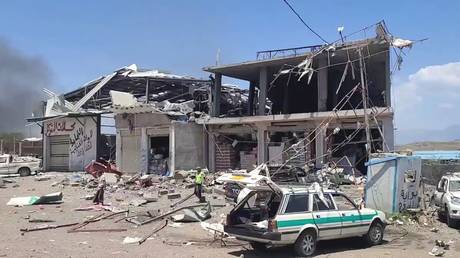
Saudi Arabia is once more entangled in the bruising machinery of the Yemeni theater, abandoning the polite fiction of a permanent disengagement. Years of quiet backchannel diplomacy, direct talks with the Houthi movement, and expensive PR campaigns designed to frame Riyadh as a regional peacemaker have hit a hard wall of operational reality. The kingdom finds itself sliding back into active confrontation, driven not by ideological zealotry, but by the cold mathematics of border security, maritime commerce, and fractured local proxies.
To understand why Riyadh is slipping back toward hostilities, one must look past the official communiques and examine the physical geography of the southern Arabian Peninsula. For the Saudi leadership, Yemen is not a distant geopolitical abstraction. It is a porous, heavily armed southern underbelly where hostile forces command the heights overlooking vital shipping corridors and petroleum infrastructure. When Houthi forces reassert pressure along strategic internal demarcation lines or test naval choke points in the Red Sea, Riyadh cannot simply shrug and look away. The kingdom's massive economic modernization projects, spearheaded by Vision 2030, depend entirely on sustained regional stability and uninterrupted maritime trade through the Bab el-Mandeb strait. Every rocket or drone launched toward Saudi airspace or commercial shipping lanes functions as a direct tax on foreign investment in Riyadh and NEOM.
The diplomatic architecture painstakingly constructed over the past several years was built on a fragile transactional premise. Riyadh offered economic incentives, salary payments for civil servants in Houthi-held zones, and formal recognition of Sanaa's negotiating weight in exchange for a durable quiet on the border. Yet, peace agreements negotiated without the participation of all domestic factions rarely hold under stress. The internationally recognized Presidential Leadership Council, propped up by Saudi financial life support, fears being permanently sidelined by a bilateral deal between Riyadh and the Houthis. At the same time, southern separatist militias backed by the United Arab Emirates have spent the intervening years consolidating territorial control from Aden to Hadramawt, creating a patchwork of heavily armed fiefdoms with competing patron states.
This multi-layered fragmentation creates an environment where localized skirmishes can rapidly escalate into full-scale tactical crises. When the Houthis sense weakness or internal disarray among their anti-Houthi rivals, they probe the front lines in Marib and Taiz. When Saudi air defenses intercept incoming projectiles originating from northern Yemen, the calculus of containment collapses. Riyadh is discovering what every major regional power eventually learns in this theater. Extrication from a deep-rooted civil conflict is nearly impossible when local allies refuse to lay down arms and adversaries maintain an asymmetric military advantage financed by external patrons.
Military strategists in Riyadh understand the limits of air power alone. The years of intensive bombing campaigns earlier in the conflict demonstrated that aerial dominance cannot permanently suppress an entrenched insurgent force deeply embedded in rugged terrain. Instead, the kingdom's renewed posture relies on a hybrid blend of targeted intelligence operations, localized proxy support, and defensive readiness, punctuated by the implicit threat of renewed kinetic strikes if red lines are crossed. Yet, this minimalist footprint is perpetually vulnerable to escalation drift.
The economic cost of sustained instability is another silent driver pulling the kingdom back into the fray. Yemen's humanitarian catastrophe has never been geographically contained. It generates perpetual refugee flows, black-market arms proliferation, and maritime security hazards that directly impact global supply chains. When international shipping lines are forced to divert around the Cape of Good Hope due to Red Sea missile threats, the shockwaves ripple straight through global energy markets and insurance premiums. Saudi Arabia, as the world's premier petroleum exporter, bears the reputational and economic brunt of these disruptions, even when the projectiles originate from forces outside its direct control.
Compounding these external pressures is the shifting stance of Western partners. Washington and European capitals remain outwardly supportive of a political settlement, but their appetite for active military partnership in offensive operations in Yemen is virtually nonexistent. Riyadh must navigate this landscape largely on its own terms, balancing the immediate imperatives of national defense with the long-term dangers of permanent entanglement. The kingdom's leadership knows that an open-ended military campaign drains fiscal resources and complicates diplomatic outreach across the wider Middle East, where Riyadh has recently sought to project an image of constructive regional mediation.
The return to active conflict is therefore a reluctant admission of failure. It signals that the grand bargain designed to secure Saudi Arabia's southern border through diplomacy has fractured under the weight of competing ambitions on the ground. As frontline skirmishes intensify and backchannel talks stall, the hard truth of the peninsula reasserts itself. Borders cannot be insulated from chaos simply by drawing a line on a map and wishing the violence away.