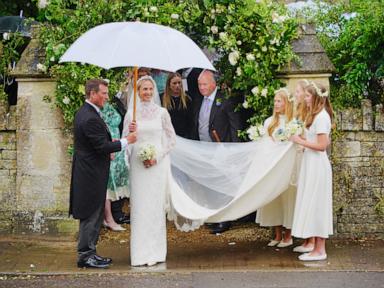
The media is currently swooning over the latest royal gathering, painting a picture of a traditional, unified family celebrating the wedding of King Charles’ nephew to a nurse. The standard narrative is predictable. It is framed as a heartwarming tale of a modern, grounded monarchy breaking down class barriers, a testament to a family that remains relevant and deeply connected to the everyday fabric of British society.
This interpretation misses the point entirely. Meanwhile, you can find related stories here: Why Everyone Is Wrong About Madonna Playing Glastonbury.
What the commentators call a heartwarming modern romance is actually a calculated exercise in brand survival. The British monarchy is not modernizing out of a sense of progressive enlightenment. It is systematically diluting its historic exclusivity because it has no other choice. Stripped of real political power, the institution’s survival depends entirely on public relations. To stay alive, it must constantly trade its remaining mystique for relatable PR lifelines.
The Illusion of the Egalitarian Royal Wedding
The lazy consensus loves a "commoner" story. When a member of the extended royal family marries a nurse, the press rushes to frame it as a victory for egalitarianism. They want you to believe that the palace walls have melted away, allowing love to conquer rigid social stratification. To explore the full picture, check out the excellent analysis by Associated Press.
Let us look at the mechanics of this phenomenon.
Historically, royal marriages served a distinct purpose: consolidating geopolitical power, securing strategic alliances, and maintaining an absolute monopoly on social prestige. Today, the currency has changed. The monarchy no longer requires foreign treaties; it requires public approval ratings.
Marrying exclusively within the high aristocracy is a strategy with diminishing returns. In a hyper-visible, democratic society, an insular, self-perpetuating elite invites resentment. By integrating professionals—nurses, sports stars, entrepreneurs—the family absorbs the goodwill associated with those professions.
The institution utilizes the genuine, hard-earned respect the public holds for an everyday profession to subsidize its own waning moral authority. It is an uneven exchange of cultural capital. The professional gains a title and permanent press intrusion, while the monarchy gains a shield against accusations of being out of touch.
The Math of the Slimmed-Down Monarchy
For decades, the public has demanded a cheaper, leaner royal family. The prevailing wisdom states that reducing the number of working royals is the key to longevity. Crop the photos. Keep only the direct line of succession on the balcony. Cut the tax burden.
This strategy contains a fatal flaw.
[Traditional Monarchy Model] -> Broad Base of Royals -> High Visibility -> Shared Burden
[Modern Slimmed-Down Model] -> Minimal Core Royals -> High Concentration of Risk -> Systemic Fragility
When you reduce the active roster of an organization to a handful of individuals, you create a fragile system with zero redundancy. We have watched this play out in real time. A single illness or a sudden family departure throws the entire institutional apparatus into chaos.
The gathering of extended family members at low-stakes events is a quiet acknowledgment of this vulnerability. The inner circle needs the outer circle to maintain the illusion of a robust, expansive institution, even as they deny those extended members official status or taxpayer funding. The palace wants the visual benefit of a massive, supportive dynasty without paying the administrative or political cost of maintaining it. It is a corporate shell game.
Dismantling the Myth of Relatability
"They are just like us."
👉 See also: The Myth of the Radio Silence
This is the most pervasive, damaging lie in modern celebrity and royal commentary.
The moment an outsider enters the royal orbit, the concept of a normal life disappears. They are absorbed into an ecosystem of intense security protocols, non-disclosure agreements, and coordinated media management. A royal wedding involving a nurse does not make the monarchy more relatable; it makes the individual less relatable.
The public pretends to want normalcy from the palace, but true normalcy would destroy the institution. The entire value proposition of a monarchy relies on a degree of distance and ceremony. If the royals become indistinguishable from the upper-middle-class residents of the Home Counties, the foundational argument for their unique constitutional status evaporates.
By chasing the metric of relatability, the monarchy actively undermines its own long-term justification. It trades its core asset—enduring, historical mystique—for short-term media approval.
The True Cost of Public Relations
The strategy of survival through strategic assimilation comes with severe institutional side effects.
- Loss of Mystique: Every time the curtain is pulled back to show a "normal" family milestone, the inherent absurdity of hereditary privilege becomes harder to ignore.
- Media Dependency: By feeding the press narrative of personal romance and domestic drama, the family becomes addicted to headlines. They no longer control the narrative; the media appetite does.
- Internal Friction: Creating a stark divide between "working" royals and "civilian" relatives breeds resentment, creating a multi-tiered caste system within a single family.
I have analyzed institutional structures for years, and the pattern is always the same. When a historic brand attempts to survive by copying the tactics of modern celebrity culture, it enters a race it cannot win. Hollywood and social media influencers are far better at being relatable than a family bound by centuries of medieval protocol.
Stop Asking if the Monarchy is Modernizing
The frequent question asked by commentators is whether these inclusive steps are enough to modernize the institution for the next generation.
This is entirely the wrong question.
The real question is whether an institution built on hereditary privilege can survive modernization at all. Modernization demands meritocracy, transparency, and equality—principles that are fundamentally antithetical to the existence of a monarchy.
Every concession to modern sentimentality, every public display of everyday normalcy, is not a step forward. It is a tactical retreat. The family is not evolving; it is managing a slow, calculated concession to the modern world, hoping the public will not notice that the core premise of the institution remains entirely unchanged.
The gathering of the clan for a high-profile wedding is a display of branding, designed to project stability while the ground shifts beneath their feet. It is a beautiful distraction from a structural paradox that cannot be resolved.