Silence.
That is the first thing you notice when a November bomb cyclone tears through the Strait of Georgia, not the howl of seventy-knot gusts against cedar siding or the shotgun crack of a Douglas fir snapping in half, because the wind eventually drops, leaving behind an unnatural, ringing quiet where the refrigerator hum and the distant ferry horn used to live.
On the coast of British Columbia, we measure the seasons differently than the rest of the country. While Toronto watches for the first slush and Calgary digs out winter parkas, the South Coast watches the barometer. When that needle drops off a cliff in late autumn, the Salish Sea stops being a postcard and turns back into an untamed, indifferent ocean.
You have likely seen the standard headlines this week. Fall storm forces BC Ferries cancellations, leaves thousands without power. To anyone living east of the Coast Mountains, that sentence reads like routine weather trivia, a minor commuter hiccup filed somewhere between traffic reports and municipal budget meetings. You skim the numbers—dozens of sailings scrubbed between Tsawwassen and Swartz Bay, Horseshoe Bay to Departure Bay locked down, tens of thousands of BC Hydro customers sitting in the dark across Vancouver Island, the Sunshine Coast, and the Lower Mainland—and you move on to your coffee.
But those dry dispatches miss the entire point of living on an archipelago. When the ferries tie up and the grid goes dark, it is not an inconvenience. It is a sudden, visceral reminder that modern coastal life hangs by a handful of steel hulls and copper wires stretched across violent water.
The Anatomy of an Island Pause
Consider what happens at 5:15 a.m. at the Tsawwassen terminal when Environment Canada hoists a wind warning.
To understand the weight of a canceled sailing, you have to meet someone like Elena. Elena is a hypothetical character, a composite of dozens of Island residents I have stood beside on cold terminal asphalt over twenty years of coastal winters, yet her morning is entirely real. She is a pediatric oncology nurse living in Nanaimo who booked a 6:00 a.m. sailing to bring her seven-year-old son to BC Children’s Hospital in Vancouver for a quarterly scan she waited four months to secure.
At 4:30 a.m., she is packing snacks in the dark because a falling hemlock branch took out a feeder line in central Nanaimo three hours earlier. Her phone battery sits at thirty-four percent. By the time her headlights sweep across the terminal approach at Departure Bay, the overhead reader board is glowing amber with the two words every islander dreads: SAILING CANCELLED.
There is no detour. There is no backroad around the Strait of Georgia.
When the 401 shuts down in Ontario, drivers grumble, check Google Maps, and snake along concession roads until they bypass the jackknifed semi. When the 405 jams in Los Angeles, you burn podcasts and creep forward at four miles an hour. On the British Columbia coast, the marine highway simply ceases to exist. Waves in the Georgia Strait—short, steep, and punishingly close together compared to the long rollers of the open Pacific—stack up to three and four meters high. Pushing a 160-meter Coastal-class vessel broadside into that trough is not bravery; it is a physics problem with an unacceptable margin of error.
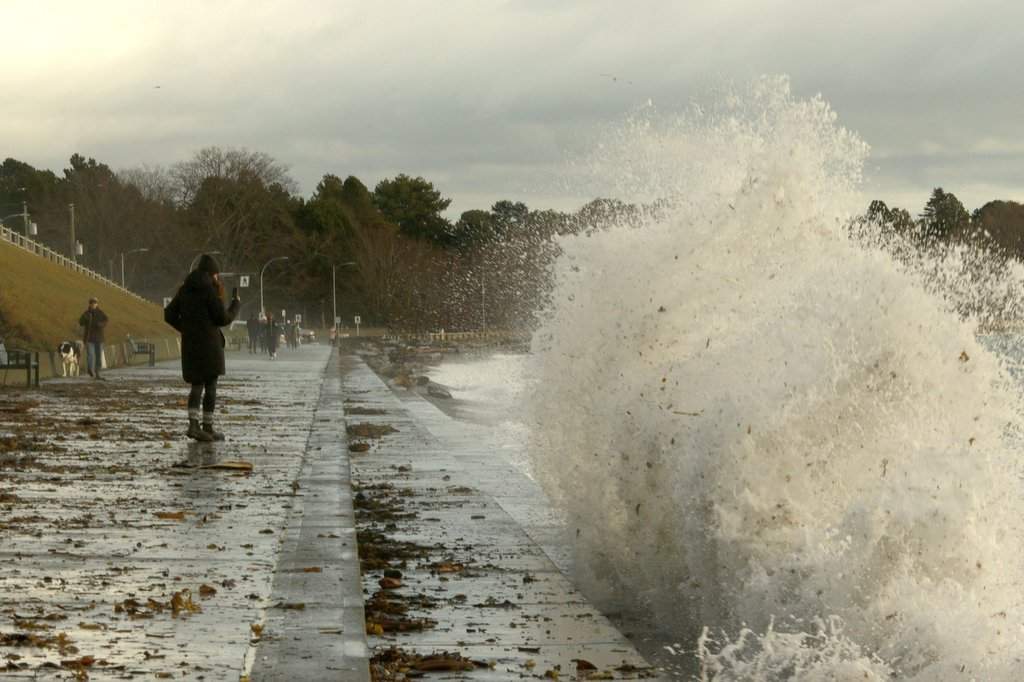
Elena sits in Lane 4 with her hazard lights pulsing against the rain-streaked windshield, watching whitecaps detonate against the breakwater. Behind her sits a flatbed carrying refrigerated insulin bound for Victoria pharmacies. Beside her idles a contractor from Sechelt whose crew cannot pour concrete because the barge carrying their aggregate is sheltering behind Bowen Island. Two rows over, a university student stares at a laptop screen that just lost its cellular tether, watching an exam deadline tick toward zero.
One weather system. One operational decision at BC Ferries headquarters. Suddenly, five hundred separate lives are suspended in salt spray and diesel exhaust.
Why the Lights Go Out So Fast Here
If the ferry cancellations sever the region’s arteries, the power outages cut its nervous system. Every single autumn, visitors from inland cities ask the same incredulous question while holding a flashlight over a cold stove: Why doesn't BC Hydro just bury the power lines?
It is a fair question, and on the surface, an obvious fix. After all, downtown Vancouver’s core rarely loses power when a Pacific low slams into Stanley Park.
The answer lies in the ground beneath our boots. Anyone who has ever tried to dig a fence post on Vancouver Island or the Gulf Islands knows that two inches of mossy topsoil covers solid, unforgiving coastal granite and glacial till. Burying high-voltage distribution lines across thousands of kilometers of fractured rock, steep ravines, and temperate rainforest does not just double the cost of electricity; it multiplies it by a factor of ten or more, running into tens of billions of dollars that would land squarely on monthly utility bills.
Instead, we string our grid through the tallest, densest coastal forest in North America. Think of our overhead distribution network like a tightrope strung through a cathedral of giant trees. For eight months of the year, those Douglas firs, western red cedars, and bigleaf maples stand like monuments. Then comes October and November.
Months of summer drought—increasingly brutal in recent years—stress the root systems and bake the soil hard. When the first atmospheric rivers and autumn windstorms arrive, two fatal mechanisms collide. First, heavy rain saturates the shallow soil, turning the earth around tree roots into grease. Second, the trees are still holding onto their autumn foliage and thick mats of wet moss, acting like giant sails catching eighty-to-one-hundred-kilometer-per-hour gusts.
They do not always snap cleanly. Often, an entire root ball lifts out of the mud like a peeled scab, sending a hundred-foot cedar crashing across three-phase lines, snapping wooden poles like toothpicks, and dragging transformers into the ditch.
I lived through the December 2018 windstorm on the South Coast—the most destructive storm in BC Hydro’s history, which knocked out power to more than 750,000 customers—and the sensory memory never quite leaves you. By day two without electricity, the novelty of candlelight curdles into a low-grade, creeping cold. Your house becomes a refrigerator in reverse. You learn how fast a hot water tank loses its heat, how quickly sump pumps stop working when the basement begins to weep groundwater, and how fragile a digital economy becomes the moment cell towers burn through their eight-hour backup batteries.
You step outside at dusk on the third evening, and the neighborhood smells entirely of woodsmoke and generator exhaust. Neighbours who spent all summer nodding politely over cedar hedges suddenly gather at the end of driveways, trading spare D-cell batteries, thermos flasks of boiled water, and rumors about when a utility truck was last spotted near the highway junction.
The Invisible Choreography Behind the Curtain
It is easy to curse a utility company when your freezer is thawing, or rage at a ferry terminal agent when you miss a wedding on the mainland. Frustration is human, especially when you are cold and stranded. Yet the real story of these storms is rarely told in the press releases, because it happens in the mud at three in the morning while the rest of us are wrapped in extra blankets.
To restore power after a major autumn blow, BC Hydro cannot simply flip a breaker at a central substation. Doing so while a live wire lies tangled in wet brush across a rural road on Saltspring Island would electrocute first responders or spark a wildfire the instant the wind dries the understory.
Instead, hundreds of line technicians, vegetation crews, and damage assessors have to walk or drive every single kilometer of downed circuit in the dark. Before a crew can even touch a broken crossarm, a faller has to buck massive, tension-loaded timber off the cables—work that carries lethal spring-back risks if a trunk shifts an inch the wrong way. Only then can linemen climb into buckets, swaying in residual gusts above slick roads, splicing heavy-gauge aluminum conductor with numb fingers.
Meanwhile, out on the water, marine dispatchers are playing three-dimensional chess against tide tables, berth availability, and crew rest regulations. You cannot simply run extra sailings at midnight to clear the backlog if the crew has hit its Transport Canada safety hours, nor can you dock a Spirit-class ferry at a berth whose hydraulic ramp was designed for a smaller vessel. Every delayed sailing cascades across the network like a dropped stack of dominoes; a wind gust in Active Pass at noon is the reason a family in Powell River cannot get home at nine o'clock that night.
What the Storm Actually Demands of Us
We have a habit, in our hyper-scheduled lives, of treating geography like an obsolete inconvenience. We book back-to-back flights out of YVR two hours after a morning ferry from Victoria, assuming the Strait of Georgia will behave like a paved boulevard. We keep three days of groceries in an electric fridge and let our gas tanks hover near empty, trusting that the invisible machinery of modern infrastructure will never stutter.
Then November arrives and strips away the illusion.
If you live on this coast, or plan to travel through it between October and March, resilience is not a hobby for preppers; it is basic literacy. It means understanding that a ferry reservation is a plan written in pencil, never ink, and building a twelve-hour buffer before any non-negotiable flight or medical appointment. It means keeping a battery-powered radio, a full tank of fuel, cash in small bills for the inevitable afternoon when Interac terminals go offline, and enough drinking water to outlast a boil-water advisory.
More than anything, it requires a shift in how we read the weather.
Late on the second day of the storm, the barometric pressure finally begins to climb. Down at the ferry terminals, deckhands in bright orange survival suits cast off the heavy nylon mooring lines, and the deep, resonant thrum of diesel-electric engines vibrates back up through the soles of waiting passengers' boots. Up on the ridge lines, the last red hazard lights on the utility poles blink out as streetlights flicker back to life across dark valleys.
The ferries are moving again, and the grid is humming, yet out in the pitch-black channel between the islands, the black water still slaps hard against the steel hull—patient, cold, and waiting for the next low-pressure system to roll off the Pacific.