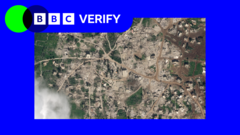
Satellite imagery and local reports confirm a systematic campaign of destruction across southern Lebanon that far exceeds the tactical requirements of border security. While official military narratives focus on the neutralization of tunnels and firing positions, the visual evidence suggests a broader, more permanent objective. Entire neighborhoods are being leveled by controlled demolitions and high-explosive airstrikes, creating a "dead zone" that may prevent civilian return for years.
This is not the collateral damage of urban warfare. It is the deliberate dismantling of the border’s social and physical geography.
The Mechanics of Clearance
Military operations usually leave behind the jagged remains of combat—bullet-scarred walls, collapsed roofs, and cratered roads. What we are seeing in villages like Mhaibib, Ramyeh, and Blida is fundamentally different. High-resolution satellite passes show clusters of buildings that existed on a Monday and were reduced to uniform gray dust by Tuesday.
The method is typically a "controlled demolition." Ground troops enter a vacated village, wire primary structures with industrial-grade explosives, and trigger a simultaneous blast. This technique is used to ensure no structure remains standing to provide cover or a basement network for future insurgent use. However, the scale of these demolitions suggests a policy of territorial denial rather than surgical defense.
When a house is hit by a missile, the debris stays local. When a village is demolished with planted charges, the very foundation of the community is pulverized. The loss of infrastructure—water towers, power lines, and schools—ensures that even if the fighting stops tomorrow, the area remains uninhabitable.
Beyond the Buffer Zone
The official justification remains the enforcement of a security corridor. The argument is that by clearing the line of sight along the Blue Line, the Israel Defense Forces (IDF) can prevent the kind of cross-border raids that triggered the current escalation. But the depth of the destruction is creeping further north.
Analysts who have tracked previous conflicts in the region note that a three-kilometer buffer is the standard military ask. Yet, the current arc of destruction reaches deeper into the Lebanese heartland, impacting villages that have no strategic height or obvious military utility. This raises a grim question about the long-term intent of the operation. Is the goal a temporary security strip or the permanent displacement of the Shia population from the border regions?
Historical precedent in the Middle East shows that "temporary" security zones have a habit of becoming permanent fixtures of the map. By erasing the physical markers of ownership—the family homes, the olive groves, and the ancestral cemeteries—the military is effectively resetting the demographic clock.
The Economic Death Blow
Lebanon’s south is the country’s agricultural engine. The destruction extends beyond the concrete and rebar of the villas and apartment blocks. White phosphorus munitions and heavy bombardment have scorched thousands of acres of ancient olive trees and tobacco fields.
Agriculture in this region is not just a business; it is a claim to the land. When an olive grove that has been tended for three generations is burned, the economic incentive to return disappears. The soil itself is being poisoned or rendered unusable by unexploded ordnance. This creates an invisible barrier more effective than any concrete wall or barbed wire fence.
The Lebanese state, currently mired in a decade-long financial collapse, lacks the capital to rebuild. Without a massive international Marshall Plan—which currently has no political backing—these villages will remain ghost towns. The strategic byproduct of this poverty is a permanent vacuum.
The Failure of International Oversight
The United Nations Interim Force in Lebanon (UNIFIL) has found itself in an impossible position. Tasked with monitoring a peace that no longer exists, peacekeepers have watched from their outposts as the landscape is reshaped. Their reports are filled with "incidents" and "violations," but they lack the mandate to intervene.
The international community’s silence on the scale of these demolitions is deafening. While high-level diplomacy focuses on ceasefire terms and the "Litani River" line, the reality on the ground is moving faster than the negotiators. By the time a deal is signed, there may be nothing left to negotiate over in the south.
A New Mapping of Reality
The destruction of southern Lebanon is being documented in real-time by a constellation of private satellites. We no longer have to wait for the fog of war to lift to see the results. Every day, fresh imagery reveals the widening gray scars where red-roofed houses once stood.
This isn't just about destroying a militant group's assets. It is about the systematic removal of a civilian presence to ensure that "security" is maintained through emptiness. This approach assumes that a vacuum is safer than a monitored border. History, however, suggests that vacuums in this part of the world are rarely empty for long. They are eventually filled by something more desperate and more radicalized than what was there before.
The strategy of total demolition creates a legacy of resentment that no security wall can contain. When you take away a man’s home, his livelihood, and his history, you leave him with nothing to lose. That is the one variable the military planners haven't accounted for in their satellite-guided calculations.
The rubble of Mhaibib is not just a pile of stones; it is the blueprint for the next century of conflict.