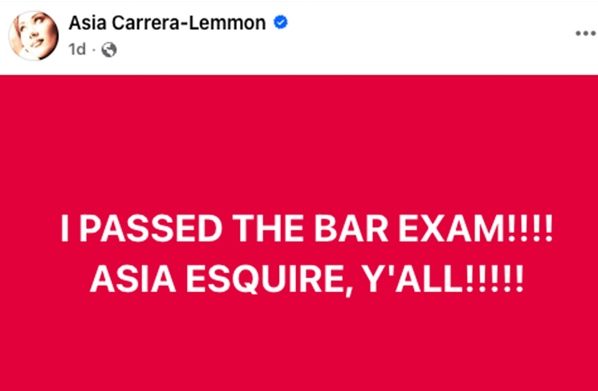
Asia Carrera has traded the glare of adult film sets for the fluorescent hum of a law office, a transition that has sent shockwaves through the legal establishment. After decades as one of the most recognizable faces in the adult industry, Carrera—born Jessica Steinhauser—has officially passed the Texas Bar Exam and obtained her license to practice law. This is not merely a celebrity pivot or a vanity project. It is a calculated, grueling achievement that challenges the gatekeeping mechanisms of professional licensing and the persistent stigma attached to the "scarlet letter" of the adult industry.
While the superficial headlines focus on the contrast between her past and present, the real story lies in the mechanics of her ascent. Carrera did not just pass a test; she navigated the "Character and Fitness" gauntlet, a subjective and often opaque review process designed to weed out candidates who lack the moral fiber to represent clients. For an industry veteran like Carrera, this was the ultimate hurdle. Her success serves as a definitive signal that the legal profession is, perhaps begrudgingly, moving toward a standard based on merit and modern ethics rather than historical moralizing.
The Character and Fitness Gauntlet
Every aspiring lawyer fears the Character and Fitness review. It is the gate. In Texas, the Board of Law Examiners scrutinizes a candidate's entire history, looking for "good moral character" and "fitness" to practice law. These terms are intentionally broad. They allow boards to investigate everything from credit scores and old traffic tickets to past employment. For someone like Carrera, whose past employment is documented in 4K resolution across the internet, the process was an exercise in vulnerability.
The board’s mandate is to protect the public. They argue that a lawyer must be trustworthy because they handle client funds and sensitive secrets. Historically, this has been used as a tool for exclusion. In the mid-20th century, it was used to keep out political radicals and those deemed "socially undesirable." Today, the focus has shifted toward honesty and disclosure. Carrera’s path suggests that the board cared less about the nature of her previous work and more about her transparency regarding it.
She didn't hide. By being upfront about her career in the 1990s and early 2000s, Carrera effectively neutralized the board’s ability to claim she lacked "candor"—the most common reason for a character-based rejection. This sets a precedent for others in stigmatized industries. If you can prove you followed the law, paid your taxes, and didn't defraud anyone while working in a marginalized field, the state cannot easily bar you from a professional license.
The IQ Myth and the Reality of the Bar
Carrera has long been known as a member of Mensa, a fact often cited as a quirky footnote in her adult film bio. But a high IQ is a poor predictor of success on the Uniform Bar Exam (UBE). The bar is not an intelligence test; it is an endurance test. It requires the memorization of thousands of rules across disparate fields: Constitutional Law, Torts, Evidence, Contracts, and Real Property.
Texas adopted the UBE in 2021, meaning Carrera had to score high enough to meet a specific threshold that is among the more rigorous in the country. To pass, a candidate must master the "IRAC" method—Issue, Rule, Analysis, Conclusion. It is a rigid, formulaic way of thinking that is the antithesis of the creative or performative arts. Carrera’s transition required a complete rewiring of her cognitive approach to problem-solving.
She spent years at Southern Utah University before making the jump to law school. This wasn't a shortcut. It was a long-haul recovery from a life that many assumed had reached its final chapter. The legal community often views "non-traditional" students with skepticism, but Carrera’s background in the adult industry likely provided a thicker skin than the average 24-year-old law graduate. Dealing with the public's perception of her body for twenty years is, in many ways, the perfect training for the adversarial nature of the courtroom.
The Industry Stigma and the Legal Double Standard
There is a profound irony in the legal profession’s discomfort with an adult film star joining its ranks. The law is a business that frequently represents the interests of the adult industry. Law firms handle the intellectual property of studios, the employment contracts of performers, and the First Amendment litigation that keeps the industry alive. To profit from the industry as a service provider is considered "white shoe" work; to have been the product itself is considered a moral failing.
Carrera is forcing the legal world to reconcile this double standard. If the industry she worked in is legal, and the money her lawyers earned from her was "clean," then her presence in the bar must be legitimate. Her license is a reminder that "morality" in the eyes of the law is increasingly defined by compliance rather than puritanism.
However, the road ahead is not paved. While the Bar has granted her the right to practice, the market is a different beast. Small firms may fear the "distraction" of her fame. Large firms may worry about client optics. Carrera is likely to find her niche in solo practice or boutique firms specializing in First Amendment rights, intellectual property, or perhaps advocacy for others in the adult space who are routinely denied basic legal protections.
The Economic Necessity of a Reinvention
We should not ignore the practical reality of Carrera’s move. The adult industry is notoriously precarious. Performers rarely have retirement funds, health insurance, or long-term career stability. For Carrera, law is the ultimate hedge. It is a profession where age is an asset rather than a liability. A 50-year-old performer is "retired"; a 50-year-old lawyer is just hitting their stride.
The skills required to survive the adult industry at a high level—contract negotiation, brand management, and navigating complex bureaucratic systems—are surprisingly transferable to law. Carrera managed her own career during an era when the industry was transitioning from physical media to the internet. She saw firsthand how digital piracy gutted the earnings of performers. This lived experience with copyright law is more valuable than any textbook analysis. When she talks to a client about "theft of services" or "IP infringement," she isn't speaking theoretically. She’s speaking from the perspective of someone who lost millions to it.
The Pushback from the Traditionalists
Not everyone is cheering. Within legal forums and private circles, there is a segment of the "old guard" that views her admission as a degradation of the profession’s dignity. They argue that the "prestige" of the bar is diminished when it includes individuals with her specific public history. This argument, however, is legally hollow. The Supreme Court has repeatedly held that the state cannot deny a professional license based on arbitrary moral grounds that do not relate to the person's ability to perform the job.
Carrera’s success is a win for the "Right to Practice" movement. It asserts that once a debt to society is paid—or in her case, once a controversial but legal career is concluded—an individual should be allowed to contribute to society in a new capacity. To deny her that right would be to impose a life sentence of professional exile.
The Texas Legal Market and the New Reality
Texas is an interesting choice for this debut. It is a state that prides itself on conservative values but also possesses a fierce "frontier" streak of individualism. The Texas Bar is one of the largest and most influential in the country. By qualifying there, Carrera has chosen a high-stakes environment. She isn't hiding in a small, obscure jurisdiction. She is in the heart of a state that is currently at the center of national legal debates regarding privacy, expression, and the role of the government in personal lives.
Her presence in the Texas Bar will likely lead to a surge in interest in "second-act" legal careers. We are seeing a trend of professionals from all walks of life—military, medicine, and now entertainment—entering law school in their 40s and 50s. They bring a level of pragmatism that the traditional law student lacks. They know how the world works, how people lie, and how systems break.
Why This Matters Beyond the Tabloids
The significance of Asia Carrera becoming an attorney is not that a "porn star" is now a "lawyer." It is that the walls between our public and private personas are crumbling. In an era where everyone has a digital trail, the legal profession can no longer afford to exclude people based on what they did in front of a camera twenty years ago. If the bar can accept Carrera, it can—and must—accept others who have non-traditional backgrounds.
This is about the democratization of the law. For too long, the legal profession has been a closed shop for the wealthy and the socially "proper." By breaking in, Carrera has widened the door for others who don't fit the mold. She has proven that the law is a tool, not a social club.
Clients don't care about a lawyer's past as much as they care about their results. If Carrera can win a motion, negotiate a favorable settlement, or protect a client's assets, her filmography becomes irrelevant. The courtroom is a place of evidence and logic. In that environment, her history is just noise. The only thing that will matter is the quality of her briefs and the strength of her oral arguments.
The Texas Bar has issued the license. The state has spoken. Asia Carrera is an attorney at law. This is a cold, hard fact that the legal establishment must now live with. It represents a shift toward a more inclusive, albeit more complicated, professional landscape.
If you are a lawyer, your new colleague is a woman who spent years being underestimated while she quietly built the intellectual foundation for this moment. If you are a client, you might find that the person who has seen the darkest and most exploitative corners of the entertainment industry is exactly the person you want in your corner when your own livelihood is on the line.
The most effective way to challenge a system is to master its rules. Carrera has done exactly that. She didn't protest the bar; she beat it. She didn't ask for permission to change her life; she earned the right through thousands of hours of study and a grueling examination process. The lesson here is simple: the past is a data point, not a destiny.
Aspiring professionals in any field should look at this case as a blueprint for reinvention. It requires total transparency, a refusal to be shamed, and a willingness to work twice as hard as everyone else to prove the doubters wrong. Carrera’s second act isn't just starting; it’s already a masterclass in professional resilience.