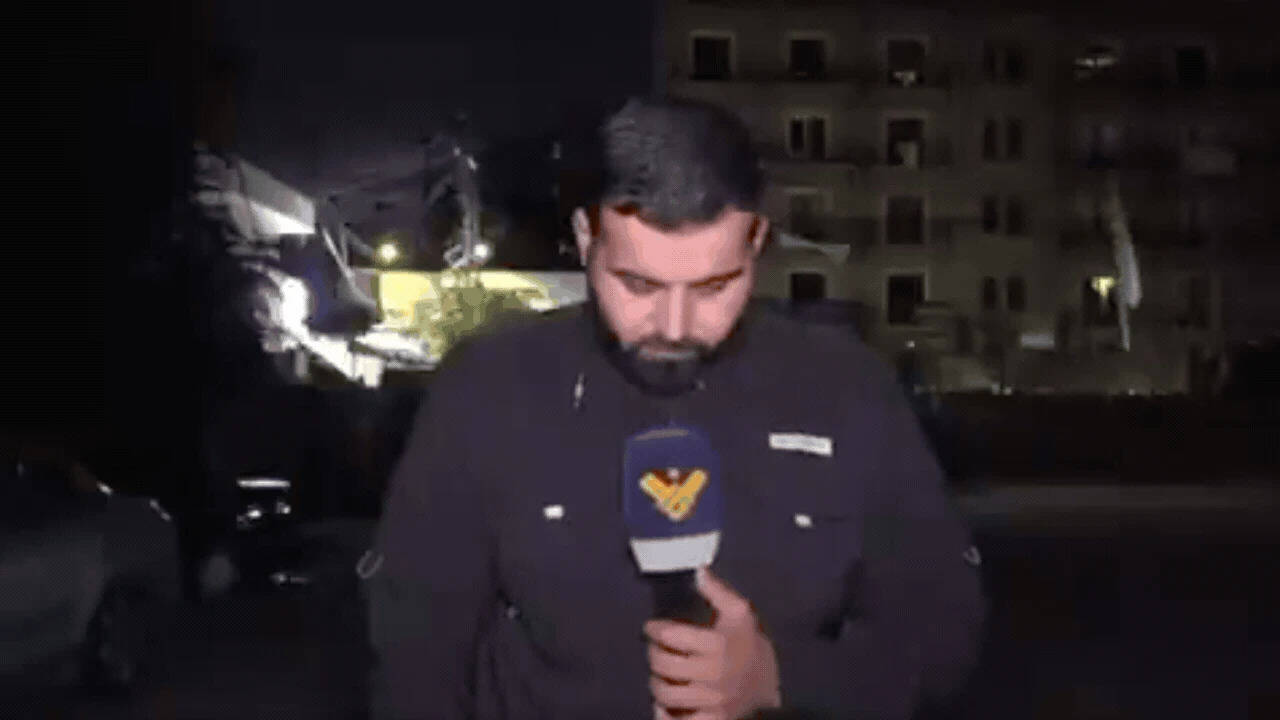
Static.
Then, the sudden, violent rupture of air.
If you have ever stood too close to an artillery discharge, you know it is not merely a sound. It is a physical entity. It hits your sternum before it reaches your ears, a blunt-force collision that rattles the teeth in your jaw and turns the air instantly thick with the taste of copper and pulverized concrete.
Now, imagine experiencing that force not from the safety of a bunker, not through the delayed filtration of history books, but through the compressed audio of a portable microphone clipped to a silk tie.
A news crew stands on a hillside in southern Lebanon. The camera is locked down on a tripod, framing a correspondent whose job is to translate chaos into coherent syntax for an audience eating breakfast thousands of miles away. Words like escalation, ceasefire, and cross-border exchanges roll off the tongue with the practiced fatigue of veterans who have lived beneath these flight paths for decades. The reporter gestures toward the horizon, pointing out where the smoke usually rises.
Then the sky breaks.
There is no countdown. There is only a jagged tear in the fabric of the afternoon.
The microphone catches the whistle first—a high-pitched, screaming velocity that defies human reaction time. And then the detonation. The frame convulses. The camera operator, operating on pure animal instinct, wrenches the unit sideways, capturing a chaotic blur of earth, sky, and flying debris before the lens settles on a billowing plume of grey smoke blooming uncomfortably close to the broadcast position.
For a terrifying, endless second, the feed goes dead silent save for the ringing whine of acoustic shock.
We consume these moments as spectacle. We scroll past them on glowing screens while waiting for our coffee to brew, treating human peril as digital background noise. But behind every live-broadcast strike is a stark, terrifying reminder of the thin, fraying boundary between the observer and the observed.
The Anatomy of a Split Second
To understand what happened on that Lebanese hillside, we have to look past the dramatic footage and examine the machinery of modern frontline reporting.
Journalists in conflict zones operate within a cruel paradox. They must make themselves visible enough to report the truth, yet vulnerable enough to capture it authentically. They carry tripods like lightning rods. They wear heavy blue vests stamped with bold, black letters that assume a combatant’s conscience will spare an observer.
History tells us that assumption is a gamble.
Consider what happens next in the control room thousands of miles away. A producer watches the live feed shudder. Blood rushes to their ears. Do they cut the feed? Do they pull the plug to protect viewers from potential tragedy, or do they keep the window open because turning away means erasing the reality of the people still standing in that fire?
It is a calculation made in milliseconds. Ethics collide with ratings, and survival battles with the insatiable public hunger for unvarnished truth. In this specific incident, the crew managed to duck, shield themselves, and eventually confirm they were uninjured, but the audio remained. That sharp intake of breath. The frantic rustle of fabric. The raw, unfiltered panic of professionals realizing their armor was just an illusion.
Living Under the Flight Path
We often talk about war in grand, sweeping terms. We map territories with arrows and discuss strategy in sterile conference rooms.
Yet, war is fundamentally domestic. It is about a journalist drinking cold tea from a paper cup while waiting for a live hit. It is about an old woman hanging laundry within sight of an observation post. It is about the specific weight of silence that settles over a valley when the shelling stops for ten minutes.
When a strike hits close to a live camera, it collapses the distance between us and them. It strips away the comforting abstraction of distance. The screen becomes a window, and suddenly, the glass feels terribly thin.
We look at our phones to escape our daily routines, searching for connection, for meaning, for proof that the world out there still makes sense. Instead, we find a hillside in Lebanon erupting into fire, and a reporter blinking dust from their eyelashes, struggling to find words for a horror that defies vocabulary.
The broadcast continues. The anchor back in the studio adjusts their papers, their voice trembling just slightly before steadying into professional cadence. They move on to the next segment. The algorithm refreshes.
Yet, somewhere in the ether, that single frame remains frozen. A reminder of how quickly the world can turn inside out, and how fragile the silence is between one heartbeat and the next.