Dust settles slowly over concrete that used to be a wall.
In a quiet neighborhood of an Iranian city, the morning air usually smells of baking flatbread and the sharp, dry scent of dust kicked up by old tires. Today, it smells like something else entirely. It smells like ionized metal and scorched earth. It smells like a technology that was designed in a windowless room five thousand miles away, executed with cold mathematical precision, and dropped into a courtyard where children were playing only hours before. Also making headlines recently: Why Pakistan Is Not Starving And The Food Crisis Narrative Is Dead Wrong.
We talk about modern warfare as if it were a spectator sport. We watch compressed video clips on our phones, squinting at silent grey pixels that bloom into white smoke. The graphics are clean. The lines are sharp. The announcers speak in low, grave tones about trajectories, payloads, and strategic deterrence.
They do not talk about the window glass. Additional details on this are covered by Reuters.
Millions of tiny, diamond-hard shards of glass, blown inward by an overpressure wave so fast the human eye cannot register it, slicing through living rooms, bedding, and family photographs. They do not talk about the silence that follows the detonation. Not a peaceful silence, but the suffocating quiet of a place where breath has been temporarily suspended by shock.
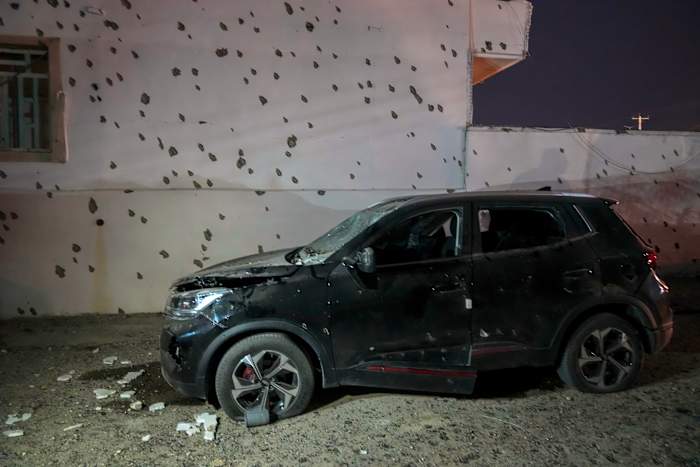
Reports from the ground in Iran are painting a devastating picture of a new kind of munitions footprint. Following recent military exchanges, investigators and local residents are surveying a trail of destruction that defies standard ordnance patterns. The damage is localized, almost terrifyingly surgical, yet absolute within its radius. Entire sections of residential structures have been sheared away, leaving cross-sections of domestic life exposed to the open sky—a turquoise kitchen cabinet hanging by a splintered stud, a child's backpack resting on a patch of floor that no longer has a room attached to it.
Military analysts looking at the imagery note the distinct signature of advanced precision-guided weaponry equipped with high-explosive fragmentation payloads. This is not the carpet-bombing of the last century. This is something refined. Something optimized to punch through reinforced structures and detonate internally, turning office buildings and apartment complexes into their own executioners.
The strategy behind these weapons is clear on paper. Minimize collateral exposure. Maximize structural compromise. Neutralize high-value nodes without committing boots to the ground.
Paper is very forgiving.
To understand what happened in that Iranian city, you have to step away from the tactical maps and look at the geometry of the impact zone. Imagine standing in the center of a street where every single storefront has been hollowed out. Not burned down—hollowed out. The facades are stripped bare, leaving skeletal frames of iron rebar reaching toward the blue sky like desperate hands.
Consider what happens next in a scenario like this. The immediate shock fades. The sirens begin their frantic, overlapping wails. Neighbors become first responders, digging through crushed cinderblocks with bare hands, fingernails turning dark with soot and blood. They are looking for cousins, for neighbors, for the old man who sold tea on the corner. They pull out a shoe. Then a book. Then a body.
This is the human cost of the invisible stakes we trade in global capitals. Every time a defense budget is approved, every time a new contract is signed for advanced kinetic delivery systems, a countdown begins. The destination is always a physical coordinate on a map where real people are sleeping, eating, arguing about dinner, or putting their kids to bed.
The weapon that left this wide path of death and destruction in Iran is part of an evolving arms race that prioritizes speed and penetration over everything else. As guidance systems become smarter, powered by machine-learning algorithms that can correct course mid-flight to account for wind shear or target movement, the margin for human error is supposedly eliminated.
Except the machine does not know what a human is.
It knows coordinates. It knows radar cross-sections. It knows thermal signatures. To the guidance chip screaming through the stratosphere at Mach numbers, a crowded residential alleyway and an empty military hangar look identical if the GPS coordinates match. The cold reality of automated war is that precision does not mean mercy. It just means the destruction arrives faster and hits closer to where it was aimed.
When we look at the reports coming out of the region, the numbers matter. Casualty counts, tonnage, blast radii, structural integrity indices. These are the tools of the trade for journalists and analysts trying to quantify a tragedy. But numbers flatten reality. They turn a neighbor into a statistic. They turn a lifetime of memories into collateral damage percentages.
Walk through the aftermath of an advanced missile strike and you realize that war has become entirely decoupled from the concept of battle. This is no longer two armies clashing on a field. This is a technological nervous system reaching across continents to touch a specific living room wall with five hundred pounds of high explosive.
The people living through this fallout are caught in a terrifying geopolitical undertow. They did not design the drones. They did not write the targeting software. They did not sign the treaties that failed or issue the ultimatums that preceded the launch. They were simply living their lives in the path of a technological inevitability.
As the international community debates the legality, proportionality, and future implications of these new weapon systems, the dust in the Iranian city continues to settle. Crews clear the rubble with heavy machinery, loading broken concrete and twisted iron into the backs of dump trucks. The street will eventually be paved over. New walls will go up. People will walk down that same sidewalk again, buying tea, talking about the weather, trying to rebuild a sense of normal in a world that can unmake their homes in the span of a heartbeat.
The crater is gone, but the shape of it remains etched into the collective memory of everyone who heard the sky tear open that night. It is a shape that defines our modern era—clean, efficient, devastating, and entirely indifferent to the lives it alters forever.