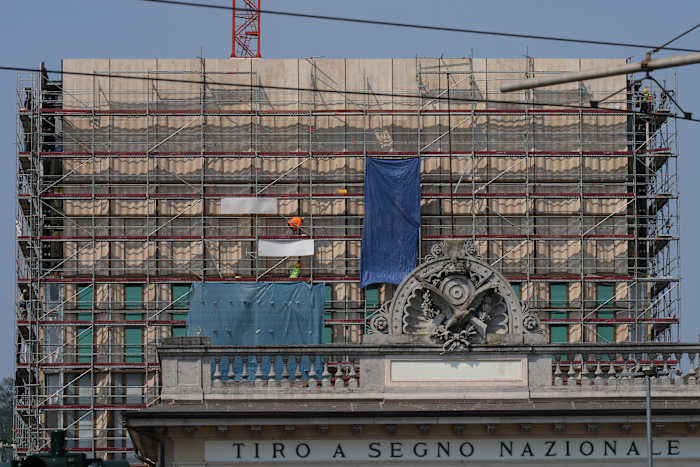
Imagine moving across the world for a prestigious government construction gig, expecting a life-changing salary, and ending up with less than $2 an hour. It sounds like a bad dream, but it's exactly what migrant workers faced while building the new $350 million U.S. Consulate in Milan.
Italian prosecutors blew the lid off a massive labor exploitation scandal involving Caddell Construction, a major Alabama-based contractor trusted by the U.S. State Department to build diplomatic missions worldwide. Two Caddell managers were arrested in Italy this June, with police catching one right as he tried to board a flight out of the country. This isn't just a corporate oversight. It's a systemic failure that raises massive questions about how the U.S. government monitors its multi-million-dollar international projects.
Inside the Milan Consulate Scandal
The details coming out of the investigation led by Milan prosecutor Paolo Storari are brutal. The probe focuses on roughly 70 workers, primarily from India and Kenya. These weren't unskilled laborers either. Many were trained electricians with years of international experience under their belts.
According to employee records and pay stubs reviewed by investigators, the actual numbers tell a horrifying story.
- The Promised Pay: Kenyan workers showed official letters on Caddell stationery promising annual salaries over 25,000 euros (nearly $29,000). An Indian electrician was promised 2,500 euros a month.
- The Reality: The Indian worker's pay slip revealed an hourly wage of just 1.55 euros ($1.80). He took home about 500 euros a month. One Kenyan electrician received 800 euros a month instead of the promised 2,300 euros.
- The Minimum Wage Gap: For context, the legal minimum wage for construction workers in Milan starts at 13.39 euros (over $15) an hour, according to the Cassa Edile benefits fund.
How did the contractor get away with this right under the nose of the State Department? Management used aggressive paycheck deductions and outright intimidation. Pay stubs showed Caddell deducted around 510 euros a month for housing and over 300 euros for food. Even with those massive deductions, the math didn't add up to the promised contract rates. The company simply pocketed the rest.
Threats Deportation and Slashed Wages
The exploitation didn't stop at the bank account. Workers reported working grueling 10-hour days, six days a week. When they tried to question human resources about the missing money, the response was immediate and hostile.
One Kenyan worker recalled being told, "Either you work or you will be returned to your country." Another electrician who utilized an AI summary of Italian labor law to advocate for his rights was threatened with a defamation lawsuit. Management casually told him the 25,000-euro figure on his official contract was just "for visa purposes" and not a real payment promise.
When the investigation started gaining traction earlier this year, Caddell fired five of the whistleblowers without cause. One man returned from visiting his family in Kenya to find he had no job, no money, and nowhere to live. Currently, some of these fired workers are sleeping in public parks in Milan, relying on local trade unions like the Fillea Cgil federation for food and legal aid.
A Pattern of Disrespect for Labor Standards
This isn't Caddell Construction's first brush with controversy. Over a decade ago, the company paid millions to the U.S. government to settle allegations that it used false claims to exploit government incentives. Now, they are facing criminal charges in Europe for treating workers like indentured servants.
Laura Malguzzi, a representative for the Fillea Cgil union, expressed shock at how brazen the exploitation was. The company literally documented their illegal wages on official pay stubs. Malguzzi noted that the managers likely operated with the "absolute certainty that they were untouchable" because they were working on a high-security U.S. government project.
The U.S. State Department issued a standard response stating they do not tolerate labor exploitation and are cooperating with Italian law enforcement. But the damage is done. The site is now operating under strict court supervision. Workers are finally limited to 45 hours a week, guaranteed two days off, and no longer see their paychecks gutted by predatory housing fees.
What Needs to Change Next
If you run an international business or oversee subcontracted projects, you can't just trust a big name blindly. The Milan scandal proves that even federal compliance mechanisms fail. To protect your operations from similar supply chain or labor disasters, you need to implement hard boundaries immediately.
First, stop relying on third-party audits that only look at paperwork. You need blind, anonymous reporting channels where workers can flag intimidation without fear of getting deported or fired. Second, mandate that all foreign labor contracts comply with local host-country standards, not just the rules of the home corporation. Local unions should have access to site conditions before prosecutors have to step in.
The Fillea Cgil union is currently fighting to recover full damages and back pay for the exploited workers. Meanwhile, the U.S. government has a massive public relations disaster to clean up. When the building meant to represent American values abroad is built on the backs of workers earning less than $2 an hour, the hypocrisy is impossible to ignore.


