The stadium lights are off. The roar of fifty thousand throats has dissolved into a haunting, metallic quiet. For anyone who watched Imran Khan marshal his men through the Lahore humidity of 1992, or saw him lift the Cricket World Cup with a fierce, quiet intensity, the contrast is staggering. The pavilion is empty. The captain is locked away.
And then, the silence broke.
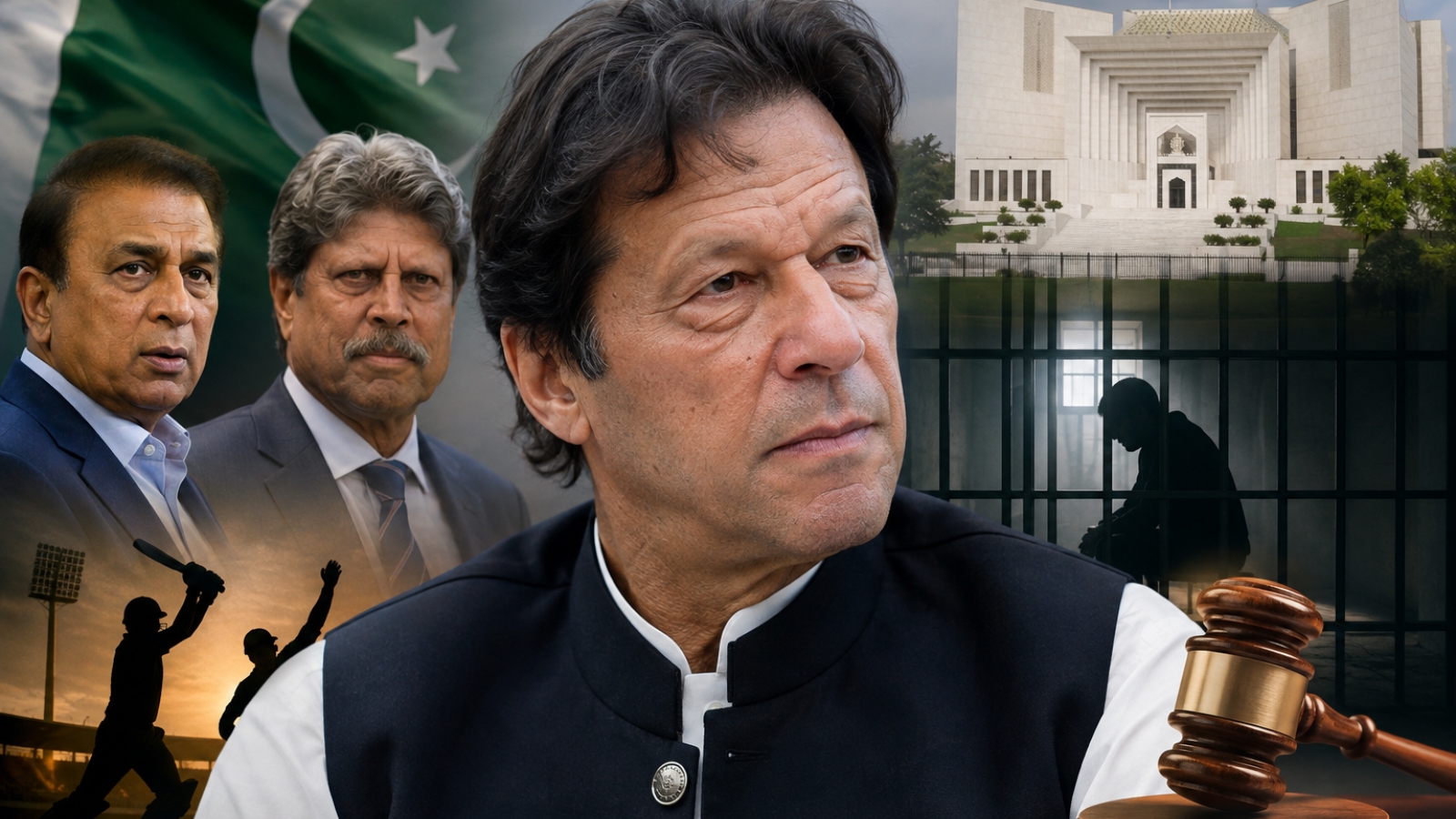
It did not break with a political manifesto or a rallying cry from the streets. It broke with health concerns whispered across borders, rising from the mouths of cricketing royalty who once stood shoulder-to-shoulder with him on the 22-yard strip. Sunil Gavaskar. Kapil Dev. Men who spent decades trying to outsmart him with a bat in hand, suddenly forced to ask a terrifying question: Is the man behind the legendary swing surviving the damp, oppressive confines of Adiala Jail?
Consider what happens when icons of opposing nations—India and Pakistan, eternal rivals bound by a shared obsession—look past the borders, past the endless political theater, and see only a human being in peril.
The Weight of the Adiala Walls
Adiala Jail is not just a building; it is a crucible. For months, rumors have bled through the concrete barriers. Prison walls have a way of swallowing sound, but they cannot entirely contain anxiety. Reports of deteriorating health, restricted access, and isolation began to accumulate like storm clouds over the Potohar Plateau.
When you spend your entire life under the open sky—running in to bowl with a violent, beautiful action, facing down hostile fast bowling on fiery pitches—the sudden contraction of space must feel like suffocation. Imran Khan was never built for confinement. His life has been a series of grand stages: Cambridge, Lord's, the Prime Minister's House, the tumultuous streets of Lahore. To reduce that trajectory to a solitary cell is a heavy architectural irony.
Yet, the physical body keeps score. At over seventy years of age, the former captain carries the mileage of a lifetime of fast bowling. Knees battered by repeated impact, a back strained by thousands of overs, and the relentless nervous energy of a hyper-competitive mind. When medical bulletins are scarce, imagination fills the void. And imagination is a cruel narrator.
The Rivalry That Transcended Politics
To understand why figures like Gavaskar and Kapil Dev raised their voices, you have to understand the sacred geometry of the 1980s Indo-Pak cricket rivalry. It was war without bullets. Every match was a national referendum.
Gavaskar knew what it took to face Imran at his peak. He knew the terrifying arc of a delivery that pitched on a length and hissed past the outside edge. Kapil Dev knew the psychological chess match of leading a team against a charismatic opponent who simply refused to lose. They were gladiators in the same ancient arena.
When gladiators respect one another, politics becomes noise.
When the news of Imran's worsening health and restricted visitation rights reached the ears of these cricketing legends, the instinct of sportsmanship kicked in. Rivalry ceases when a peer is in mortal danger. Gavaskar’s public expressions of concern and Kapil Dev’s empathetic appeals were not political acts; they were human ones. They were saying: We fought him, we feared him, we admired him. But we will not watch him fade away in the shadows.
The Supreme Court Steps In
Power fears nothing so much as a martyr, and it distrusts an unchecked vacuum even more. As the chorus of concern swelled from international sporting icons, domestic legal pressure, and anxious supporters, the machinery of justice began to grind.
The Supreme Court of Pakistan stepped into the labyrinth.
Judicial intervention in high-profile political imprisonments is a delicate dance. Every ruling is scrutinized, every delay is interpreted as complicity or courage. Yet, the intervention regarding medical access and conditions of confinement marked a crucial pivot. Courts became the last remaining theater where the battle could be fought with rules rather than batons.
The state argued security protocols; the defense argued basic human rights. But hovering above the legal briefs was the simple, undeniable reality of a man's biological vulnerability. You can lock away a politician. You can censor a leader. But how do you explain to history that a national hero, a man who gave millions their proudest sporting memory, was denied the dignity of adequate healthcare?
The Psychology of the Ultimate Fighter
To truly grasp the tragedy of this moment, look back at the 1992 World Cup. Pakistan was down and out. They were playing like a fractured team on the verge of collapse. Then, Imran Khan did something extraordinary. He wore a tiger shirt to motivate his squad and told them simply: Cornered tigers fight back.
He dragged that team across the finish line on sheer willpower and bruised ribs.
That stubborn, unyielding defiance is his greatest asset and his deepest curse. It is why he refuses to cut a deal, why he remains defiant behind bars, and why his supporters view him through the lens of mythological endurance. But biology does not care about myth. Bone density decreases, immune systems weaken, and isolation takes a heavy toll on the human psyche, no matter how fiercely guarded.
The tragedy lies in the stubbornness of the system matching the stubbornness of the man.
The Lingering Question
History will judge this era not by the transient political battles that clutter the nightly news, but by how a nation treated its most consequential figures. Imran Khan’s story is still being written, penned in ink that is part courtroom transcript, part prison diary, and part public myth.
The stadium lights are off. The crowd has gone home. But the echoes remain. Across borders, past the barbed wire and the sterile legal chambers, the world watches to see if the old captain can weather the toughest innings of his life.
The game is far from over.