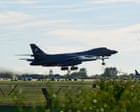
Dawn in Gloucestershire arrives without fanfare. Over the flat pastures and ancient hedgerows surrounding Royal Air Force Fairford, the morning mist usually burns off to reveal the heavy, predatory silhouettes of strategic bombers parked on the tarmac. But on an autumn Sunday, the flightlines emptied with a speed that left local residents blinking in disbelief. Within hours, a dozen massive B-1 Lancer bombers, aircraft designed to carry the weight of global deterrence on their titanium shoulders, lifted off into the grey English sky and headed west. They did not return.
Official statements offered the customary bureaucratic polish. Military spokespeople spoke of routine operational requirements and shifting strategic priorities. Yet beneath the calm exterior of defense briefings, a frantic pulse was racing. Intelligence analysts, counter-terrorism police, and Pentagon commanders knew the truth was far more fragile. A quiet, terrifying scramble had taken place behind closed doors, born from a convergence of sudden threats and invisible lines drawn across the Middle East.
To understand why the United States pulled its apex predators out of British airspace with such blinding urgency, one must look past the official press releases and examine the raw mechanics of modern vulnerability.
Imagine standing near the perimeter fence of the Gloucestershire base on a late September night. The wind rustles through the grass, carrying the distant hum of heavy jet engines undergoing maintenance. For decades, Fairford has served as an unsinkable aircraft carrier anchored firmly in the English countryside—a vital staging post linking North American power projection with European and Middle Eastern theaters. It is a place where locals are accustomed to the roar of military might, treating the thunder overhead as the ambient soundtrack of the modern alliance.
That soundtrack fractured when local vigilance pierced the perimeter of normal operations. A watchful farmer, tracking suspicious vehicle movements near the base perimeter under the cover of darkness, dialed emergency services. What followed was a rapid escalation that shocked national security circles. Counter-terrorism officers descended on the area, arresting multiple individuals on suspicion of reconnaissance and explosive offenses linked to a potential targeted plot against the facility.
While the suspects were eventually released on bail, the ripple effect through the intelligence community was immediate and severe. Reports surfaced of specific, actionable threat streams pointing toward hostile state-backed actors—specifically factions tied to Iran’s regional network—viewing foreign bases utilized for anti-regime strikes as legitimate domains for asymmetric retaliation.
When new threat warnings spiked sharply at command headquarters, hesitation evaporated. The risk calculus shifted in a single afternoon. Leaving a squadron of multi-million-dollar strategic bombers sitting on a conventional European runway exposed to localized sabotage or sophisticated infiltration was a gamble no commander was willing to take. The order was given: scatter, fly, and clear the deck.
The hasty departure of the Fairford fleet underscores a brutal modern reality. Superpower projection relies on immense logistical footprints, but those very footprints create sprawling targets in an era of asymmetric warfare. A base with decades of institutional familiarity also carries predictable vulnerabilities. When security is compromised from within or near its borders, the immense strategic value of an overseas outpost turns instantly into an acute liability.
The empty tarmac in Gloucestershire now sits as a stark monument to a changing world. The bombers are gone, recalled across the Atlantic to safer domestic expanses, leaving behind quiet runways and a lingering debate over the true cost of projecting power across oceans. The silence left behind is heavy, pregnant with the quiet realization that the front lines are no longer neatly sequestered overseas. Sometimes, they run right through the English countryside.
US bombers withdraw from Fairford airbase
This video provides a direct look at the sudden departure of the U.S. bomber fleet from RAF Fairford amid the unfolding security crisis.