The sea does not care about borders. It moves in dark swells, folding over coral reefs that took millennia to grow, indifferent to the gray hulls of warships casting long shadows across the water. For centuries, this stretch of the South China Sea was known mostly by the men who fished it—men who watched the horizon not for radar signatures, but for the sudden black turn of a squall.
Today, the horizon has changed.
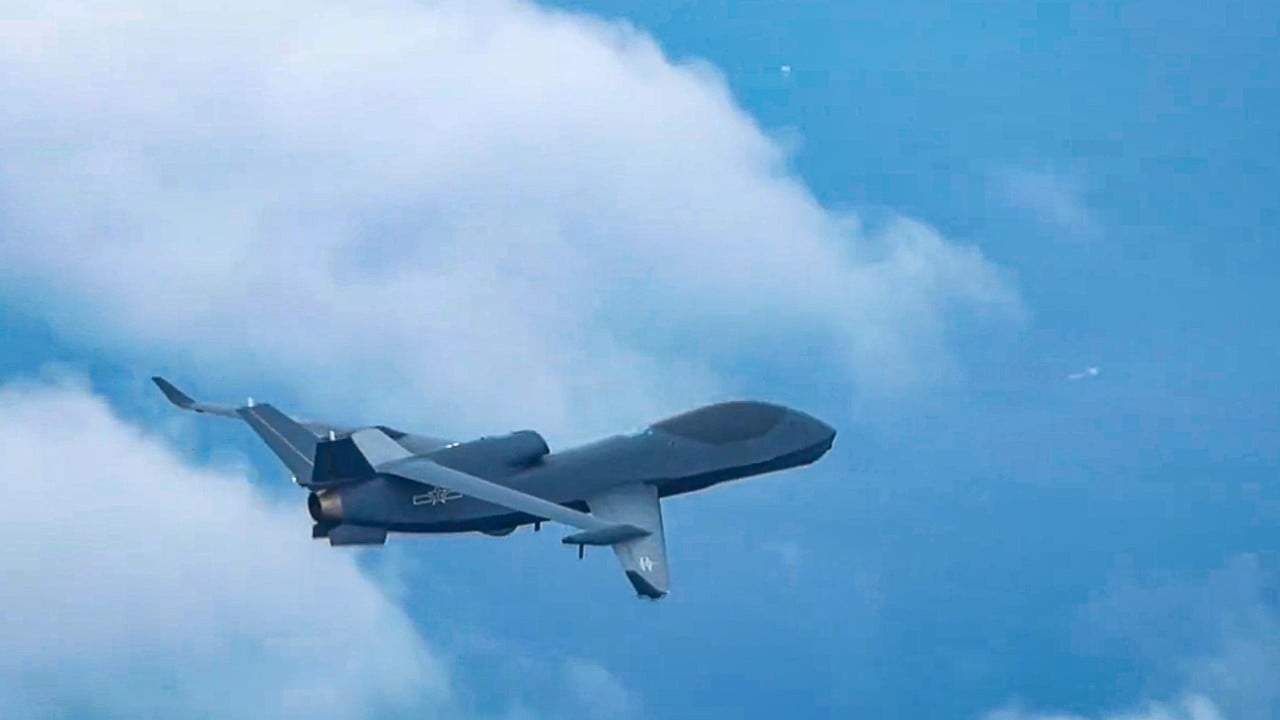
High above the contested waters of the Scarborough Shoal, a shape cuts through the thin, freezing air of the stratosphere. It has no pilot. It carries no coffee cups, no family photographs taped to a dashboard, no human breath fogging a canopy. It is the WZ-7 Soaring Dragon, and its maiden deployment to this jagged maritime flashpoint marks a subtle, terrifying shift in how nations watch one another.
To understand what happened the day that drone appeared in the skies near the shoal, you have to look down from twenty thousand feet. You have to stand on the rolling deck of a civilian vessel or sit inside a crowded command bunker hundreds of miles away, watching a screen where a gray icon represents thousands of tons of steel and human lives.
For years, aerial reconnaissance meant risk. It meant sending human crews into hostile airspace, gambling with international incidents, and accepting the brutal math of gravity and anti-air missiles. But high-altitude, long-endurance drones have rewritten that calculus. The WZ-7—with its distinct joined-wing design, resembling a sleek, angular double-diamond floating against the azure—represents a mechanical detachment from consequence.
Consider what happens next when a machine like this takes station.
It does not blink. It does not grow tired during a forty-eight-hour patrol loop. Its synthetic aperture radar and electro-optical sensors strip away the cover of night, turning pitch-black ocean into a georeferenced grid of coordinates. Every movement of a coast guard cutter, every deployment of a rubber Zodiac boat, every radio transmission bouncing across the salt air is captured, logged, and fed back to neural networks capable of predicting tactical maneuvers before the sailors executing them have finished their morning coffee.
We have built a world where our most consequential moments are witnessed by things that cannot feel the wind.
The Scarborough Shoal itself is little more than a ring of rocks and shallow water, a sunken volcano rim jutting out of the Luzon Sea. Yet it has become one of the most heavily contested intersections on the planet. Why? Because geography is destiny. Control the shoal, and you command the approaches to the Manila shipping lanes, the vital energy conduits feeding East Asia, and the airspace above trillions of dollars in global commerce.
When the dragon arrived, it did not fire a shot. That is the modern illusion of power. Modern conflict rarely announces itself with the thunder of broadsides or the screaming descent of dive bombers. It arrives in silence. It establishes dominance by simply being there, an unyielding fixture in the sky that whispers to every rival navy: We see you. We see everything.
Imagine sitting in a maritime surveillance outpost on the western coast of Luzon, watching the radar display flicker. The operator, a veteran of twenty years who remembers when patrols were flown by rumbling, oil-stained turboprops, stares at the telemetry. The object on the screen is cruising at an altitude usually reserved for commercial airliners, yet it loiters with the stubborn patience of a vulture. It is too high to intercept easily, too sophisticated to ignore, and too permanent to dismiss as a passing anomaly.
That is the psychological friction of the new era.
Military planners talk endlessly about range, payload, and sensor suites. They use dry acronyms to mask the raw, jagged edge of military competition. But the human element remains stubbornly at the center of the storm. On both sides of the water, young men and women are waking up to a reality where their safety is calculated by algorithms running on servers thousands of miles away.
The deployment of the WZ-7 near Scarborough Shoal is not merely a technical milestone for aerospace engineering. It is a warning about the shrinking margin for human error. When machines with the endurance of days and the analytical power of supercomputers manage the perimeter of a territorial dispute, the speed of escalation accelerates beyond human reflexes. Decisions that once allowed for hours of diplomatic back-and-forth, of coffee-fueled late-night phone calls between capitals, are now compressed into milliseconds.
The sea continues its ancient rhythm. The waves break over the shallow coral heads of the shoal, white foam hissing against the ancient limestone. But beneath the surface of the water, and far above it in the freezing blue, a different kind of tide is rising. It is cold. It is relentless. And it is watching.