The sea tells lies in the quiet hours of dawn. Standing on a rocky outcrop overlooking the turquoise expanse of the Mediterranean near the Egyptian coast, the water looks timeless, ancient, and pristine. It is the sea of Homer, of Phoenician traders, of bronze hulls cutting through salt-sprayed horizons. Yet, beneath that shimmering surface, an quiet revolution is underway. A biological migration is reshaping the deep, rewriting the ecological code of an entire basin, and few people are watching.
Consider the journey of a single organism: the silver-cheeked toadfish. It is an unassuming creature, mottled gray and silver, carrying within its flesh a neurotoxin potent enough to silence a human life. Decades ago, this fish lived exclusively in the warm, tropical waters of the Red Sea and the Indian Ocean. It had no business being here, trapped in the chilly nets of a Greek or Maltese fisherman. But the world changed in 1869, and with it, the boundaries of the oceans dissolved.
Human engineering achieved what nature never intended. When the Suez Canal sliced through the desert sands of the Sinai Peninsula, it did more than shorten the maritime distance between Europe and Asia. It opened a watery doorway, a wet bridge known to marine biologists as the Lessepsian migration, named after Ferdinand de Lesseps, the French diplomat who oversaw the canal's construction. For over a century and a half, that canal has functioned as a biological highway. Red Sea species, accustomed to hypersaline, ultra-warm waters, began to creep northward. At first, they were curiosities. Now, they are conquerors.
Imagine standing on the deck of a wooden trawler out of Port Said. The air smells of diesel, salt, and the sharp tang of drying fish scales. The captain, a weather-beaten man whose grandfather fished these exact waters, hauls in a net that he expects to be filled with familiar bounty: red mullet, common sole, perhaps a stray octopus. Instead, the deck wriggles with alien shapes. Nomura jellyfish as wide as wagon wheels. Dusky spinefoot rabbitfish, with venomous dorsal spines that demand cautious, gloved hands. Long-spined sea urchins that scour the rocky reefs bare, turning vibrant kelp forests into barren underwater deserts.
The sea is filling up with gatecrashers.
To understand why this is happening so rapidly, you have to look at the physics of the canal itself. For generations, the migration was slowed by a natural barrier: the Bitter Lakes, a stretch of hyper-saline water along the canal's route where salt crystals formed a toxic crust that most marine life could not cross. It was a biological speed bump. But human ambition could not leave well enough alone. The canal has been repeatedly widened and deepened. Fresh water from the Nile, which once formed a protective chemical plume at the Mediterranean mouth, was dammed and diverted by the Aswan High Dam. The salinity of the Bitter Lakes dropped. The speed bump was removed.
Water moves. Life follows.
Marine biologists use cold, clinical terms to describe this process: bio-invasion, ecological displacement, trophic cascading. But these words strip the drama from what is essentially an underwater slow-motion collision. When an invasive species arrives, it rarely brings its natural predators along. In the Red Sea, the silver-cheeked toadfish is kept in check by larger predators that hunt it, and parasites that weaken it. In the Mediterranean, it finds an ecosystem wide open, undefended, and rich with unexploited food sources.
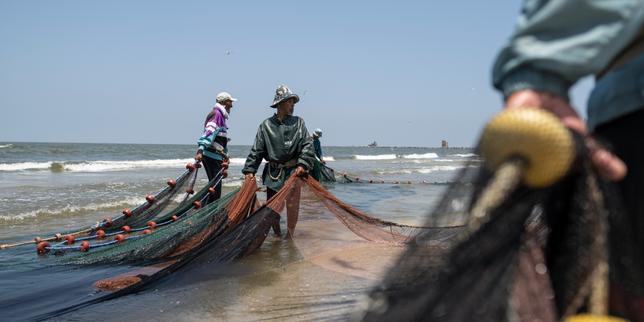
The consequences ripple outward, touching the livelihoods of people who have never heard of a Lessepsian migration. A small-scale fisherman in the eastern Mediterranean pulls up his nets to find them clogged not with marketable catch, but with venomous rabbitfish that tear the mesh and destroy his gear. These herbivorous invaders graze down the algae and sea grasses with a mechanical efficiency, leaving behind bare rock where small fish used to hide from predators. The nurseries of the sea are vanishing.
Step back and look at the broader picture. The Mediterranean Sea represents less than one percent of the world's ocean surface, yet it hosts nearly ten percent of known marine species. It is a biological hotspot, a semi-enclosed basin that acts as a giant evolutionary laboratory. When you introduce hundreds of aggressive, heat-tolerant species from the Red Sea into a basin that is already warming rapidly due to climate change, you are not just adding new fish. You are rewriting the rules of survival.
The warming of the Mediterranean acts as an accelerant on this fire. As global temperatures rise, the sea warms, making its waters increasingly hospitable to creatures that evolved in the tropics. What started as a trickle of exotic arrivals through the Suez Canal has become a steady, relentless stream. Lionfish, with their gorgeous, fan-like venomous fins and voracious appetites for juvenile fish, now patrol the reefs of Cyprus and Crete. Striped eel catfish move in dense, lethal schools across sandy bottoms.
It is easy to despair when confronted with the scale of this transformation. You cannot simply build a wall across the ocean floor. You cannot drain the canal. The migration is a permanent feature of our modern geological epoch, a physical testament to the fact that human actions have planetary consequences.
Yet, human ingenuity, which opened the door, is also searching for the latch.
In laboratories from Haifa to Athens, scientists are racing to understand the behavior of these invaders. They are mapping migration corridors, studying genetic markers, and—crucially—trying to shift culinary habits. In parts of the Aegean and the Levant, local restaurants are being encouraged to put invasive rabbitfish and blue crabs on the menu. If you cannot stop them from coming, you can eat them into submission. It is a humble, grassroots defense strategy, turning an ecological catastrophe into a local delicacy.
At the same time, international pressure mounts on authorities to implement stricter ballast water controls on the massive container ships that transit the canal daily, and to study the feasibility of ecological barriers—such as bubble curtains or localized salinity locks—at strategic points along the waterway. These are modest proposals against an immense tide, but they represent a refusal to simply surrender the sea to chaos.
Night falls over the Mediterranean. The surface smooths out into a sheet of dark obsidian, reflecting the cold light of the stars. Out on the water, the ships still glide through the Suez Canal, carrying the commerce of nations from the Red Sea into the Mediterranean, their propellers churning the water, indifferent to the invisible passenger list clinging to their hulls.
Beneath that surface, the silent migration continues. Ancient ecosystems are falling away, replaced by resilient, adaptable newcomers that care nothing for history or heritage. They only know that the door was opened, the water was warm, and the sea was waiting.
The story of the Mediterranean is no longer just about the civilizations that sailed across its surface. It is about the life that swims beneath it, and the heavy, quiet price of bridging worlds that nature meant to keep apart.