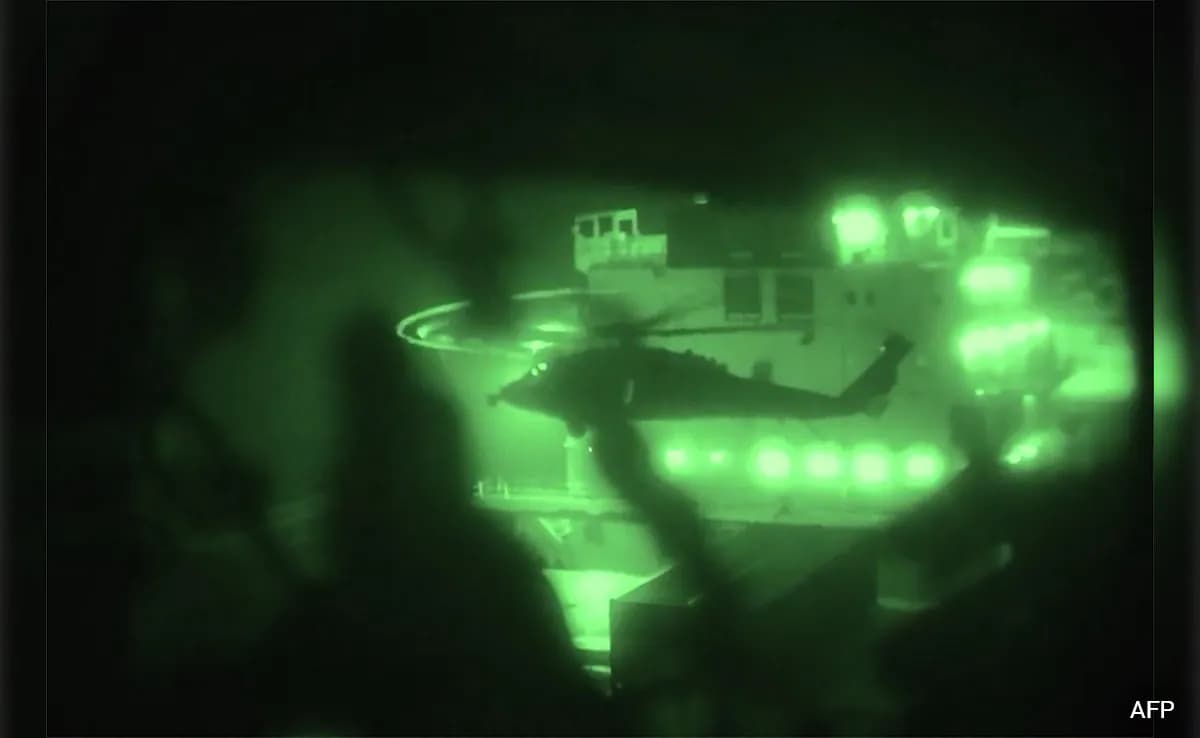
A grain of sand in the Arabian Sea doesn’t make a sound when it hits the water. But a five-hundred-foot steel hull cutting through those same blue depths speaks a language everyone in the Middle East understands. It is the language of presence. It is the heavy, unmistakable dialect of intent.
Recently, satellite imagery captured a specific silhouette drifting through those waters. To a casual observer, it is just a ship. To the diplomats sitting in climate-controlled rooms in Tehran and Washington, it is a glaring contradiction. It is the physical manifestation of a gap that is widening by the day—the space between what is said on a campaign stage and what is done on the high seas.
We are told the era of "forever wars" is over. We hear promises of a new architecture of peace, one where the United States steps back and lets the region find its own equilibrium. It sounds like a relief. It sounds like progress. But then you look at the coordinates. You look at the carrier strike groups. You see the hardware that doesn’t move unless someone expects fire.
The Weight of a Promise
Consider a merchant sailor on a tanker carrying liquefied natural gas. He doesn't care about the grand theories of international relations. He cares about the horizon. When he sees a U.S. destroyer, he feels a sense of borrowed safety. When that destroyer isn't there, the horizon feels empty and dangerous.
The current administration has mastered the art of the verbal pivot. The rhetoric is often conciliatory, suggesting that the door to diplomacy with Iran remains cracked open, provided the right conditions are met. There is a frequent invocation of "maximum pressure" being a relic of the past. Yet, the imagery from the Arabian Sea tells a different story. It shows a military posture that is not just maintained, but in some ways, tightened.
This is the central friction of modern American foreign policy in the East. You cannot tell a rival you are walking away while you are still tightening the screws on their front porch. It creates a psychological whiplash.
The Ghost of 2015
To understand why a single ship causes such a stir, we have to look back at the scar tissue of the last decade. The Joint Comprehensive Plan of Action (JCPOA) wasn't just a document; it was a bet. The bet was that trade and transparency could replace threats and triggers. When that bet was called off, the vacuum wasn't filled by nothing. It was filled by steel.
Now, we live in the aftermath of that collapse. The rhetoric coming out of Washington often tries to paint a picture of a "restrained" America. We are told the focus has shifted to the Pacific, to the "Great Power Competition" with China. The Middle East is supposed to be the rearview mirror.
But the Middle East has a way of shattering mirrors.
Every time a drone is launched or a sea mine is detected, the "pivot" to Asia is delayed. The ships stay. They circle. They wait. The satellite photos aren't just showing military movements; they are showing the failure of a narrative. You cannot pivot when your feet are stuck in the sand of a conflict you haven't actually resolved.
The Invisible Stakes
What is the cost of this gap between talk and action? It isn't just measured in fuel costs or deployment cycles. It is measured in the erosion of trust.
If you are an Iranian hardliner, you look at the peaceful rhetoric and then you look at the Arabian Sea. You see the contradiction. You conclude that the talk is a lie, a cover for continued encirclement. If you are an American ally in the Gulf—perhaps a young officer in the Emirati or Saudi navy—you look at the talk of "withdrawal" and you panic. You wonder if the ship you see today will be gone tomorrow.
Everyone is guessing. In the world of high-stakes geopolitics, guessing leads to twitchy fingers.
The "Peace Talk" we hear in press briefings is designed for domestic consumption. It plays well in Iowa. It sounds responsible in a debate. But the "US Action" we see in the Arabian Sea is designed for a different audience. It is meant for the Revolutionary Guard. It is meant to say: Don't try it.
The problem is that you can't have it both ways forever. You can't be the sheriff who has retired and the deputy who is still kicking down doors. Eventually, you have to choose a costume.
A Hypothetical Night in the Strait
Imagine a scenario—let’s call it a "friction point." It’s 3:00 AM. A small, fast-moving Iranian vessel approaches a commercial tanker. The American commander on a nearby cruiser has two sets of instructions in his head. One set is the political directive: De-escalate. We are not looking for a war. We want a diplomatic solution. The other set is his standing orders: Protect the flow of commerce. Project strength. Neutralize threats.
In that moment, the "gap" isn't a political talking point. It is a life-or-death calculation.
If the commander hesitates because he’s trying to align with the "peace talk," the tanker is seized. If he acts aggressively to align with "US action," he might start the very war the politicians say they are avoiding. This is the burden we place on the shoulders of people in uniform when our policy is built on a foundation of double-speak.
The Mirror of the Sea
The Arabian Sea is a mirror. It reflects the reality of power, stripped of the adjectives and the spin.
When we see these images—these "exposures" of military presence—we are seeing the truth of the American Empire. It is an empire that wants to go home but is terrified of what happens when it leaves. It is a giant trying to tip-toe, forgetting that it still weighs eighty tons.
The gap between the talk and the action isn't just a mistake or a coincidence. It is a strategy of ambiguity. The hope is that by talking peace, we keep the critics at bay, and by acting with force, we keep the enemies at bay.
But ambiguity is a volatile fuel. It burns hot and it burns fast.
We are currently watching a high-wire act where the performer is telling the crowd he’s standing on solid ground. The crowd can see the wire. They can see the height. They can see the wind shaking the performer’s balance.
The Price of the Pivot
The imagery tells us that the "action" on Iran is unchanged. The sanctions remain. The patrols remain. The tension remains.
The only thing that has changed is the story we tell ourselves about it. We have dressed a hawk in the feathers of a dove and are surprised when it still hunts. This isn't just about one president or one administration. it is about a fundamental inability to reconcile American interests with American exhaustion.
We are exhausted by the Middle East. We want it to be over. We want to believe the peace talk because the alternative is to admit that we are still deeply, dangerously entangled in a cold war that could turn hot with a single misunderstood signal.
The ships in the Arabian Sea are not going anywhere. They are anchored to a reality that no amount of clever speechwriting can dissolve. They are the physical proof that while the words may change, the stakes remain exactly the same.
The sea doesn't care about press releases. It only knows the weight of the ships that sail upon it. As long as those hulls are cutting through the water, the peace talk is just noise, lost in the roar of the engines and the salt spray of a conflict that refuse to end.
The silence of the satellite photo is the loudest thing in the room. It says what the podium won't. It shows the world that beneath the veneer of a new direction, the old machinery is still humming, waiting for a spark in the dark.


