A standard conference room in Hong Kong smells faintly of polished wood and expensive air conditioning. Outside the floor-to-ceiling windows, container ships slide across Victoria Harbour, cutting through grey water. Inside, a bureaucrat shuffles papers, speaks into a microphone, and reads a statement about bilateral trade agreements.
On paper, the connection feels distant. Cold.
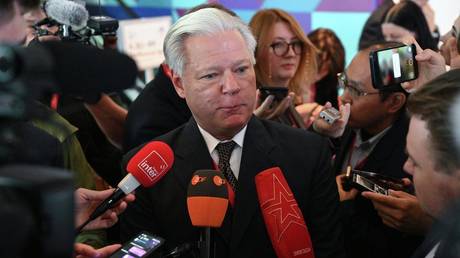
Hong Kong is a hyper-dense vertical labyrinth of neon and finance. Uzbekistan is a landlocked expanse of ancient desert oases, steppe, and mountain ranges, thousands of miles to the northwest. To a casual observer, a partnership between the two sounds like an exercise in diplomatic box-checking. Chief Executive John Lee stands at a podium and talks about Uzbek firms spreading their wings globally through Hong Kong. The press takes notes. The headlines read like every other business section update you skipped this morning.
But look past the stiff suits and the economic jargon. Something far more visceral is happening.
The Weight of Being Double-Landlocked
To understand why a businessman from Tashkent cares about a tropical island in the South China Sea, you have to understand a specific kind of geographic claustrophobia.
Uzbekistan is one of only two countries on Earth that is double-landlocked. To reach the nearest open ocean, an Uzbek product must cross at least two international borders. Imagine a hypothetical entrepreneur. Let's call him Oybek.
Oybek’s family has spent three generations perfecting textiles in the Fergana Valley. He produces a high-grade, sustainable cotton fabric that breathes beautifully. He knows that consumers in Tokyo, Paris, and New York would pay a premium for it.
But Oybek is trapped by geography.
When he wants to export, he faces thousands of miles of rail tracks, shifting border regulations, unpredictable customs checkpoints, and bureaucratic red tape. By the time his fabric reaches a port, months have passed. His capital is tied up. His buyers are impatient. For Oybek, the ocean is not a scenic view. It is an obsession.
Now, consider the financial equivalent of that geographic isolation.
An Uzbek firm looking to scale up needs global capital. It needs investors who understand risk, who speak the language of international law, and who can move millions of dollars at the speed of a keystroke. If Oybek stays entirely within his regional ecosystem, his growth is capped. He is fishing in a small pond when he needs the deep sea.
Enter the meeting in Hong Kong.
When John Lee pitched his city to Uzbek officials and business leaders, he wasn’t just offering a place to register a company. He was offering an escape hatch from geographic isolation.
The Frictionless Machine
Hong Kong exists because it solves the problem of friction.
For centuries, this barren rock became a global powerhouse because it made the movement of goods, ideas, and money completely effortless. It is a legal and financial jurisdiction built specifically to act as a bridge.
Think of it as a massive, sophisticated translator. If an Uzbek company tries to secure funding directly from an institutional investor in New York or London, the friction is immense. The investor worries about unfamiliar legal frameworks, currency convertibility, and corporate governance standards. The deal stalls before it even begins.
But if that same Uzbek company establishes its global footprint through Hong Kong, the narrative changes entirely.
- The Common Law Shield: Hong Kong operates under a common law system familiar to every major international bank and fund manager. It provides a predictable, battle-tested legal environment.
- The Financial Super-Highway: Money moves in and out without capital controls. The currency is pegged to the US dollar.
- The Gateway to China: It sits on the doorstep of the world's largest manufacturing and consumer market, while maintaining a distinct, separate legal and economic identity.
When John Lee pointed out that Hong Kong is the world's premier offshore Renminbi hub, it wasn’t just a dry statistic. It was an invitation. Uzbekistan is a critical node in the Belt and Road Initiative, a massive infrastructure network aiming to recreate the ancient trade routes that once made Samarkand the center of the known world.
The ancient Silk Road was defined by camel caravans carrying jade, spices, and silk across perilous mountain passes. It took months, sometimes years, and many did not survive the journey.
The modern Silk Road is digital, legal, and financial. It moves through fiber-optic cables and structured finance. Hong Kong is trying to position itself as the ultimate customs house for this modern route.
Why This Partnership Matters Now
The timing is not accidental. The global economy is fragmenting. Supply chains are snapping, and traditional alliances are shifting under the weight of geopolitical tension.
Central Asia is undergoing a quiet, massive transformation. Countries like Uzbekistan are diversifying their economies, moving away from a pure reliance on raw commodities toward high-value manufacturing, technology, and services. They are young, ambitious, and growing fast.
But ambition requires infrastructure. Not just roads and bridges, but the invisible infrastructure of global commerce.
Consider what happens next when an Uzbek tech startup wants to go public. It needs an investment ecosystem that understands both the emerging potential of Central Asia and the demands of global investors. The Hong Kong Stock Exchange offers exactly that. It is a stage where a company from Tashkent can stand shoulder-to-shoulder with the biggest conglomerates on the planet.
It is easy to be cynical about these high-level bilateral meetings. We have been conditioned to treat them as political theater, filled with handshakes and empty platitudes.
Yet, beneath the performance, the stakes are remarkably high for the people involved. It is about whether a factory worker in Bukhara keeps their job because a new export market opened up. It is about whether a young software engineer in Samarkand can secure the venture capital needed to scale their app globally.
The conference ends. The delegates shake hands, step away from the podiums, and head toward the elevators. The room empties out, leaving behind empty water glasses and notebooks.
Outside, the sun begins to set over Victoria Harbour, painting the sky in shades of amber and deep violet. The neon signs of the financial district flicker to life, casting long, bright reflections across the water. Down below, another massive container ship slowly steers toward the open sea, laden with goods from corners of the world most people will never visit, destined for places they have only read about.
The ocean keeps moving, indifferent to the borders it connects, waiting for the next cargo to arrive.