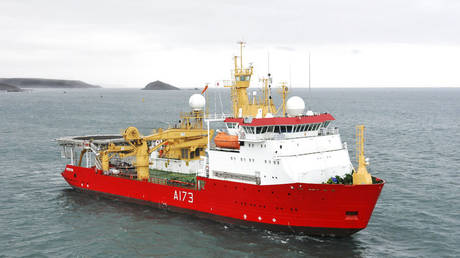
Towing the Royal Navy's sole ice patrol ship HMS Protector back into Devonport after a double engine defect in October 2026 exposes a structural flaw in British polar strategy: single-asset dependency paired with repeated stopgap procurement. Headlines focused on the drama of a broken ship at sea miss the underlying mechanics. A single aging hull carrying sovereign, hydrographic, inspection, and scientific duties across two hemispheres creates a severe operational bottleneck whenever propulsion fails.
What a headline report treats as an isolated mechanical failure is actually the predictable result of long-term asset stretching, delayed fleet replacement, and an unbuffered mission profile. Understanding why this breakdown matters requires separating verified facts from educated hypotheses, examining the technical constraints of polar propulsion, and tracing how fleet bottlenecks ripple into maritime governance and South Atlantic deterrence.
Deconstructing the Competitor Narrative and Mapping Its Logic
Standard coverage of HMS Protector's October 2026 tow into Devonport follows a familiar media arc. First comes the alarm over a double engine defect on Britain's only naval icebreaker. Second comes political and strategic commentary linking the outage to broader defense budget strain and tensions over the Falkland Islands. Third comes speculation about whether the engines are unrepairable and whether a replacement will take until the 2030s.
That narrative works well for immediate news impact, yet it leaves major causal links unexamined. Reporting a breakdown as a sudden shock obscures the fact that HMS Protector began life in 2001 as the commercial vessel MV Polarbjørn before entering Royal Navy charter in 2011 and outright purchase in 2013. Treating a 25-year-old commercial-derived vessel running high-duty polar cycles as a routine frontline warship hides how operational tempo and past refits shape reliability over time.
Another gap in standard reporting is functional conflation. Observers often treat "polar presence" as a single monolithic capability. In practice, scientific ice resupply, hydrographic charting, Antarctic Treaty inspections, fisheries enforcement, and visible naval presence require distinct legal authorities, hull ratings, and endurance profiles. Conflating them makes it harder to see which exact capabilities vanish when HMS Protector goes offline.
Verified Facts Versus Educated Hypotheses
A rigorous strategic assessment starts by sorting confirmed facts from plausible but unproven explanations:
- Confirmed operational event: HMS Protector suffered a propulsion or engine defect at sea in October 2026 and was towed back to HMNB Devonport rather than completing operations under its own main power.
- Confirmed hull lineage and class: Built in 2001, the 89-meter, roughly 5,000-tonne ship holds a DNV Ice Class 05 rating suited to first-year ice up to 0.5 meters thick, and was originally acquired as a stopgap after HMS Endurance suffered severe flooding damage in 2008.
- Confirmed mission scope: The vessel alternates deployments between polar and sub-polar waters, supporting hydrographic surveys, research logistics, Antarctic Treaty inspections, and sovereign presence.
- Confirmed procurement uncertainty: Replacement planning has been discussed in defense policy circles, with procurement method and delivery timing still unresolved.
- Educated hypothesis on root cause: Media and naval observers have raised questions about whether cumulative operating wear, prior propulsion or overhaul work, or maintenance practices contributed to the failure. Without a formal technical investigation report, attributing the defect to a single maintenance error or a single component remains an educated hypothesis rather than a proven fact.
- Educated hypothesis on repair viability: Claims that the main engines could face long-term or permanent unserviceability reflect informed commentary on marine engineering economics, not a finalized engineering verdict. At some point in a ship's life cycle, the cost and downtime of major machinery replacement exceed the remaining useful service life of the hull.
The Three Pillars of Polar Maritime Capability
Evaluating what the Royal Navy loses during an outage requires breaking polar maritime operations into three distinct pillars: Hull and Icebreaking Physics, Multi-Mission Tasking, and Sovereign and Legal Presence. A failure in propulsion collapses all three at once for a single-ship fleet.
Hull and Icebreaking Physics
Ice navigation imposes mechanical loads that differ sharply from open-ocean transit. A vessel rated to DNV Ice Class 05 is engineered for first-year ice up to roughly half a meter thick, rather than heavy multi-year pack ice that demands massive displacement and extreme icebreaking power. Breaking ice relies on hull geometry, weight, installed power, and controllable propulsion to ride onto or fracture ice sheets while managing shock loads on shafts, bearings, and main engines.
When a vessel has a single main propulsion plant configuration or limited redundancy under heavy load, mechanical stress compounds risk. Even if a ship has auxiliary or maneuvering thrusters for station-keeping or harbor work, those systems are not substitutes for main propulsion during long-distance ocean transits or sustained ice operations.
Multi-Mission Tasking
Unlike a single-purpose cargo ship, HMS Protector functions as a multi-role platform. Its task list spans hydrographic surveying to update nautical charts, logistical support for polar research stations, small-boat operations in shallow or confined waters, and environmental monitoring.
This breadth creates an efficiency gain during normal operations because one crew and one hull cover multiple tasks. The hidden cost is concentration risk. When that single multi-mission platform enters unplanned dry dock or extended repair, every scheduled survey window, station support slot, and seasonal deployment competes for scarce alternatives or slips into future years.
Sovereign and Legal Presence
In contested or strategically sensitive regions such as the South Atlantic and Antarctic approaches, physical presence carries diplomatic and legal weight. Inspections under international treaty frameworks and visible naval patrolling signal active stewardship rather than passive paper claims.
Civilian research vessels can sustain scientific logistics in many circumstances, but they do not carry the same naval command posture or sovereign enforcement mandate as a commissioned warship. Losing the commissioned polar vessel therefore creates a capability gap that civilian science tonnage cannot fully close.
The Cost Function of Stopgap Fleet Management
In defense and infrastructure economics, deferring capital replacement often looks frugal on an annual budget ledger while imposing high hidden costs over time. The cost function of running an aging single-ship fleet can be expressed conceptually across four variables:
- Capital expenditure (CapEx): Outright purchase or new-build construction requires large upfront outlays and multi-year lead times.
- Operating and maintenance expenditure (OpEx): Older machinery and complex polar environments drive higher inspection frequency, specialized parts demand, and rising overhaul costs.
- Availability and downtime cost (Downtime): Every week spent in unplanned repair or towage reduces operational days at sea and forces schedule compression.
- Strategic opportunity cost (Opportunity): Missed seasonal windows in high latitudes cannot simply be made up in mid-winter when ice and weather conditions tighten.
When procurement decisions slip, policymakers frequently lean on short-term life extensions or emergency charters. That pattern appeared after HMS Endurance was lost to service in 2008, leading to chartering Polarbjørn before purchasing her. The limitation of stopgap charters is market timing: suitable ice-capable vessels are scarce globally, and emergency charters tend to carry premium rates and compromised mission fit.
Missed Cause-and-Effect Chains in Polar Operations
Three second-order cause-and-effect chains explain why a single propulsion failure reverberates far beyond the engine room:
- Seasonal windows amplify minor delays into full-season losses. Polar deployment calendars are tightly bound to seasonal ice retreat, daylight, and weather windows. A multi-month engineering investigation or refit that overlaps with the southern summer deployment window does not merely delay a mission by a few weeks; it can forfeit an entire annual operating cycle.
- Unplanned maintenance crowds out planned maintenance. When an active fleet has zero spare hulls, an unplanned casualty forces planners to reassign engineering labor, dockyard slots, and funding. That diversion can squeeze preventative maintenance schedules across other vessels or delay replacement procurement milestones.
- Capability gaps erode deterrence credibility incrementally. Deterrence in remote maritime theaters rarely breaks in a single dramatic moment. Instead, repeated availability gaps signal fiscal and operational strain, encouraging rival claimants or competitors to test diplomatic boundaries while capability remains thin.
Tactical Decision Logic for Fleet Continuity
To manage polar capability without falling back on reactive scrambling, defense planners can apply a structured four-step decision sequence when a sole specialized asset suffers a major failure:
- Triage technical viability using a hard cost-to-life threshold. Engineers should establish a strict boundary comparing estimated repair and machinery replacement cost—plus expected post-repair reliability—against remaining hull life and replacement build timelines. Avoid open-ended repair loops on aging propulsion plants if the hull itself is nearing end-of-life.
- Unbundle the mission set before seeking replacements. Separate scientific cargo and research support from naval patrol, hydrography, and treaty inspection tasks. Assigning each sub-mission to the most cost-effective available platform prevents over-specifying a single replacement or leaving high-value tasks unstaffed.
- Evaluate lease-to-buy and allied pooling options early. If an immediate gap is unavoidable, compare commercial charter options against allied vessel sharing or modular survey packages before market availability tightens. Commercial charters solve near-term presence but may lack naval communications, self-defense fittings, or sovereign tasking flexibility.
- Lock in a standardized, multi-hull replacement program. Replace single-point reliance with a clearly funded build program designed around commercial-derived proven subsystems where appropriate, while maintaining realistic spares and maintenance margins.
Operational Limitations and Trade-Offs
No fleet strategy eliminates risk entirely. Commissioning a bespoke heavy military icebreaker maximizes capability and endurance, yet drives up unit cost and build time, risking further budget friction. Conversely, relying on commercial charters or light ice-classed hulls lowers upfront cost but constrains ice thickness limits, endurance, and sovereign authority. Even a two-ship class reduces single-point failure without guaranteeing zero downtime if both hulls face concurrent maintenance or severe weather.
Strategic Play for Polar Fleet Resilience
Stop treating polar icebreaking as a one-off ship replacement problem and commit to a two-tier continuity architecture: pair a near-term commercial or allied bridge solution for non-combat research and survey support with a ring-fenced, multi-vessel naval ice patrol procurement program backed by dedicated lifecycle maintenance funding. In high-latitude maritime strategy, a smaller, well-maintained, redundant capability delivered on schedule outperforms an ambitious single-hull concept that leaves the theater empty during repairs.


