The asphalt is a black scar through the emerald skin of Sumatra. To a driver in a rusted truck, the road is a convenience—a straight line through the dense humidity of Northern Indonesia. But to an orangutan, this twenty-foot wide strip of sun-baked tar is an abyss. It is a dead zone. It is the end of the world.
For years, the Sumatran orangutan has been a prisoner of its own biology. These are creatures of the heights. Their hands are hooked tools designed for the swinging physics of the canopy. Their feet are essentially a second pair of hands. On the ground, they are clumsy, vulnerable, and exposed to every predator and speeding vehicle that claims the lowlands. When we build a road through their forest, we aren't just laying pavement; we are shattering a home into disconnected islands.
Imagine a mother orangutan. Let’s call her Maya. She is a theoretical construct based on the very real data points gathered by conservationists in the Batang Toru forest. Maya carries her infant on her hip, her long, copper fur matted with the damp of the morning. She reaches the edge of the clearing. The familiar tangle of branches ends abruptly. Before her lies a void of light and heat. Across that void, she can see the fruit trees she needs to survive, the genetic diversity she needs to ensure her lineage doesn't wither in a shrinking territory.
She stops. She waits. She turns back.
This is the silent tragedy of fragmentation. It isn't as loud as a chainsaw or as visible as a forest fire. It is a quiet, creeping starvation of the gene pool. If populations cannot mix, they cannot survive. They become ghosts in their own woods.
The Physics of the Solution
The fix sounds almost insulting in its simplicity. If the canopy is gone, we must build a new one.
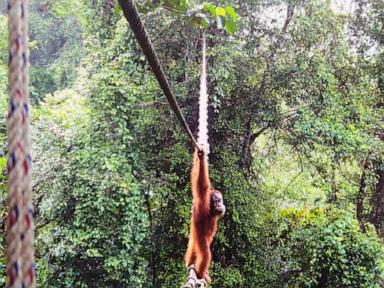
In the Gayo Lues district of Aceh, conservationists didn't wait for a miracle. They looked at the gap and decided to bridge it with nothing more than heavy-duty rope and a bit of human ingenuity. They constructed a suspended walkway—a series of thick, weather-resistant lines strung sixty feet above the speeding traffic.
At first, the skeptics were vocal. Primates are notoriously cautious. A new object in their environment is often met with suspicion, if not outright terror. Would a creature as intelligent as an orangutan trust a man-made thread?
The answer came from a motion-triggered camera trap. The footage wasn't just a record of animal movement; it was a vindication of a desperate gamble.
The lens caught a large male, his cheek pads wide, his eyes scanning the horizon. He didn't hesitate for long. He reached out, his massive fingers gripping the rope with the same instinctive certainty he would use on a mahogany branch. He swung. He moved with a grace that the road below could never afford him. Beneath his feet, the trucks roared past, oblivious to the fact that a billion years of evolution was crossing over their heads.
This wasn't a fluke. It was a bridge in every sense of the word.
The Invisible Stakes
Why does a few hundred feet of rope matter to a global audience?
We often talk about conservation in terms of massive numbers—millions of acres, billions of dollars, thousands of species. But those numbers are too big to feel. They slip through the cracks of our empathy. The reality of the Sumatran orangutan is found in the individual. There are perhaps fewer than 14,000 of them left in the wild. Every time a single individual crosses that road to find a mate, the survival odds of the entire species shift by a fraction of a percent.
When we fragment a forest, we create "islands of the living dead." These are pockets of habitat where the animals are technically alive, but because they are cut off from the rest of their kind, their population is functionally extinct. They are trapped in a slow-motion collapse.
The rope bridge is a rejection of that collapse.
It represents a shift in how we view our relationship with the natural world. For decades, the philosophy was "keep them away." We built fences. We created borders. But animals don't understand borders. They understand corridors. They understand the flow of life from one food source to the next.
The technology involved here isn't the "cutting-edge" nonsense of a Silicon Valley boardroom. It is the technology of observation. It is the work of people like the North Sumatra Hydro Energy staff and local conservation groups who spent months tracking movement patterns, identifying exactly where the crossing points used to be before the roads arrived.
The Human Element
Consider the rangers who check these camera traps. They trek through mud that threatens to swallow their boots, battling leeches and the oppressive heat of the Indonesian noon. They do this for a single frame of grainy, night-vision footage.
When they see an orangutan using the bridge, it isn't just data. It’s a victory for a specific kind of human persistence. It’s the realization that while we are the ones who broke the world, we are also the only ones who can stitch it back together.
There is a profound humility in building a bridge for a being that doesn't know you exist. Maya doesn't thank the engineers. She doesn't understand that the rope she grips was manufactured in a factory and hauled up by a team of sweaty humans. To her, it is simply a path. A way forward.
But the stakes are not just hers. They are ours.
The Sumatran rainforest is one of the most carbon-rich landscapes on the planet. The orangutans are the "gardeners" of this forest. They eat fruit and travel long distances, dispersing seeds that grow into the giant trees that breathe for the rest of us. If the gardeners die out because they can't cross a road, the garden eventually follows.
The Anatomy of the Crossing
The bridge itself is a marvel of low-tech resilience. It has to withstand the tropical sun, which cracks rubber and fades plastic. It has to endure the torrential rains of the monsoon season. Most importantly, it has to be comfortable for the animal.
- Tension: The lines must be taut enough to support the weight of a 200-pound flanged male but flexible enough to mimic the sway of a living tree.
- Grip: The texture of the rope must allow for the complex mechanics of an orangutan's hand.
- Placement: It must be high enough to clear the tallest trucks but integrated into the existing canopy so the animals actually find it.
When these elements align, the result is a seamless transition. The camera footage shows mothers with infants on their backs, young juveniles testing their strength, and dominant males reclaiming their territory. They are using the bridge as if it has always been there.
This success has a ripple effect. If a rope bridge works for an orangutan, what could a similar structure do for the gibbons? For the clouded leopards? For the countless other species that find themselves staring at a strip of asphalt with no way to get to the other side?
A Different Kind of Progress
We are taught that progress is the road. We are taught that development is the ability to move goods and people faster and more efficiently. But maybe true progress is the ability to move ourselves forward without leaving everything else behind.
The road through the Batang Toru forest isn't going away. The demand for infrastructure, for energy, and for connectivity is a reality of the modern world. We cannot simply wish the roads out of existence. But we can refuse to accept the road as a finality.
The rope bridge is a compromise. It is an admission of guilt and a gesture of repair. It is a tiny, swaying thread of hope in a world that often feels like it is coming apart at the seams.
The next time you see a road stretching into the distance, think of Maya. Think of the copper-haired giant sitting at the edge of the trees, looking at the gap. She doesn't need a miracle. She doesn't need a grand gesture. She just needs a way to keep moving.
She reaches out. She finds the rope. She crosses.
Deep in the Aceh forest, the camera shutter clicks. A single frame captures a creature suspended between two worlds, navigating a man-made solution to a man-made problem. The trucks continue to rumble below, but for a moment, the gap is closed. The forest is whole again, one handhold at a time.