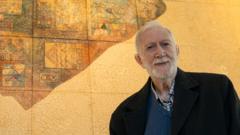
Art rarely carries the weight of a nation. For Sliman Mansour, who passed away at the age of 79, it carried an entire civilization's memory, struggle, and defiance.
Friends, family, and cultural figures gathered at St. Peter's Church in Birzeit to lay the legendary Palestinian painter and sculptor to rest. His funeral marked the end of an era, closing a five-decade chapter of artistic resistance that shaped modern Palestinian identity. But his visuals aren't going anywhere. They live on in t-shirts, tattoos, posters, and the collective consciousness of a diaspora.
The Man Who Painted Sumud
Born in Birzeit in 1947 just months before the Nakba, Mansour lived through the brunt of displacement and occupation. He didn't just paint landscapes; he painted sumud, the Arabic term for steadfastness.
If you grew up seeing iconic images of Palestinian resilience, you already know his work. Consider his 1974 masterpiece, Camel of Hardships. It shows an elderly Palestinian man carrying the Old City of Jerusalem on his back inside a wooden frame. It's heavy. It's devastating. And it became an instant visual anchor for millions who refused to let their heritage be erased.
His art wasn't confined to fancy galleries. It was meant for the streets.
When Mud Replaced Oil Paints
History shifted during the First Intifada in the late 1980s. Israeli restrictions and boycotts made commercial art supplies hard to get. Did Mansour stop creating? Absolutely not.
Instead, he co-founded the "New Vision" art group alongside fellow creators and made a radical pivot. They boycotted Israeli art materials entirely. Mansour and his peers started crafting art from the literal earth beneath their feet. They used:
- Local mud and clay
- Straw and twigs
- Coffee beans and henna
This wasn't just a clever workaround. It was a profound political and artistic statement. Using mud and straw meant the land itself was forming the canvas. The medium and the message became one.
Rehumanizing a People Through Art
Mansour once noted in an interview that breathing and existing as a Palestinian under occupation was treated as a threat by the Israeli state. To combat systemic dehumanization, he viewed culture as a tool for survival.
"As artists and people who deal with culture, it's our role to rehumanize the Palestinian people," Mansour explained.
His paintings avoided overt messages of hatred. They focused on olive trees, traditional embroidery, village elders, and daily domestic life. He wanted to show the simple beauty of a culture that others tried to wipe out. For Palestinians scattered across the globe, his canvases acted as an emotional bridge back home.
A Legacy Etched in History
Tributes poured in from across the Arab world and international art institutions following his death. Figures like Emirati art patron Sultan Sooud Al Qassemi remembered him as a giant of modern art. Institutions like the Palestinian Museum noted that Palestine wasn't just the subject of his work, but its ultimate purpose.
The funeral in Birzeit and subsequent memorial gatherings in Jerusalem and Ramallah offered communities a chance to mourn. Yet, the overwhelming sentiment remains gratitude. Mansour gave people an enduring visual language. He proved that pens, brushes, and mud can outlast walls, checkpoints, and censorship.
Look at his paintings today. You'll see why his final chapter closes with a legacy that refuses to fade.