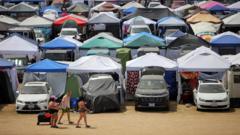
The shift from traditional festival camping to high-amenity "glamping" at Coachella represents more than a lifestyle trend; it is the physical manifestation of capital-intensive luxury encroaching on spaces historically defined by resource scarcity and communal equity. This transition creates a friction point between British festival-goers—who subscribe to a "hardship-as-authenticity" model—and the American commercialization of the outdoor experience. By quantifying the variables of comfort, social signaling, and logistical efficiency, we can map the structural collapse of the egalitarian festival archetype.
The Tri-Factor Model of Festival Accommodation Evolution
The migration from a $50 nylon tent to a multi-thousand-dollar climate-controlled yurt is driven by three measurable pressures:
- Thermal Regulation and Physiological Retention: The Indio desert environment presents extreme diurnal temperature shifts. Standard camping offers zero insulation, leading to cognitive fatigue and physical exhaustion. Luxury upgrades are a biological hedge, allowing participants to maintain higher levels of social and physical performance over a 72-hour period.
- The Time-Efficiency Premium: Traditional camping requires high labor inputs (setup, teardown, hydration logistics). Luxury tiers outsource this labor to the festival organizers. For high-net-worth individuals, the hourly value of their time far exceeds the cost of a pre-pitched Safari tent.
- Social Stratification and Scarcity Signaling: As festivals become global media events, the accommodation becomes a stage set. The "fancy" tent serves as a visual indicator of status within a crowded, anonymous environment.
The British Friction Point: Cultural Capital vs. Financial Capital
The specific grievances cited by British attendees regarding the "Americanization" of Coachella camping stem from a fundamental disagreement on the definition of "festival spirit." In the UK, festivals like Glastonbury have historically operated on a flattened social hierarchy. The prestige is found in endurance—navigating mud, rain, and minimal facilities.
When American festival-goers introduce high-end amenities, they replace cultural capital (the status earned through shared hardship) with financial capital (the status purchased through upgrades). This creates a "dual-class" system that breaks the illusion of a temporary utopia. For the British traditionalist, the presence of a mirror, a real mattress, and air conditioning isn't just a comfort; it is a betrayal of the collective struggle that supposedly validates the musical experience.
The Economic Impact of Luxury Tiering
Festival organizers utilize "glamping" as a tool for revenue maximization without increasing the total footprint of the event. A standard campsite occupies roughly 100 square feet and generates a flat fee. A luxury yurt occupies 150 square feet but generates 20 to 50 times the revenue.
- Margin Expansion: The marginal cost of providing a bed and a fan is negligible compared to the premium charged.
- Segmenting the Market: By offering tiers, organizers capture "consumer surplus"—money that wealthy attendees are willing to spend but would otherwise keep if only a base-level ticket were available.
- Infrastructure Stress: While glamping reduces the volume of trash (as cheap tents are often abandoned), it increases the demand for power grids and water supply, shifting the logistical burden from waste management to utility provision.
The Efficiency Frontier of High-End Camping
Critics often view luxury camping as "lazy," but from a systems-analysis perspective, it is a pursuit of the efficiency frontier. A participant who sleeps in a climate-controlled environment requires fewer recovery days post-event and can maintain a higher level of engagement with the festival's primary assets (the music and brand activations).
However, this efficiency introduces a "bubble effect." When the environment becomes too curated, the participant is insulated from the spontaneous social interactions that occur in high-density, low-amenity camping. This leads to a decline in the "network effect" of the festival, where the value of the event is derived from the density of unpredictable human connections.
Determinants of the Modern Festival Experience
To understand why the "fancy tent" is now inevitable, we must look at the changing demographics of the attendees. The average age of a Coachella attendee has trended upward alongside the rising cost of entry. As the demographic shifts toward mid-career professionals, the tolerance for physical discomfort drops.
- Sanitation Access: The "Cost of Cleanliness" is a primary driver. Private showers and flushable toilets are the most cited reasons for upgrading. This highlights a failure in basic infrastructure that organizers have successfully monetized.
- Security and Asset Protection: As attendees bring higher-value electronics (cameras, smartphones, laptops) to document the event, the insecurity of a standard tent becomes a financial risk. The lockable nature of luxury accommodations acts as a primitive form of insurance.
The Operational Reality of Logistics Providers
The companies supplying these "fancy tents" are not lifestyle brands; they are logistics and rental firms operating on razor-thin windows of time. The assembly of a "safari camp" in the desert is a feat of rapid deployment.
- Prefabrication: Components are modular to ensure a 48-hour setup time for thousands of units.
- Climate Mitigation: The use of reflective materials and raised flooring is a technical requirement to prevent heatstroke, not just an aesthetic choice.
- The "Turnkey" Mandate: The modern consumer demands a zero-friction arrival. The moment an attendee has to hammer a stake into the ground, the luxury value proposition evaporates.
The Structural Inevitability of the Two-Tier Festival
The conflict between British "grit" and American "glam" is a lagging indicator of a broader economic shift. Festivals are no longer counter-cultural experiments; they are high-yield asset classes. In any high-yield environment, the optimization of the high-spending guest is the priority.
The "fancy tent" is a response to a saturated market where simply "being there" is no longer enough of a draw for the top 10% of the wealth bracket. To keep these high-value consumers engaged, the festival must mimic the hospitality standards of a boutique hotel. This creates a feedback loop: as more luxury options are added, the "standard" experience feels increasingly impoverished by comparison, driving more people to upgrade.
Strategic Position: The Hybridization of Camping
For those seeking to navigate this landscape, the optimal strategy is not to reject the luxury trend but to identify the point of diminishing returns. The jump from a standard tent to a "ready-to-go" basic tent offers the highest ROI in terms of stress reduction vs. cost. The jump from a basic tent to a $10,000 luxury villa is an exercise in pure status signaling with minimal marginal gains in actual utility.
Investors and organizers should anticipate a move toward "modular infrastructure" where attendees can pick and choose specific upgrades (e.g., just power, or just a bed) rather than being forced into all-or-nothing luxury packages. This unbundling of amenities would mitigate the social friction by allowing for a more gradual spectrum of comfort rather than a stark, visible divide between the "haves" and "have-nots" in the camping lots.
The long-term risk to the Coachella brand—and festivals like it—is the loss of the "bohemian" facade that justifies the high ticket price. If the environment becomes indistinguishable from a luxury resort, it loses the "edge" that makes it a cultural touchstone. The British critics are right about one thing: when you remove the struggle, you risk removing the soul of the event. But from a balance sheet perspective, the soul is a non-performing asset.