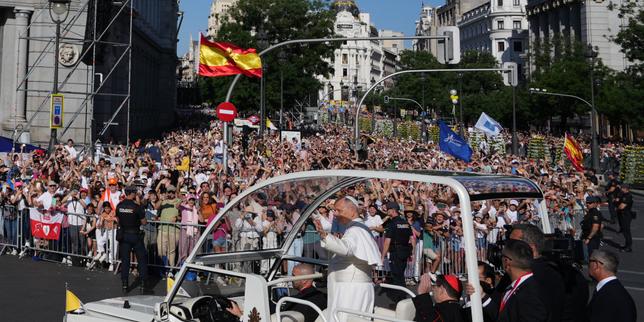
The heat in Madrid during August does not just sit on you. It presses down like a physical weight, baking the asphalt until the air above it shimmers with a dizzying distortion. On a normal summer Sunday, the Cuatro Vientos airbase is a bleak, sprawling expanse of concrete and dry earth, bleached white by the relentless Spanish sun.
But this was not a normal Sunday.
By mid-morning, the concrete had vanished. In its place was a sea of humanity so dense that from an aerial view, the ground appeared to be moving, shifting in waves of color and motion. More than 1.2 million people had occupied the airfield. They came from every corner of the globe, speaking a Babel of languages, packed shoulder to shoulder in a space built for airplanes, not souls.
To understand what drew more than a million people to a scorching airfield, you have to look past the official press releases and the sheer, staggering statistics. You have to look at the dust on their shoes.
The Crucible of Cuatro Vientos
Consider a young woman named Maria. She is nineteen, from a small town outside Porto, and she has spent the last three days sleeping on cardboard sheets, eating lukewarm rations from a backpack, and sharing portable toilets with thousands of strangers. Her skin is sunburned. Her throat is parched.
Under normal circumstances, this scenario would be classified as a logistical nightmare, a borderline humanitarian crisis. If a music festival subjected its patrons to these conditions, the internet would erupt in outrage. Yet, Maria was smiling.
This is the strange alchemy of World Youth Day. The event, presided over by Pope Benedict XVI, transformed a barren military site into the temporary capital of the Catholic world. The sheer volume of people created a localized ecosystem of shared endurance. When the sun finally dipped below the horizon on the eve of the final mass, it brought little relief. Instead, it brought a sudden, violent summer storm.
Lightning ripped across the Madrid sky. Powerful gusts of wind tore at the temporary structures, ripping umbrellas from hands and threatening to topple the massive altar. The sound of the wind was deafening.
In that moment, the event hovered on the edge of panic. Security personnel braced for chaos. The Pope’s own aides urged him to seek shelter, to abandon the stage for his own safety.
He refused. He sat in his chair, drenched by the driving rain, watching the crowd.
And then, something extraordinary happened.
Instead of fleeing for cover or erupting into chaos, the crowd of over a million young people began to sing. They sang in French, in Spanish, in English, in Polish. The voices rose above the howling wind, a collective defiance of the elements. It was a visceral demonstration of shared resolve. They had not traveled thousands of miles to be scattered by a thunderstorm.
The Anatomy of a Crowd
When the media reports on a gathering of this scale, the focus inevitably lands on the number. 1.2 million. It is a statistic that is easy to write but impossible to truly comprehend.
How do you visualize a million people?
Imagine filling Europe’s largest football stadiums to maximum capacity. Now imagine twelve of them, emptied out into a single, sun-baked field. It is a logistical puzzle that requires months of planning, miles of temporary water piping, hundreds of medical tents, and an army of volunteers working through the night to distribute millions of communion wafers.
But the logistics only explain the how. They do not explain the why.
The modern world is increasingly fragmented. We live behind screens, interacting through curated personas and algorithmically filtered feeds. Isolation is the quiet epidemic of our time. For many of the young people gathered in Madrid, the primary draw was not merely religious obligation, but the rare, intoxicating experience of absolute solidarity.
To look to your left and see a teenager from Brazil, to look to your right and see a student from South Korea, both enduring the same heat, the same thirst, and the same exhaustion for the exact same purpose—it changes a person's perception of their place in the world. It morphs a solitary, internal belief into a visible, global movement.
The critics of these massive papal gatherings often point to the superficiality of the festival atmosphere. They argue that the emotional high of a mega-event quickly evaporates once the backpacks are packed and the flights home are boarded. They see it as a spiritual Woodstock, a fleeting moment of euphoria with little lasting substance.
That perspective misses the underlying tension of the event.
The Message in the Modern Age
When Pope Benedict XVI finally addressed the massive throng during the Sunday morning mass, the storm had passed, leaving behind a damp, humid haze. The tone of his homily was not one of easy reassurance or cheap optimism. He did not offer a watered-down, feel-good message designed to please a young crowd.
Instead, he issued a challenge that bordered on counter-cultural.
He spoke directly to a generation facing unprecedented economic uncertainty, a youth culture in Europe grappling with skyrocketing unemployment and a shifting moral landscape. He warned against the temptation of drifting through life without anchors, of creating a customized faith that demands nothing and changes less.
The contrast was stark. Here was an elderly German theologian, speaking in measured, academic tones, delivering a message of discipline and ancient tradition to a crowd raised on instant gratification and hyper-individualism. By all the laws of modern marketing, the message should have fallen flat. It should have bored them.
Yet, the silence that fell over the airfield during his address was total.
It was a silence born of respect, but also of a deep, collective exhaustion that had transcended into focus. The contrast between the roaring storm of the night before and the pin-drop silence of the morning mass was the true narrative arc of the weekend.
The Dispersal
By Sunday afternoon, the great exodus began.
The 1.2 million people did not vanish instantly; they bled back into the city of Madrid. They clogged the metro stations, lined up outside corner stores to buy out the remaining stocks of bottled water, and sat on their luggage along the grand boulevards of the Spanish capital.
The city, which had been paralyzed by the sheer volume of visitors for a week, began to breathe again. The temporary altars were dismantled. The miles of water pipes at Cuatro Vientos were uncoupled. The local shopkeepers counted their record-breaking receipts, and the sanitation workers faced the Herculean task of cleaning up after an army.
Left behind on the concrete of the airbase were thousands of discarded water bottles, broken sandals, and the trampled dust of a million footsteps.
As Maria and her friends boarded the bus back to Porto, the sunburns were already beginning to peel. The euphoria of the singing in the rain was fading into the reality of sore muscles and a fourteen-hour drive ahead.
The true measure of what happened in Madrid is not recorded in the official attendance figures or the economic impact reports generated by the city council. It exists only in the quiet internal shifts of the individuals who were there. They returned to their respective corners of the earth with a shared memory of a night when the wind blew hard, the rain poured down, and they chose to stand their ground together.