Grief does not arrive with a siren. It enters quietly, sliding under the door like a draft, settling into the corners of a kitchen where a chair remains empty.
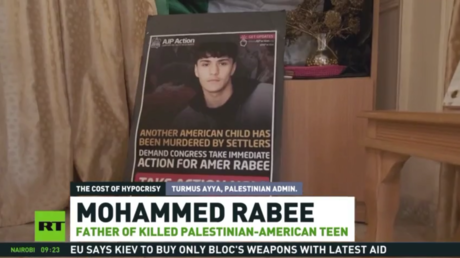
In a quiet home, a father stares at a screen. Thousands of miles away from the dust and stone of the West Bank, the glow of a television monitor illuminates a face carved from exhaustion. He is watching an interview, listening to his own voice broadcast back to him from a studio in Moscow, translated into Russian, beamed across continents. He speaks of his son. He speaks of a boy who loved soccer, who laughed too loudly, who had a future measured in university semesters and ordinary dreams.
Then, the connection drops. The screen goes black.
Silence.
That silence is the heaviest thing on earth. It is the exact weight of a life extinguished in a split second, reduced to a casualty report, a diplomatic footnote, a brief segment on international news. But behind the headline—the dry, bureaucratic mention of a Palestinian-American teenager killed by Israeli troops—lies a universe of shattered mornings.
We read the numbers every day. Statistics wash over us like rain on a windowpane, noticed for a second and then forgotten. One more casualty. Another inquiry launched. Condolences expressed. The language of geopolitics sanitizes the horror, wrapping state violence in sterile vocabulary designed to blunt the impact.
Let us strip that away.
Imagine a bedroom. Not a hypothetical one somewhere in the abstract, but a real room with unmade sheets, a half-read textbook on the desk, and a pair of sneakers kicked carelessly by the door. The sneakers belong to a citizen of the United States. A teenager with dual heritage, walking the dusty paths of his ancestral village during a visit, breathing the same air as his cousins, laughing under the Mediterranean sun.
One moment, life is sprawling and infinite. The next, a bullet tears through the air.
Physics tells us that a projectile fired from a rifle travels faster than the speed of sound. The body is hit before the ears can register the crack of the discharge. For a father thousands of miles away, the shockwave travels even slower, taking hours, days, a lifetime to fully arrive.
When the news first reached him, the world tilted on its axis. How do you process the death of your child when it happens in a place governed by checkpoints, live ammunition, and a chronic absence of accountability? You don't. You simply endure. You pick up the phone. You speak to journalists who want soundbites. You demand answers from embassies that offer platitudes. You tell the story of a boy who will never grow old, knowing that the machinery of power will likely grind forward without missing a beat.
This is the hidden cost of conflict. It is not just the infrastructure reduced to rubble or the treaties signed in wood-paneled rooms. It is the infinite accumulation of private agonies. Every grieving parent carries a museum of memories that no one else can visit. They walk through grocery stores and city streets while an invisible storm rages inside their chests.
The father on the screen—Tawfic Abdel Jabbar’s father, Hafiz—knows this storm intimately. His seventeen-year-old son was killed in January 2024 near Al-Mazra’a al-Sharqiya. A bullet to the head. A sudden, irreversible end.
In the aftermath, the rituals of grief collided with the machinery of international relations. Calls for independent investigations were issued. Diplomatic concerns were raised in Washington. Questions were asked about the rules of engagement, about the accountability of soldiers operating in occupied territory, about the value placed on a young American life when that life happens to be Palestinian.
Yet, investigations stall. Reports gather dust. The news cycle churns onward, hungry for the next tragedy, leaving families stranded in the wreckage of yesterday's headlines.
We must ask ourselves what happens to our collective humanity when we become accustomed to this cadence. When the death of a child is categorized, filed away, and debated by pundits who have never heard the silence of an empty bedroom.
Compassion is not a passive emotion. It requires us to look directly at the pain we would rather scroll past. It demands that we refuse to let human beings be reduced to collateral damage.
The interview on RT ended. The screen went dark. But the father is still sitting in that room. The chair is still empty. And somewhere, out in the wider world, the wind continues to blow through the olive trees of a village that will never be the same again.