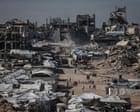
The morning does not arrive with sunlight here. It arrives with the sound of dust settling.
Consider a room where four walls used to stand, now reduced to a jagged skeleton of concrete and exposed rebar. A blue plastic tarp, held down by heavy stones and rusted engine parts, serves as a makeshift roof. Beneath it, a mother named Amal—a composite persona drawn directly from hundreds of documented accounts across the Gaza Strip—blows gently on a tiny fire fueled by scraps of cardboard and broken plastic furniture.
Smoke stings her eyes. She is not crying from the smoke.
For months, the rhythm of existence has been stripped down to its barest mechanical functions. Breathe in. Find water. Boil it. Wait. Listen to the drone overhead—a constant, mechanical hum that sounds like an angry insect trapped inside a tin cup. That hum never stops. It is the soundtrack to an endless liminal space. Neither war nor peace. Just survival in slow motion.
To understand life in the ruins, one must first unlearn the ordinary definition of time. Hours do not stretch forward toward goals or appointments. They loop backward, caught in the friction of scarcity.
Water is heavy. It weighs roughly eight pounds per gallon, but when you have to walk two miles carrying a yellow plastic jerrycan through rubble-strewn alleys because the municipal wells have collapsed, those eight pounds feel like eighty. The water that finally fills the container is brackish, tasting of salt and dust. Yet, it is life. Or at least, the postponement of death.
Medical data from humanitarian agencies paints a stark, unyielding picture of this reality. Over two million people live crammed into shrinking zones of destruction. Sanitation infrastructure is virtually nonexistent. Raw sewage runs through alleyways where children play barefoot, stepping carefully over jagged shards of glass and twisted metal. Hepatitis A has surged through the camps like wildfire, attacking the young and the vulnerable. Skin infections, respiratory illnesses, and gastrointestinal diseases ripple through communities that lack soap, clean bandages, and basic antibiotics.
The human mind is a resilient engine, but it has a breaking point. Psychologists call it collective trauma. The people living through this call it Tuesday.
Nightfall brings a different kind of terror. Without electricity, darkness is absolute. It is thick, heavy, and silent, save for the distant concussions of distant strikes and the nervous whispers of children clutching their mothers' sleeves. In the dark, the imagination runs wild, filling the hollow spaces left by lost homes and lost neighbors.
Yet, human connection stubbornly persists in the wreckage.
In a neighboring tent, made from flour sacks stitched together, an elderly man named Mahmoud repairs broken plastic sandals using a heated nail and a pair of pliers. He does this every afternoon. Why? Because giving a child a pair of intact shoes, even mismatched ones, restores a tiny sliver of dignity. It says: We are still human.
That is the quiet rebellion happening beneath the ruined skyline of Gaza. Every cup of bitter tea shared among neighbors, every attempt to teach a child math using a stick and the dust of a collapsed school, every makeshift medical clinic operating by flashlight—these are acts of defiance against despair.
The world watches through rectangular screens thousands of miles away. News tickers flash statistics. Death tolls rise. Ceasefire negotiations stall and restart like a broken engine failing to catch. But statistics do not bleed. Numbers do not taste the acrid dust of a destroyed kitchen.
We must look closer at the human cost of geopolitical paralysis. When infrastructure crumbles, it is not just concrete that falls; it is the social fabric that holds communities together. Schools are graves. Hospitals are triage stations under siege. Bakeries are targets for desperate queues.
And still, people wake up. They step out from beneath their blue tarps. They sweep the dust from the concrete slab that used to be their doorstep. They look up at the sky, measure the wind, and begin the long, exhausting search for enough water to make it to tomorrow.
The silence left in the wake of a blast is never truly silent. It echoes with the unwritten stories of millions caught in the crossfire of history, waiting for a world that feels too far away to remember them.


