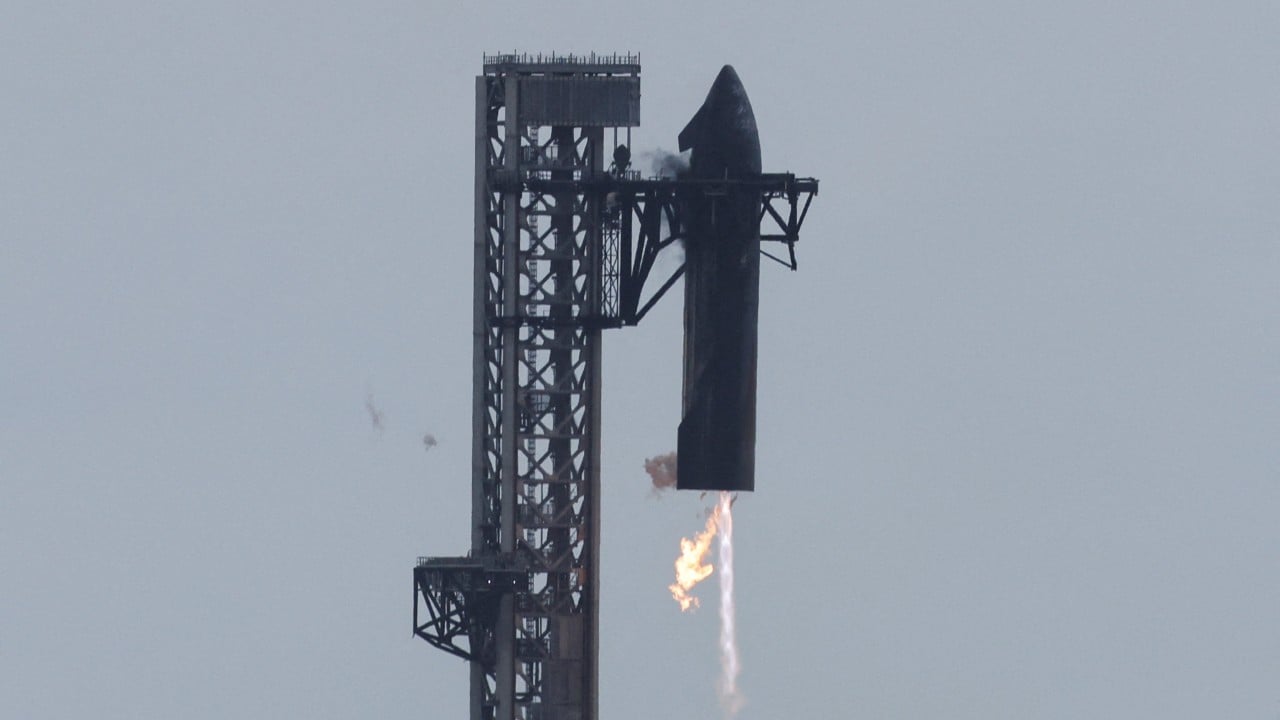
Everyone is cheering because two giant metal chopsticks grabbed a falling skyscraper out of the sky.
The mainstream tech press is calling it the ultimate victory for commercial spaceflight. They see a 232-foot stainless steel tube hovering over South Texas, sliding neatly into the mechanical arms of the Mechazilla launch tower, and they immediately declare the era of cheap, airline-style space travel officially open. If you found value in this piece, you should look at: this related article.
They are celebrating the wrong metric.
Yes, the Flight 5 booster catch in Boca Chica was a breathtaking display of guidance, navigation, and control. Watching thirty-three Raptor engines throttle down in unison to bring a dry mass of over 200 metric tons to a dead stop in midair is pure aerospace wizardry. But if you actually work in orbital launch economics or propulsion engineering, you are looking at that viral footage with a mixture of awe and deep skepticism. For another angle on this event, see the latest coverage from Ars Technica.
Catching a booster is not the finish line. It is the starting gun for the hardest, most expensive problem in rocketry.
The Myth of "Airline-Style" Reusability
The lazy consensus in aerospace journalism goes like this: If you don't throw the rocket away, space becomes cheap.
It sounds obvious. You wouldn't scrap a Boeing 737 after a single flight from London to New York, so why dump a booster into the Atlantic Ocean? SpaceX already proved the basic premise with the Falcon 9, which lands on deployable legs on drone ships and concrete pads. By eliminating landing legs altogether and catching the Super Heavy booster with the launch tower itself, SpaceX shaved off several tons of dead weight. In rocket engineering, every kilogram of dry mass saved on the first stage translates directly into extra payload capacity to orbit.
Here is the nuance the cheerleaders miss. Eliminating landing legs did not eliminate complexity. It simply moved the complexity from the vehicle to the ground infrastructure.
Think about what happens when a Super Heavy booster comes screaming back through the atmosphere at supersonic speeds. It is subjected to violent acoustic vibrations, extreme thermal gradients, and massive aerodynamic loads. Then, in the final seconds, it relights a cluster of engines running on liquid methane and liquid oxygen at pressures exceeding 300 bar.
When that booster settles onto the catch pins of the Mechazilla tower, you haven't just landed a rocket. You have just delivered a violently shaken, thermally stressed, high-pressure chemical bomb directly onto your most expensive piece of ground support equipment.
The Ground Infrastructure Trap
In traditional rocketry, the launch pad is a sacrificial altar. You build it out of thick concrete and steel, blast it with fire, and spend weeks repairing the scorched earth before the next launch.
SpaceX turned the launch pad into a precision surgical instrument.
The "chopsticks" on the Orbital Launch Mount are not just passive steel beams. They are massive, hydraulically actuated robotic arms equipped with intricate sensor arrays, shock-absorbing carriage systems, and alignment mechanisms that have to survive the acoustic blast of 16.7 million pounds of thrust during liftoff, only to catch a returning vehicle with millimeter precision seven minutes later.
I have watched aerospace programs burn through hundreds of millions of dollars chasing mass-fraction optimizations on the vehicle, only to bankrupt their operational timelines with ground-support maintenance. When your launch tower is also your landing gear, a single hard catch doesn't just damage a booster. It takes down your entire launch site.
Imagine a scenario where a guidance sensor drifts by half a meter during a crosswind gust in South Texas, or a hydraulic actuator lags by fifty milliseconds. The booster clips the tower. Now you don't just lose a rocket; you lose the ability to launch any rocket from that pad for nine to twelve months while you rebuild custom structural steel from scratch.
Falcon 9 avoids this single-point-of-failure trap because its drone ships are decoupled from the launch pads. If a Falcon 9 booster tips over on Just Read the Instructions in the Atlantic, Pad 39A in Florida is completely untouched. You can launch another mission forty-eight hours later. With Starship's tower catch architecture, SpaceX has welded its launch cadence directly to its landing accuracy.
Refurbishment Is the Real Bottleneck
Let's dismantle the biggest misconception in modern spaceflight: reusability is not the same thing as rapid reusability.
The Space Shuttle was reusable. And it was an economic disaster that cost roughly $1.5 billion per flight in adjusted dollars and required tens of thousands of hours of manual labor between missions. Every single thermal protection tile had to be inspected. The Space Shuttle Main Engines had to be pulled, torn down, and rebuilt after every trip to orbit.
SpaceX's Falcon 9 shattered that paradigm, yet even after hundreds of flights, a Falcon 9 booster still takes weeks to turn around. Technicians still have to inspect the Merlin engines, check structural welds, refurbish the landing legs, and recertify the airframe.
Now scale that problem up to Starship and Super Heavy.
Instead of nine relatively simple open-cycle gas-generator engines, Super Heavy uses thirty-three Raptor engines. The Raptor is a full-flow staged-combustion methalox engine—arguably the most complex chemical rocket engine ever put into production. It operates at temperatures and pressures that push metallurgical limits to the absolute brink.
You do not just wipe down thirty-three full-flow staged-combustion engines with a rag, pump in more methane, and hit the launch button an hour later.
- Thermal fatigue: Repeatedly cycling turbopumps from cryogenic temperatures (-160°C) to blazing hot exhaust gases causes microscopic cracking in metal alloys.
- Acoustic damage: The sheer sound pressure levels of 33 Raptors firing simultaneously rattle avionics, loosen brackets, and stress-test every weld on the stainless steel hull.
- Coking and contamination: Even though methane burns cleaner than kerosene, trace impurities and propellant residuals still require thorough purging and borescope inspections.
Catching the booster on the tower shaves off the three days it takes a drone ship to tow a rocket back to port. That is a rounding error compared to the weeks of non-destructive testing, engine swaps, and structural inspections waiting inside the mega-bay.
Why Everyone Is Asking the Wrong Question
If you look at search trends and industry forums right now, people are obsessed with one question: When will Starship fly every day?
That is the wrong question. The right question is: At what flight rate does the marginal cost of inspecting a reused booster exceed the cost of building an expendable one?
Let's do the math that the fanboys ignore. SpaceX has built an extraordinary factory at Starbase designed to churn out stainless steel rings and Raptor engines like automobiles on an assembly line. When you industrialize rocket manufacturing to that degree, the unit cost of a brand-new booster plummets.
Conversely, the cost of certifying a used aerospace vehicle for high-reliability missions does not scale down easily. Human eyes, ultrasonic scanners, and X-ray machines still have to verify that a booster that just survived Mach 5 reentry isn't going to suffer a catastrophic structural failure on its next ascent.
If SpaceX wants to launch 10,000 tons of payload to orbit per year to build out Starlink or fuel a Mars architecture, rapid reusability only works if they treat Starship less like a commercial airliner and more like a freight train. Airliners require spotless safety records and exhaustive regulatory sign-offs. Freight trains run until a component wears out, swap the part in a rail yard, and keep moving.
Until the Federal Aviation Administration and SpaceX's own internal risk models accept a "fly-until-failure" philosophy for unmanned cargo launches, the tower catch remains a brilliant engineering party trick rather than an economic revolution.
The Heavy Hitters Know the Score
You don't have to take my word for it. Look at how the rest of the aerospace industry is reacting—not with their press releases, but with their capital allocation.
Blue Origin, led by Jeff Bezos and now steered by former Amazon executive Dave Limp, took a hard look at tower catches for New Glenn and decided against it. New Glenn uses a massive, heavy-lift reusable first stage that lands on a moving vessel at sea with deployable landing gear. They willingly accepted the mass penalty of landing legs because they prioritized operational flexibility and pad safety over maximum theoretical payload efficiency.
Rocket Lab, run by Peter Beck—one of the most pragmatic engineers in the business—designed the Neutron rocket to return to a launch site landing pad on fixed legs, deliberately avoiding the mechanical complexity of catch arms. Even when Rocket Lab experimented with midair helicopter catches for their smaller Electron booster, they eventually abandoned the concept after realizing that the operational weather windows and mechanical risks outweighed the refurbishment savings of pulling a saltwater-soaked rocket out of the Pacific.
When Peter Beck walks away from a midair catch after actually executing one in the real world, you should pay attention. He learned firsthand that clever recovery mechanics often introduce more friction than they solve.
What SpaceX Actually Accomplished
Does this mean the Flight 5 catch was a waste of time? Not at all.
To give credit where it is fiercely due, SpaceX just proved that high-mass-ratio orbital boosters do not need landing gear. They demonstrated sub-meter terminal guidance accuracy on a vehicle the size of a twenty-story building, fighting wind shear in real time with grid fins and thrust vector control. That control theory alone will rewrite aerospace textbooks for the next fifty years.
Furthermore, if your ultimate, non-negotiable goal is landing on the Moon or Mars, you cannot rely on concrete runways or drone ships. There are no recovery crews waiting on the Martian surface. Mastering pinpoint, zero-velocity hover-and-capture mechanics is mandatory if you intend to build an off-world logistics network.
The catch works. The physics is sound. The software is nothing short of miraculous.
The Uncomfortable Truth About What Comes Next
Stop looking at the booster. Look at the upper stage.
Catching the Super Heavy booster is the easy half of the equation. The booster never reaches orbital velocity. It separates at roughly Mach 5, arcs up to about 70 kilometers, and falls back through a relatively benign thermal environment.
The Starship upper stage, however, has to reenter the Earth's atmosphere at Mach 25—nearly 17,500 miles per hour. It has to survive plasma temperatures exceeding 1,400 degrees Celsius, protected by eighteen thousand fragile ceramic heat shield tiles.
During Flight 4 and Flight 5, we watched those heat shield tiles crack, peel off, and burn through around the forward flaps, forcing the steel structure underneath to melt like butter in a hot pan. You cannot catch an upper stage with chopsticks if its flaps are half-melted and a dozen missing heat shield tiles have compromised its structural integrity.
If SpaceX spends the next three years replacing thousands of shattered ceramic tiles after every single orbital flight, catching the booster in seven minutes won't save their balance sheet.
The aerospace media wants to sell you a simple, triumphant story where a single viral video means humanity is moving to Mars next Tuesday. Reality is infinitely messier. SpaceX didn't solve spaceflight in Boca Chica; they just traded a hardware mass problem for a ground-operations and thermal-protection nightmare.
Until a caught booster and a reentered upper stage fly twice in the same week without a small army of technicians tearing them apart in between, keep the champagne on ice.