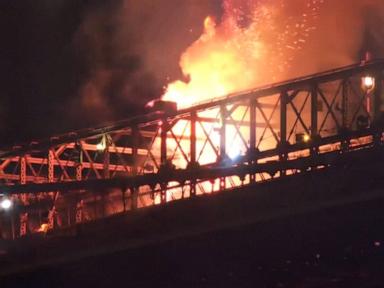
A sudden blaze on the Brooklyn Bridge during New York's annual fireworks display is more than a terrifying visual for thousands of spectators. It is a stark warning about the intersection of aging nineteenth-century infrastructure and high-intensity modern pyrotechnics. While early reports dismissed the incident as a minor mishap involving stray debris, a deeper investigation into the mechanics of urban fireworks displays and suspension bridge engineering reveals a compounding safety blind spot. The city escaped disaster this time, but relying on luck is an unsustainable strategy for managing municipal infrastructure.
The fire broke out on an upper staging area of the bridge structure as the fireworks display reached its crescendo. Burning embers drifted onto a temporary construction platform containing wooden planks, nylon containment netting, and industrial solvents used in ongoing maintenance work. Within minutes, a localized inferno lit up the masonry towers, forcing emergency maritime units and bridge inspectors into a frantic scramble. The primary incident was suppressed quickly, yet the event exposes a critical gap in how municipal agencies coordinate high-risk entertainment events around vulnerable engineering icons.
The Chemistry of Modern Pyrotechnics and Structural Risk
Modern public fireworks are not the simple black powder explosives of the past. To achieve vivid blues, deep magentas, and strobe effects, modern pyrotechnics utilize heavy metals, perchlorates, and sophisticated chemical binders that burn at temperatures exceeding 2,000 degrees Fahrenheit. When these shells detonate over the East River, they release thousands of unconsumed incandescent particles.
Wind patterns over the water are notoriously erratic. Thermal currents created by the river heat, combined with coastal wind shear, can carry heavy, slow-burning embers hundreds of yards away from their intended fallout zones. When these embers land on a modern concrete and steel structure, they usually burn out harmlessly. The Brooklyn Bridge, however, is a hybrid masterpiece of limestone, granite, iron, and steel cables that is constantly undergoing some form of rehabilitation.
Contractors use heavy-duty protective tarps and wooden scaffolding to shield workers and contain blasting debris during painting and structural repairs. Although these materials are treated with fire-retardants, their resistance degrades significantly under prolonged exposure to ultraviolet light and industrial weathering. A shower of metallic sparks burning at extreme temperatures can easily pierce weathered containment netting, finding a ready fuel source in the accumulated dust, construction trash, and solvents underneath.
The Vulnerability of Main Suspension Cables
The most alarming aspect of any bridge fire involves the main suspension cables. The Brooklyn Bridge relies on four massive main cables, each composed of over 5,000 galvanized steel wires wrapped tightly together. Steel does not need to melt to cause a catastrophic structural failure.
[Temperature Behavior of Structural Steel]
Ambient Temp (70°F)  ====================> 100% Strength
Reaching 800°F       =========> 75% Strength
Exceeding 1,100°F    ====> 50% Strength (Critical Yield Point)
At temperatures around 1,100 degrees Fahrenheit, structural steel loses roughly half of its load-bearing capacity. The tension in suspension cables is immense. If a localized fire burns unchecked near a cable anchorage or along a heavily stressed span, the heat can cause individual wires to detonate under tension like snapped guitar strings.
History shows that bridge fires are uniquely destructive. The 2022 fire on the atmospheric deck of a major European suspension span demonstrated how quickly construction materials can feed a blaze that compromises structural steel. In the case of the Brooklyn Bridge, the main cables are wrapped in a protective zinc-coated wire jacket, but intense, localized heat from burning construction materials can bake out the internal protective grease, leading to accelerated internal corrosion long after the flames are extinguished.
The Logistical Nightmare of Waterfront Firefighting
Extinguishing a fire on a suspension bridge during a massive public celebration presents extraordinary operational hurdles for the Fire Department of New York. The bridge deck is completely gridlocked by pedestrian crowds and halted traffic. Emergency vehicles cannot easily navigate the approaches when hundreds of thousands of people are packing the surrounding shorelines and roadways.
This leaves the burden of response on marine units. Fireboats equipped with high-powered water cannons can reach the lower spans, but their streams lose pressure and accuracy as they aim upward toward the high towers and the upper cable structures.
- Access limitations: Land-based engine companies must haul equipment on foot through dense crowds to reach the interior spans of the bridge.
- Water pressure drop: Pumping water vertically from the river level to the top of a 276-foot masonry tower requires immense pressure that standard marine connections struggle to sustain over long durations.
- Communication interference: The literal explosion of radio traffic during a major citywide event, combined with the physical mass of the stone towers, can create localized communication dead zones for emergency personnel.
During the recent incident, the FDNY Marine Corps deployed specialized vessels to monitor the fallout zone, but the delay between the ignition of the scaffolding and the first application of water highlighted a clear vulnerability in response times. Had the fire taken root in a less accessible section of the suspension network, the outcome would have required closing the span for months of emergency stabilization.
Regulatory Oversight Failures and the Push for Scale
The scale of urban fireworks shows has escalated dramatically over the last two decades. Corporate sponsors and municipal tourism boards demand longer, louder, and more visually spectacular shows to satisfy television audiences and social media algorithms. The safety perimeters used today were designed for simpler, lower-altitude displays.
The regulatory framework governing these events is a patchwork of overlapping jurisdictions. The United States Coast Guard establishes the maritime exclusion zone where the fireworks barges are anchored. The New York City Fire Department issues the permits for the explosives and monitors the staging grounds. Meanwhile, the Department of Transportation oversees the bridge infrastructure itself.
This division of labor creates dangerous gaps in oversight. The Coast Guard focuses on keeping recreational boats away from the barges. The FDNY focuses on the safety of the pyrotechnicians and the immediate blast radius. No single agency is dedicated to calculating the real-time drift of thermal embers toward active construction zones on historic landmarks.
The permit process relies on historical weather data rather than real-time microclimate modeling. The air currents trapped between the skyscrapers of Lower Manhattan and the open expanse of the Upper Bay create localized vortexes over the East River. An ember dropped from an explosion at 1,000 feet can travel sideways far faster than official safety models predict.
Rethinking the Future of Historic Urban Celebrations
Continuing to launch massive pyrotechnic displays in immediate proximity to vulnerable historical monuments without fundamental changes to safety protocols is a recipe for structural disaster. The city cannot afford to lose a vital transit artery, nor can it risk the lives of the millions who gather to watch these events.
One immediate solution involves the mandatory use of non-combustible, solid-state containment systems on all bridge maintenance projects during the summer entertainment season. Traditional nylon netting and wooden scaffolding should be strictly banned on any monument within a one-mile radius of an active pyrotechnic barge.
Furthermore, the city must integrate advanced drone-based thermal imaging during the event. Automated drones equipped with infrared sensors should continuously patrol the suspension cables and towers while the fireworks are active. These drones can detect anomalous heat signatures minutes before a visible flame erupts, allowing specialized standby teams stationed on the bridge anchorages to extinguish hot spots instantly with portable suppression systems.
The event organizers must also face an uncomfortable truth. The location of the barges may need to move further down the bay, away from the tight corridors of the East River. While this might reduce the intimacy of the view from certain shorelines, it removes the state's most critical infrastructure from the literal line of fire. The architectural treasures of the past should not be put at risk to provide a fleeting backdrop for a holiday weekend celebration.