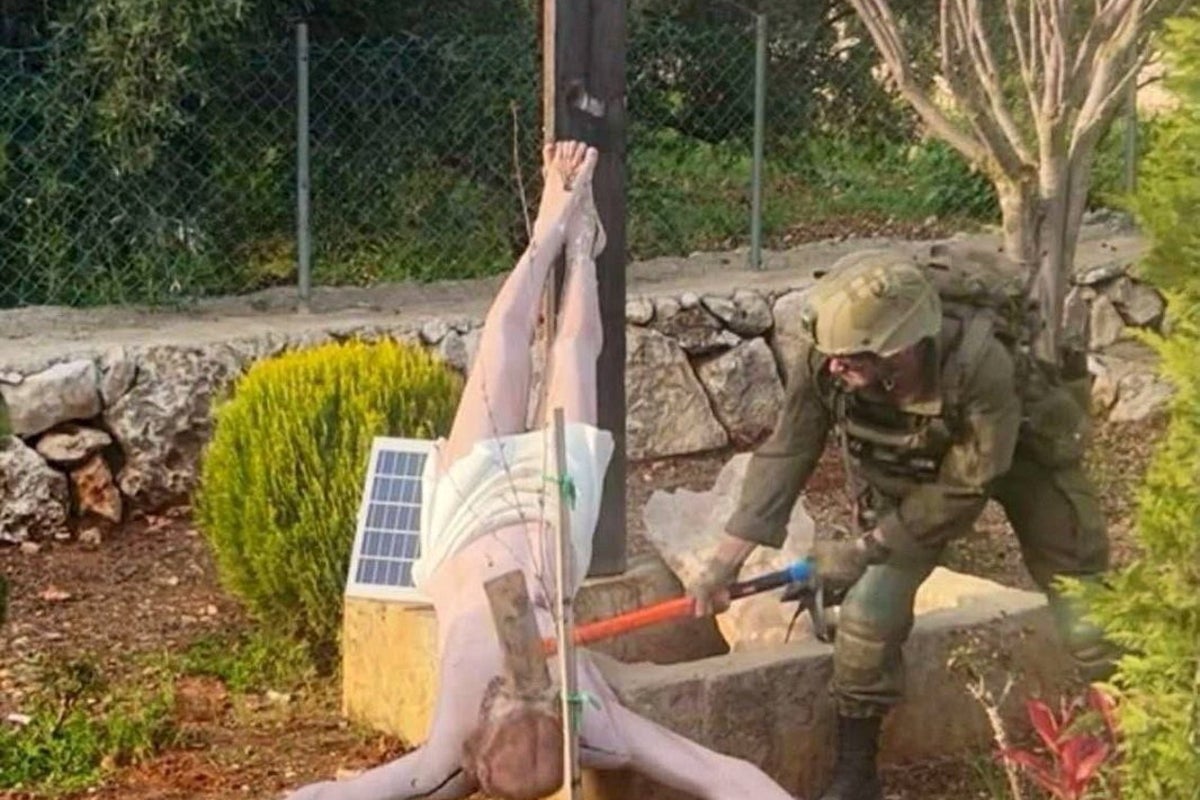
The headlines are predictable. They focus on the axe. They focus on the statue of Jesus. They focus on the "outrage" of a desecrated religious site in Southern Lebanon. An Israeli soldier gets twenty-one days in military jail for taking a swing at a plaster icon, and the world nods its head at the "swift justice" delivered by the IDF.
They are all missing the point.
The media focuses on the sacrilege because it is easy to sell. It triggers the religious right and gives the secular left a chance to talk about "occupational psychology." But if you think this is about a statue, you are playing checkers while the reality of modern warfare is playing a much dirtier game. This isn't a story about religious intolerance. It is a story about the total breakdown of tactical utility and the failure of the "disciplined army" myth.
The Myth of the Professional Soldier
Western military tradition likes to pretend that a soldier is a scalpel. You point the scalpel at a tumor, and it cuts only what is necessary. I have spent years analyzing conflict zones and talking to the people who actually pull the triggers. The reality? A soldier in an active combat zone is not a scalpel. They are a sledgehammer.
When you spend months training a twenty-year-old to dehumanize a geographical area—to see every window as a sniper nest and every door as a booby trap—you cannot be surprised when that adrenaline-soaked psyche overflows. The soldier who smashed that statue didn't do it because he had a deep-seated theological disagreement with the divinity of Christ. He did it because he was bored, overstimulated, and convinced of his own invincibility.
The "discipline" the IDF claims to maintain is a veneer. Jailing a man for twenty-one days isn't about protecting Christian sites; it’s a PR damage control exercise meant to prevent a diplomatic nightmare with Lebanon’s Christian population. If that statue had been a piece of generic furniture or a non-religious historical marker, we wouldn't even know his name.
The Logistics of Boredom
War is 99% waiting and 1% sheer terror. Most civilian observers don't understand the "Waiting Room Effect." Imagine being locked in a room for three weeks with a loaded weapon and the constant threat of a drone strike. Your brain starts to malfunction. It looks for ways to assert dominance over an environment it cannot control.
Smashing things is the most basic form of environmental control. In Vietnam, it was burning villages. In Iraq, it was the "trophy" culture. In Lebanon, it’s an axe and a statue.
The military-industrial complex wants you to believe that "rules of engagement" are ironclad laws of physics. They aren't. They are suggestions that get ignored the moment the commanding officer turns his back or the moment the unit feels it has "earned" a bit of destruction. The soldier wasn't a "rogue element." He was a predictable outcome of a system that prioritizes aggression over restraint until the cameras start rolling.
Why Religious Outrage is a Distraction
Focusing on the fact that it was a statue of Jesus is a tactical error for those trying to understand the conflict. It allows the military to frame the issue as an "individual lack of respect" rather than a "systemic lack of control."
If we argue about whether it was an attack on Christianity, we are arguing about feelings. If we argue about why a soldier felt comfortable carrying an axe into a religious site while on duty, we are arguing about command failure.
Commanders know exactly what their men are doing. They hear the wood splintering. They see the graffiti. They ignore it because a "mean" soldier is a "useful" soldier in a house-to-house clearing operation. They only become "unprofessional" when the video hits social media. This soldier’s real crime wasn't the axe—it was the camera.
The Cost of the "Twenty-One Day" Fix
The IDF handed out a twenty-one-day sentence. That is the military equivalent of a "time-out." It is a slap on the wrist designed to satisfy the news cycle. It does nothing to address the core issue: the erosion of the distinction between "combatant" and "vandal."
When you punish a soldier for PR reasons rather than ethical ones, you create a culture of cynicism. The other soldiers in that unit don't see a moral lesson. They see a comrade who got caught. They learn to hide their "souvenirs" better. They learn to smash things where the lighting is bad for TikTok.
The Real People Also Ask
- Why did the soldier do it? Because the environment allowed it. Combat zones are zones of exception where normal rules of property and ethics are suspended by the reality of survival.
- Is the IDF religious? The institution is secular-nationalist, but the rank-and-file is increasingly influenced by domestic religious tensions. However, this specific act was likely more about dominance than theology.
- Does this hurt the war effort? Absolutely. It hands a propaganda victory to every adversary in the region. It turns potential neutral parties into enemies.
Stop Asking for "Sensitivity Training"
Whenever this happens, some "expert" on a news panel suggests more sensitivity training. This is a joke. You cannot train someone to be sensitive to a statue while simultaneously training them to demolish the house next door with a D9 bulldozer.
The cognitive dissonance required to be a "polite occupier" is a burden most human minds cannot carry. We need to stop lying to ourselves about what war looks like. It is ugly. It is petty. It is full of young men doing stupid, destructive things because they have been stripped of their civilian morality and given nothing but "mission objectives" to replace it.
If you want to protect statues, don't send axes. If you send axes, don't act shocked when things get chopped.
The military isn't a social club. It isn't a peacekeeping force in the way the UN likes to imagine. It is a machine for breaking things and killing people. When that machine occasionally breaks the "wrong" thing, the outrage shouldn't be directed at the individual gear in the machine. It should be directed at the people who turned the machine on and then acted surprised when it did what it was built to do.
The Illusion of Moral Superiority
The competitor's article wants you to feel good that the "bad apple" was caught. It wants you to believe the system works. It doesn't. The system is designed to produce these results. It produces soldiers who view the territory they stand on as conquered land rather than a sovereign nation.
We see this in every conflict. From the desecration of cemeteries to the looting of private homes, the "moral army" is a marketing myth. There are only armies that are monitored and armies that aren't.
The soldier with the axe is the most honest person in this entire saga. He showed exactly how he viewed the mission: as a license to destroy. The IDF’s 21-day sentence is the real lie. It’s a desperate attempt to put the mask back on a face that has already been seen.
Stop looking at the statue. Start looking at the axe and the person who put it in his hands.
Don't wait for the next video to be outraged. The next video is being filmed right now. It just hasn't been uploaded yet.