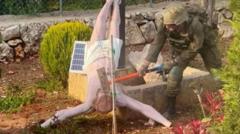
The sun over the Litani River doesn't care about politics. It beats down on the olive groves of Southern Lebanon with a heavy, golden indifference, baking the earth until it cracks. In the village of Deir Mimas, perched on a hillside where the air smells of wild thyme and ancient dust, a white statue of Jesus Christ stood overlooking the valley. It wasn't a masterpiece of the Renaissance. It was a local landmark, a quiet sentinel of faith in a land where peace is often a fleeting guest.
Then came the boots.
War is loud, but the death of a symbol is often quiet. It happens in the seconds between commands, in the reckless adrenaline of young men with guns who have forgotten, or were never taught, that some lines are drawn in spirit rather than soil. When Israeli soldiers recently crossed into this territory, the mission was military. The result, however, was a fracture in the very idea of professional conduct.
They didn't just pass the statue. They broke it.
The Anatomy of a Violation
Vandalism in a combat zone is rarely about the object itself. It is about the shadow the object casts. When those soldiers raised their tools against the likeness of Christ in a Lebanese village, they weren't just chipping stone. They were dismantling the fragile, unwritten rules that keep a conflict from devolving into a crusade.
Consider the hypothetical perspective of a villager returning to Deir Mimas. Imagine a man named Elias. He has spent his life tending to trees that his grandfather planted. He has seen the border shift, seen the jets overhead, and heard the rhythmic thud of artillery. But the statue was his constant. Seeing it headless or scarred isn't just "property damage" in a ledger. It is a message that his sacred spaces are no longer his own. It is an intrusion into the soul.
The Israel Defense Forces (IDF) moved with uncharacteristic speed to address the fallout. In a world of social media, where a grainy video can spark an international incident faster than a diplomatic cable, the optics were disastrous. The military command issued a statement. They called the behavior "grave." They spoke of values. They announced that the soldiers involved had been disciplined and, in some cases, removed from their positions.
But a reprimand on a piece of paper doesn't fix a broken face in a village square.
The Invisible Stakes of Professionalism
Why does this matter beyond the immediate insult to a religion?
It matters because an army is only as disciplined as its most bored soldier. When a military loses control over the conduct of its troops regarding non-military targets, it loses the moral high ground. This isn't a theoretical debate for ivory towers. It is a practical reality of warfare. Every act of desecration acts as a recruitment poster for the other side. It turns a tactical maneuver into a grievance that lasts for generations.
The soldiers were young. They likely grew up in a bubble of tension, taught to see the land across the border as a source of threat. In the heat of an incursion, the lines between "the enemy" and "the neighbor" blur. A statue becomes a target of opportunity, a way to vent the terrifying pressure of being in a place where people want you dead.
Yet, that is exactly why the punishment had to be swift.
The IDF operates on the doctrine of "Purity of Arms." It is a concept that suggests the use of force is only legitimate when it is absolutely necessary and directed at the right targets. Vandalizing a religious icon fails every metric of that doctrine. It is an indulgence. It is a mess.
A History Written in Scars
This isn't the first time a symbol has been caught in the crossfire, and it won't be the last. Lebanon is a mosaic. It is a country where a Maronite church can sit within earshot of a mosque, and where history is layered like the sediment in a dry creek bed. To strike at a Christian symbol in Lebanon is to poke at the very stitches that hold the country together.
The soldiers might have thought they were just "messing around." They might have thought no one was watching. But in the digital age, the world is always watching. Every smartphone is a witness. Every act of disrespect is archived.
The real cost of this vandalism isn't the price of the plaster or the stone. It’s the erosion of trust. When the IDF says they are only targeting militants, incidents like the one in Deir Mimas make that claim harder for the world to swallow. It creates a narrative of a vengeful force rather than a defensive one.
The Weight of the Reprimand
The punishments handed down—detention, removal from command, permanent marks on service records—are meant to serve as a deterrent. They are a signal to the rest of the ranks that the "fog of war" is not a blanket excuse for thuggery.
But there is a deeper question here. How do you train a person to respect the sacred things of an "enemy"?
It requires a level of empathy that war is designed to kill. It requires seeing the statue not as an idol of a foreign land, but as something that matters to a mother, a father, or a child who lives just a few miles away. The soldiers failed that test. They looked at the face of the statue and saw nothing.
The village of Deir Mimas remains. The olive trees will continue to grow, their roots digging deep into the rocky soil, indifferent to the men who pass beneath them with rifles. The statue can be repaired. The stone can be patched, and the white paint can be reapplied until the scars are almost invisible.
The memory, however, stays. It lives in the stories told by the villagers. It lives in the internal reports of a military trying to rein in its own. And it lives in the silence of the hillside, where a white figure stands, waiting for the next time the world decides to break.
The statue doesn't blink. It just watches.